Ghana’s central bank unexpectedly cut its key interest rate to 11% from 14% on Wednesday, explaining that this was necessary to align monetary policy with market borrowing costs.
Ghana’s Finance Minister Cassiel Ato Forson outlined plans to spend $10 billion over the next four years to lift economic growth to 8%, and repay some debt due next year ahead of schedule.
Ghana plans to ban exports of unprocessed minerals by 2030 as Africa’s biggest gold producer seeks to capture more value from its natural resources and spur domestic industrialization, President John Mahama said.
Ghanaian inflation accelerated slightly as service price-growth picked up pace, hardening expectations the central bank will keep interest rates on hold.
Ghana’s central bank maintained its key interest rate for a third straight meeting as the wars in Ukraine and Iran keep grain and energy prices elevated, threatening to push inflation higher.
Ghana’s annual inflation rate resumed its upswing in August as the rise in oil prices caused by the war in Iran seeped into transport and utility costs.
Ghanaian annual inflation unexpectedly slowed in July as food-price growth eased and a more stable exchange rate helped contain the cost of imported goods.
Ghana’s central bank joined a growing number of peers keeping interest rates higher for longer as renewed hostilities between the US and Iran bring fresh inflation risks.
Ghana’s economy grew at a faster pace in the first quarter, buoyed by its strongest industrial-sector performance in nearly two years as higher mining output helped cushion the impact of rising energy and food costs stemming from the war in Iran.
Ghana’s annual inflation rate edged higher a second straight month as the war in Iran fanned price pressures, increasing the likelihood that the central bank will keep interest rates on hold when it next meets.
Ghana wants large-scale gold mines to sell at least 30% of their annual output to the central bank to increase local refining and boost the country’s foreign-exchange reserves.
The legal Gold Fields Ltd., front, and AngloGold Ashanti Plc, background, mines in Tarkwa, Ghana, on Thursday, Oct. 17, 2024. The indebted West African state is potentially losing billions from illegal gold mining, known as galamsey, that is causing environmental carnage.
Ghana has asked the International Monetary Fund for a policy support program to sustain economic reforms and build on recent gains as its $3 billion bailout nears an end.
Commercial buildings on the skyline beyond Oxford Street in Accra, Ghana.
Ghana’s inflation rate increased for the first time in 16 months as the surge in global energy prices caused by the conflict in the Middle East drove up domestic fuel costs.
A vendor hands a Ghana cedi banknote to a customer at a market in Accra. Photographer: Ernest Ankomah/Bloomberg
Ghana’s annual inflation rate cooled, extending an easing streak to a 15th month despite pressure for higher fuel prices because of fallout from the Iran war.
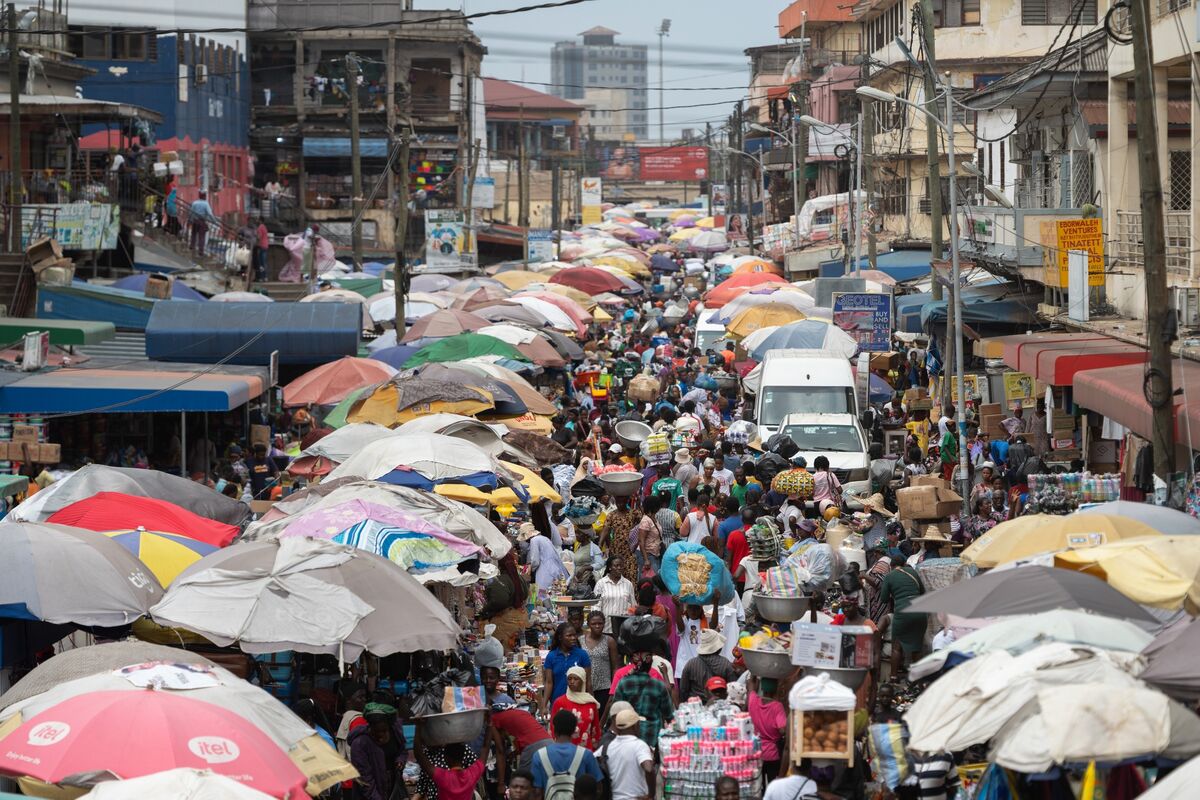
Shoppers at the Okaishie outdoor market in Accra, Ghana.
Ghana’s interest-rate easing cycle is expected to continue on Wednesday despite inflation risks stemming from conflict in the Middle East.
Residential and commercial buildings on the skyline at night in Accra, Ghana, on Sunday, Dec. 4, 2022. With debt interest payments eating up more than half of government revenues Ghana has asked the IMF for a $3 billion bailout, proposed a debt restructuring that could involve losses of up to 30% for foreign investors and is planning to barter some of the gold it produces for oil. Photographer: Nipah Dennis/Bloomberg
Ghana’s inflation rate fell to a near three-decade low in February, bolstering expectations for a fifth straight rate cut even as conflict in the Middle East threatens to rekindle global price pressures and cloud the outlook.
Ghana’s annual inflation rate fell to an almost three-decade low, giving the central bank another reason to consider a fifth consecutive cut in borrowing costs.
Africa’s top bullion producer has benefited from an improved fiscal outlook and record-high gold prices. Photographer: Ernest Ankomah/Bloomberg
 Anmelden