The yen slid to the verge of 160 to the dollar, a key threshold that’s raising the specter that policymakers in Tokyo will swoop in again to defend the currency.
The yen broadly held its gains after the Bank of Japan left its benchmark rate unchanged in an 8-1 vote, while signaling underlying inflation had reached its 2% target and opening the door to a December hike. The BOJ also accelerated the pace of ETF sales to about ¥860 billion ($5.5 billion) a year.
Global fund managers are warming to Japan’s bond market again as signs of recovering domestic demand and a more supportive policy backdrop add to the appeal of elevated yields.
The yen’s sharp drop after the Federal Reserve’s hawkish hike is raising the stakes for the Bank of Japan’s policy meeting Friday, with strategists warning the currency could weaken further unless officials convince markets that more tightening is coming.
Japan’s transformation from sleeping economic giant to magnet for growth and investment is set to face its fastest sequence of interest rate hikes since the bursting of Tokyo’s asset bubble more than a generation ago.
The Bank of Japan could raise interest rates at three consecutive meetings through December in an extreme scenario where yen weakness persists, according to Nomura Securities Co.
Strategists view Bank of Japan Governor Kazuo Ueda’s comments at press conference following the central bank’s decision to hold rates as moderately hawkish with some expecting an earlier rate hike.
A looming announcement from Prime Minister Sanae Takaichi to go ahead with a plan to cut Japan’s sales tax on food risks pressuring the yen and government bonds by stoking investor concerns over the country’s deteriorating fiscal outlook.
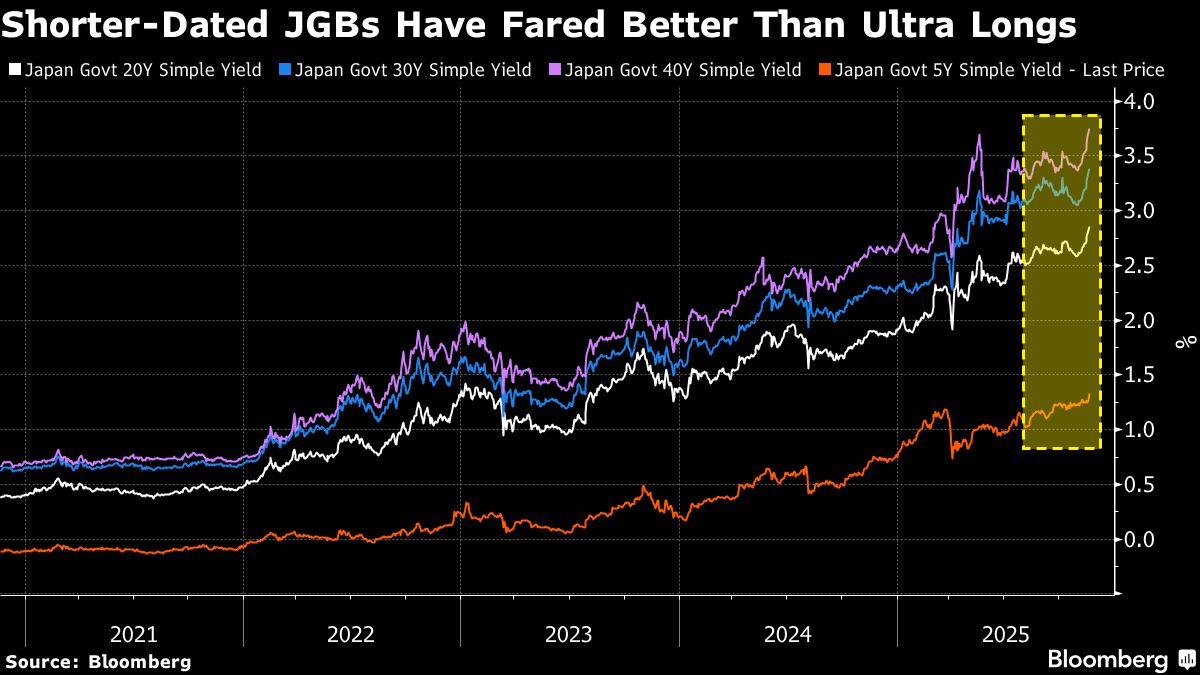
Japanese government bonds sold off on Monday sending yields to record highs as rising oil prices fueled inflation fears. Here’s what strategists are saying:
Billboard advertisements at a pedestrian crossing in Shibuya district in Tokyo, Japan, on Wednesday, Sept. 17, 2025. Japan is scheduled to release consumer price index (CPI) data on Sept. 19. Photographer: Noriko Hayashi/Bloomberg
Japan’s two-year bond auction on Thursday will test investor demand after recent policy signals from the Bank of Japan and the Federal Reserve added upward pressure to short-term rates.
A Japanese flag flies outside the Bank of Japan (BOJ) headquarters in Tokyo, Japan, on Tuesday, April 28, 2026. The Bank of Japan left its benchmark interest rate unchanged in a split vote that increased the likelihood of a hike in June and pushed the yen higher.
Japan’s two-year government bond auction drew solid demand, as elevated yields supported investor appetite despite rising expectations that the Bank of Japan will tighten policy.
A woman wearing a kimono walks through the Torii gate tunnel to the Otome Inari Shrine at the temple grounds of the Nezu Shrine in the Yanesen district of Tokyo, Japan.
The yen dropped to its weakest level in 18 months despite Japan’s finance minister and her US counterpart uniting in their concern over the currency’s slide.
Japanese government bonds slumped, with the two-year yield rising to its highest level since 2008, after comments from the Bank of Japan chief brought a December rate hike into focus.
Japan issued its strongest warning yet over recent movements in the yen, with the nation’s finance minister specifically mentioning intervention as an option as she tried with only limited impact to stem falls in the currency.
 Anmelden