Japan’s response to China’s latest export controls is likely to be cautious, reflecting both limited options for retaliation and a lack of appetite to escalate an already fraught relationship with its largest trading partner.
China started an anti-dumping probe into a key chipmaking material from Japan, escalating the dispute between Asia’s largest economies shortly after Tokyo officials rebuked Beijing over potentially wide-ranging export controls.
Hours after President Xi Jinping posed for selfies with South Korea’s Lee Jae Myung in Beijing, China sent a very different message to Japan, escalating their dispute by imposing export controls.
Lee Jae Myung, left, with Xi Jinping in Beijing on, Jan. 5.
America’s allies offered a measured response after US troops captured Venezuelan leader Nicolas Maduro in a raid, a move that sent shockwaves around the world and highlighted divisions among governments.
TOPSHOT - Venezuela's President Nicolas Maduro gestures during a rally to mark the anniversary of the Battle of Santa Ines, in Caracas on December 10, 2025. (Photo by Federico PARRA / AFP via Getty Images)
Japan’s industry ministry is set to nearly quadruple its budgeted support for cutting-edge semiconductors and artificial intelligence development to about ¥1.23 trillion ($7.9 billion) for the fiscal year starting in April.
A prototype of a Rapidus 300mm wafer displayed at the Semicon Japan exhibition. Photographer: Kiyoshi Ota/Bloomberg
A US-Japan consultation panel held its first meeting to consider initial projects for a $550 billion investment pledge that is a pillar of the two countries’ trade deal.
US President Donald Trump, left, and Sanae Takaichi, Japan's prime minister, during a trade signing ceremony at the Akasaka Palace state guest house in Tokyo, Japan, on Oct. 28.
Japan’s exports to the US rose for the first time since Donald Trump announced baseline tariffs in early April, the latest indication that economies are faring better than expected in a more protectionist global trade environment.
A container ship at the Oi Container Terminal in Tokyo. Photographer: Akio Kon/Bloomberg
Comments made a month ago by Japanese Prime Minister Sanae Takaichi that triggered a diplomatic spat with China over Taiwan appear to have been unscripted, based on documents obtained by a lawmaker, in what could point to a misstep by the premier.
The Bank of Japan can only estimate within a wide range where the so-called neutral interest rate might reside, Governor Kazuo Ueda said, as expectations mount over the likelihood authorities will get closer to that point with another hike this month.
China continued to voice its frustration with Japan after new comments from Prime Minister Sanae Takaichi reaffirming Tokyo’s long-held position that it understands and respects Beijing’s view on Taiwan.
A senior Japanese national security official confirmed with a French foreign policy adviser that both nations would cooperate toward realizing a free and open Indo-Pacific, ahead of Emmanuel Macron’s visit to China, according to Japanese media reports.
A coalition of Japanese lawmakers promoting friendship with China met with Chinese Ambassador to Japan Wu Jianghao in Tokyo, according to local media, signaling efforts to ease tensions while the two nations also sparred over disputed islands.
Japan is set to spend roughly ¥252.5 billion ($1.6 billion) in an extra budget to further support developments of artificial intelligence and semiconductors.
Tokyo’s inflation held steady and industrial output unexpectedly rose, keeping the Bank of Japan on track to consider an interest rate hike in December or January.
Food items for sale at a store in Tokyo. Photographer: Kiyoshi Ota/Bloomberg
The Japanese government denied a report that US President Donald Trump advised Prime Minister Sanae Takaichi to avoid provoking China over Taiwan.
TOPSHOT - US President Donald Trump (L) and Japan's Prime Minister Sanae Takaichi arrive on board the US Navy's USS George Washington aircraft carrier at the US naval base in Yokosuka on October 28, 2025. (Photo by ANDREW CABALLERO-REYNOLDS / AFP) (Photo by ANDREW CABALLERO-REYNOLDS/AFP via Getty Images)
Japan will likely lean more heavily on the US and its allies if China escalates economic pressure, as Tokyo seeks to navigate the fallout from Prime Minister Sanae Takaichi’s remarks linking Taiwan’s security to its own.
US President Donald Trump and Sanae Takaichi in Tokyo, on Oct. 28.
Japan should leverage its alliance with the US to counter China’s threats rather than seeking quick compromises alone that will lead to long-term losses, according to an outspoken Japanese lawmaker whose entry into China has been banned.
Japan’s inflation ticked higher and exports rose, keeping the Bank of Japan on track for an interest rate hike in coming months as Prime Minister Sanae Takaichi prepares an economic package aiming to soothe public discontent over rising living costs.
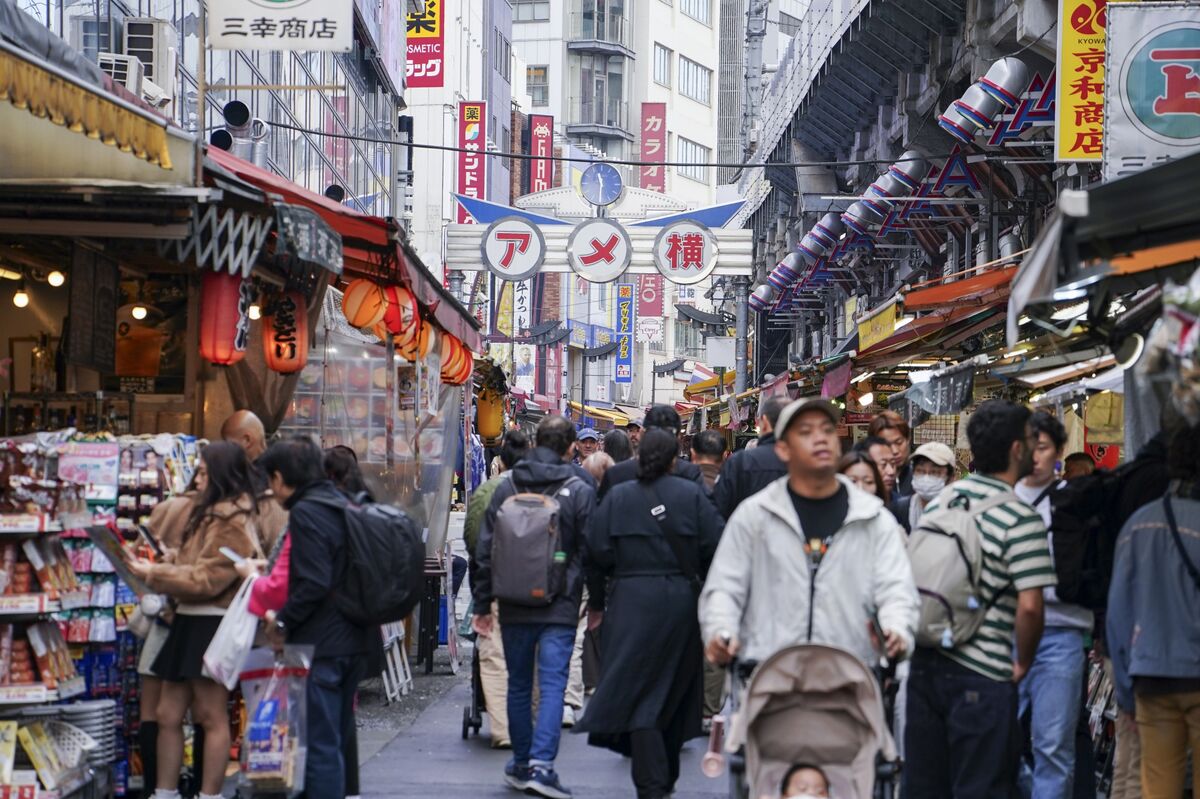
The Ameya-yokocho market in the Ueno area in Tokyo, Japan.

 Anmelden