China’s economy lost more momentum last quarter even as it met the government’s target in 2025, in another year of lopsided growth that will be hard to sustain in an era of protectionism around the world.
As Xi Jinping battles unprecedented deflation and shrinking investment, he’s betting that China can sell more and more goods to the world to drive growth. To that end, Donald Trump’s threats against key US allies are coming at a good time.
Container ships at the Yangshan Deepwater Port in Shanghai, China, on Wednesday, May 14, 2025. China and the US agreed to temporarily lower tariffs levied against each other's products — the first major de-escalation in the trade row that was touted by US President Donald Trump as a "total reset" of bilateral ties.
China’s economy likely capped 2025 with its weakest quarterly growth in three years, exposing a lopsided reliance on exports over consumption that’s set to extend into coming months.
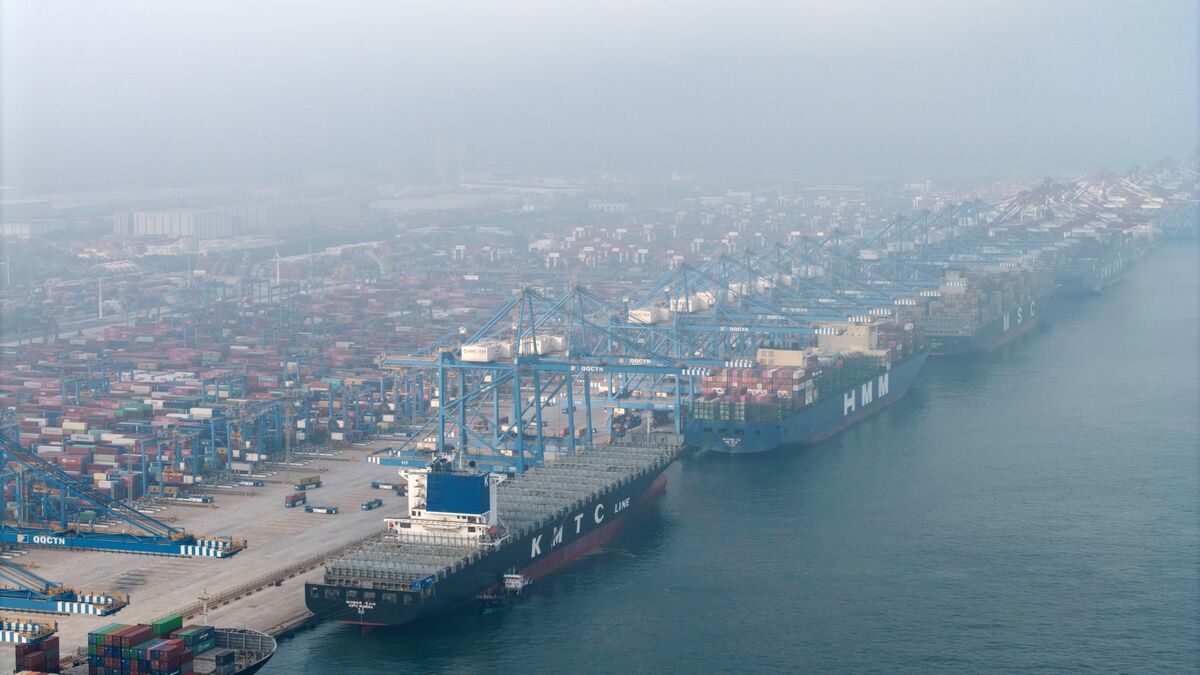
Container ships moored at the Qingdao Port in Qingdao, China.
China’s exports ended last year with a growth spurt and sent its trade surplus to a record $1.2 trillion in 2025, extending a boom that’s seen factories escape Donald Trump’s tariffs by making deeper inroads into markets beyond the US.
China’s commerce ministry said its key priorities this year include strengthening legal frameworks, improving export controls and enhancing risk prevention to safeguard supply chain resilience and national security.
China has completed the maiden flight of the Tianma-1000, an unmanned cargo aircraft capable of logistics and emergency responses, China Central Television reported Sunday.
China announced initial public spending plans worth a total of $51 billion to boost consumption and investment next year, moving early to shore up demand and cushion the economy against rising external headwinds.
China has kept its central bank on the sidelines of managing an economy hampered by weak demand and deep-seated imbalances, defying Wall Street forecasts for the biggest interest-rate cuts in a decade.
China said it will expand government spending and improve how it deploys capital in 2026, aiming to balance supporting growth and containing debt risks.
China is about to start paying interest on its official digital currency in a fresh push to get more people to use it after about a decade of development and testing.
China’s central bank reaffirmed its supportive monetary policy stance while signaling continued caution toward aggressive stimulus, reinforcing a shift toward securing long-term stability over immediate fixes.
The People's Bank of China (PBOC) headquarters in Beijing. Bloomberg
Chinese President Xi Jinping lashed out at inflated growth numbers and vowed to crack down on the pursuit of “reckless” projects that have no purpose except showing superficial results.
China’s finance ministry plans to issue ultra-long-term special government bonds next year, with proceeds used to support major national strategies and security initiatives.
Pedestrians pass Christmas trees in Shenzhen, China, on Thursday, Nov. 27, 2025. China's Finance Minister Lan Fo'an pledged to implement a stronger and proactive fiscal policy over the next five years in an effort to support the country's economic growth, state media Xinhua News Agency reported this month. Photographer: Qilai Shen/Bloomberg
Key economic data for November are set to show China’s domestic demand remained subdued — or even weakened further — offsetting the country’s solid performance in exports.
Workers on the assembly line at the BYD Co. factory in Zhengzhou, Henan province, China.
China signaled it will maintain economic support but refrain from ramping up stimulus next year, underscoring a shift from defending against US tariffs to securing growth in the longer term.
Shoppers in the Nanjing Road West shopping area in Shanghai, China, on Sunday, March 2, 2025. President Xi Jinping heads into China's biggest political huddle of the year with his economy finally getting back some swagger.
The International Monetary Fund linked China’s booming exports and growing trade imbalances in part to a real depreciation of the yuan, a subtle shift in its stance that adds to rising global concerns over the currency’s weak exchange rate.
China’s top leaders are signaling they are on alert for a potential flareup of tensions in global commerce as they draw up economic plans for next year, after amassing a record trade surplus despite the tariff war with the US.
China’s leaders are widely expected to stick with its manufacturing-led growth strategy in key policy meetings this month, even as calls grow at home and abroad for a more urgent shift toward consumption.
A worker on the production line for kitchen utensils at a factory near Zhuhai, China.

 Anmelden