Imports through California’s Port of Long Beach dropped 13% in January from last year, when shippers were rushing to move freight in anticipation of President Donald Trump’s tariffs.
Cranes at the Port of Long Beach in Long Beach, California, US, on Friday, Feb. 20, 2026. President Donald Trump imposed a 10% global tariff on foreign goods, moving quickly to preserve his trade agenda after the US Supreme Court struck down many of the levies he imposed last year. Photographer: Kyle Grillot/Bloomberg
Phantom importers, sky high tariffs and suspiciously cheap shipping offers are fueling a surge in trade fraud, leaving law-abiding American businesses to foot the bill.
The Spliethoff Singelgracht container ship departs the Port of Baltimore in Baltimore, Maryland, US, on Thursday, March 6, 2025. US President Donald Trump exempted Canadian goods covered by the North American trade agreement known as USMCA from his 25% tariffs, offering major reprieves to the US's two largest trading partners.
Dealt a blow by the Court, the US president finds himself with less leverage as he tries to rebuild his protectionist trade wall.
US President Donald Trump during a news conference in the James S. Brady Press Briefing Room of the White House in Washington, DC, US, on Friday, Feb. 20, 2026. Trump delivered a broadside against Supreme Court justices after they struck down the bulk of his sweeping global tariffs, delivering a major blow against his signature economic policy.
In invoking what he claimed were virtually unlimited powers to impose tariffs under a 1977 emergency law, US President Donald Trump took unprecedented action. Now, the Supreme Court has determined that it was illegal, too.
The US Supreme Court in Washington, DC, US, on Tuesday, Jan. 13, 2026. At issue in the cases being argued Tuesday is whether states may categorically bar transgender girls from competing on girls’ sports teams based on biological sex - and whether such policies should be reviewed deferentially, as the court held in Skrmetti, or subjected to heightened judicial review. Photographer: Kent Nishimura/Bloomberg
Thousands of companies and importers are set to launch what could be a prolonged battle to try to recoup as much as $170 billion in tariffs they’ve already paid to the US government after the Supreme Court struck down a key tool in President Donald Trump trade policy.
A container ship leaves the Port of Newark in Elizabeth, New Jersey.
US trade representative lauds Bangladesh wheat shipment while American exports to China flounder
Bloomberg Best of the Year 2025: Workers load soybeans into a truck to be dispatched during a harvest at a farm in Orizona, Goias state, Brazil, on Friday, Feb. 21, 2025. Photographer: Dado Galdieri/Bloomberg
For customs brokers who handle US tariff payments and paperwork, the job just got a lot more complicated
US President Donald Trump during an Economic Club of Detroit event at Sound Board Theater at MotorCity Casino Hotel in Detroit, Michigan, US, on Tuesday, Jan. 13, 2026. Trump said he would cut off federal funding to so-called sanctuary cities at the end of the month as part of his administration’s efforts to address fraud, in the latest escalation over immigration policy with Democratic jurisdictions. Photographer: Emily Elconin/Bloomberg
The fate of the majority of President Donald Trump’s tariffs is in the hands of the US Supreme Court, which is expected to rule sometime in the next few months on the legality of the sweeping levies. Lower courts ruled in 2025 that the tariffs were issued illegally, but the import taxes remained in place to allow the Trump administration to make its case before the Supreme Court.
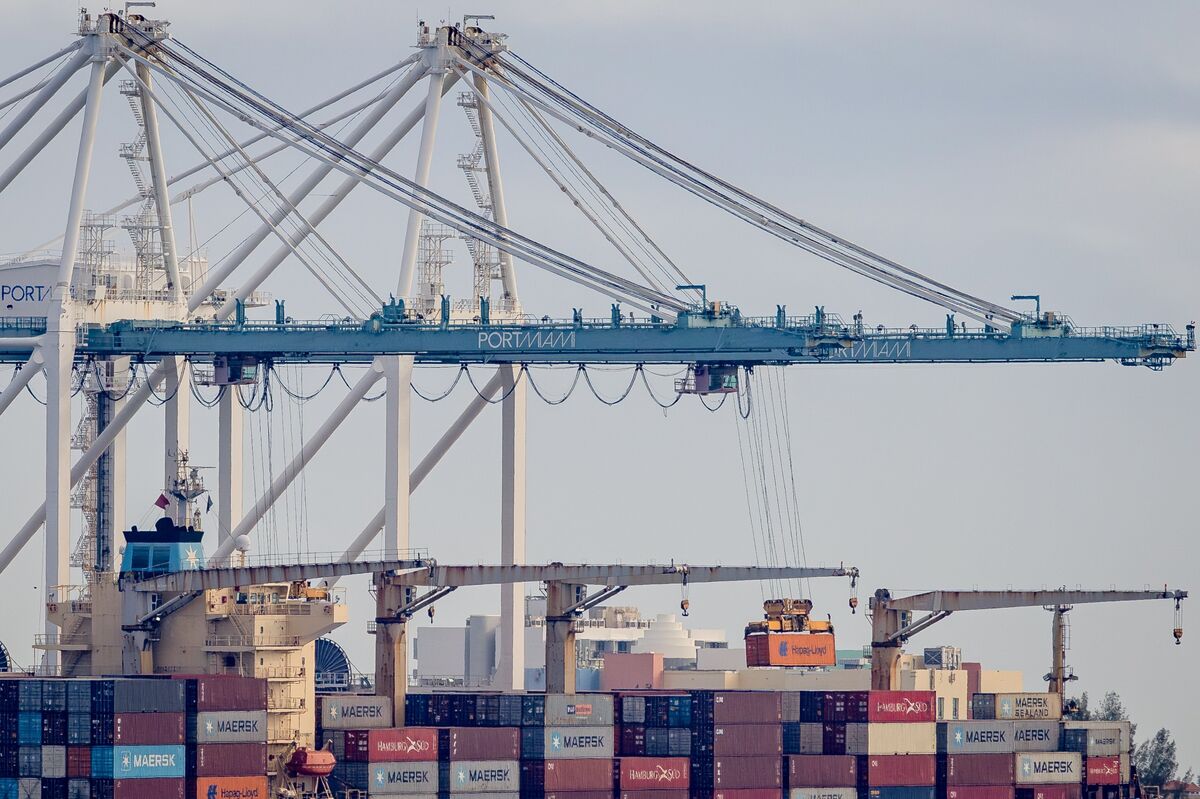
A crane lifts a shipping container at PortMiami in Miami, Florida. Photographer: Eva Marie Uzcategui/Bloomberg
The US high court has recessed for the holidays, signaling a ruling on tariffs no sooner than early January
A demonstrator outside the US Supreme Court in Washington, DC, US, on Wednesday, Nov. 5, 2025. In a high-stakes legal showdown, the Supreme Court will consider arguments that Trump exceeded his constitutional authority with many of the sweeping tariffs he has imposed on goods from around the world. Photographer: Eric Lee/Bloomberg
After a rollercoaster year for maritime shipping in 2025, next year looks to bring more stability
Container ships at the APM Maersk Terminal at the Port of Los Angeles in Los Angeles, California, US, on Tuesday, July 8, 2025. President Donald Trump vowed to push forward with his aggressive tariff regime in the coming days, stressing he would not offer additional extensions on country-specific levies set to now hit in early August while indicating he could announce substantial new rates on imports of copper and pharmaceuticals. Photographer: Eric Thayer/Bloomberg

 Anmelden