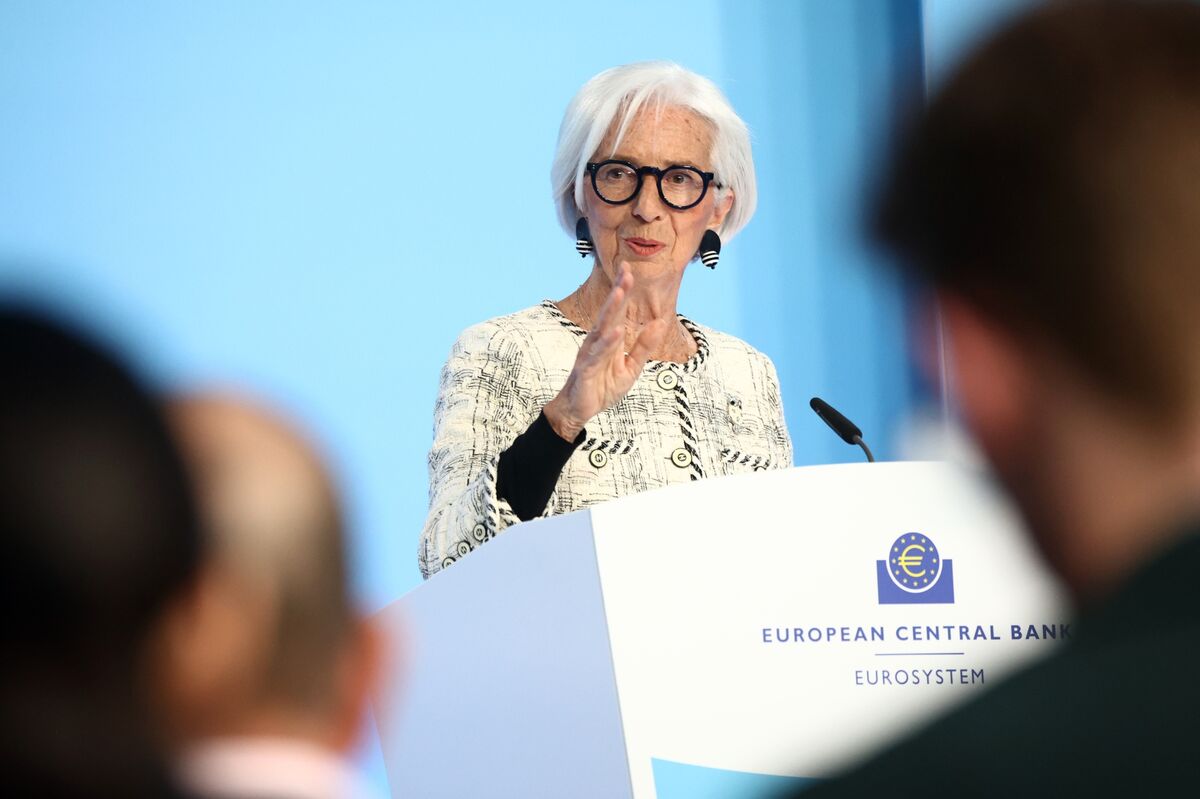
There’s a high probability that the European Central Bank will raise borrowing costs next month if the Iran war doesn’t end in the meantime, according to Governing Council member Pierre Wunsch.
European Union officials are exploring whether the bloc needs new measures to protect its economy against an influx of Chinese goods, according to people familiar with the matter.
European Central Bank policymakers are likely to raise interest rates at their next meeting in June unless there are positive developments on energy prices and ending the Iran war, according to people familiar with the situation.
ECB President Christine Lagarde and ECB Vice President Luis de Guindos during a rates decision news conference in Frankfurt on April 30.
President Christine Lagarde signaled the European Central Bank will consider a possible interest-rate hike in June after policymakers debated and rejected the idea on Thursday.
Christine Lagarde on April 30. Photographer: Liesa Johannssen/Bloomberg
The euro-area economy unexpectedly slowed at the start of 2026, with soaring energy costs triggered by the Iran war threatening stagflation in the months ahead.
Chancellor Friedrich Merz’s bid for a meaningful rebound in 2026 is getting harder to deliver by the week, despite the huge stimulus flowing into Europe’s biggest economy.
Hungary’s new leader has made adopting the euro one of his top priorities, a step that would mark the largest expansion of the single-currency bloc since Greece joined in 2001.
Peter Magyar on election night in Budapest, on April 12. Photographer: Akos Stiller/Bloomberg
European Central Bank President Christine Lagarde welcomed signals from Hungary’s incoming leadership that they would take steps to join the euro zone, which she called the natural path for the European Union’s members.
Christine Lagarde during an interview in Washington, DC, on April 14. Photographer: Al Drago/Bloomberg
The economic toll of the Iran war is hitting home in Europe, where more muted growth and faster inflation risk deepening industrial, fiscal and political pressures across the region.
Private-sector activity in the euro area rose at the slowest pace since last May as the Iran war stokes inflation while endangering a nascent economic recovery.
Euro-zone inflation would peak at 6.3% in the first quarter of 2027 under a severe version of how events in Iran may play out, according to the European Central Bank.
The European Central Bank is well placed to deal with growing dangers from the war in Iran after holding interest rates unchanged for a sixth meeting, President Christine Lagarde said.
Christine Lagarde. Photographer: Alex Kraus/Bloomberg
Europe must do more to foster innovation and stop leaning on other parts of the world for technological advancement, according to Philippe Aghion, who jointly won the 2025 Nobel Prize for economics.
Philippe Aghion Photographer: Stephane de Sakutin/AFP/Getty Images

 Anmelden