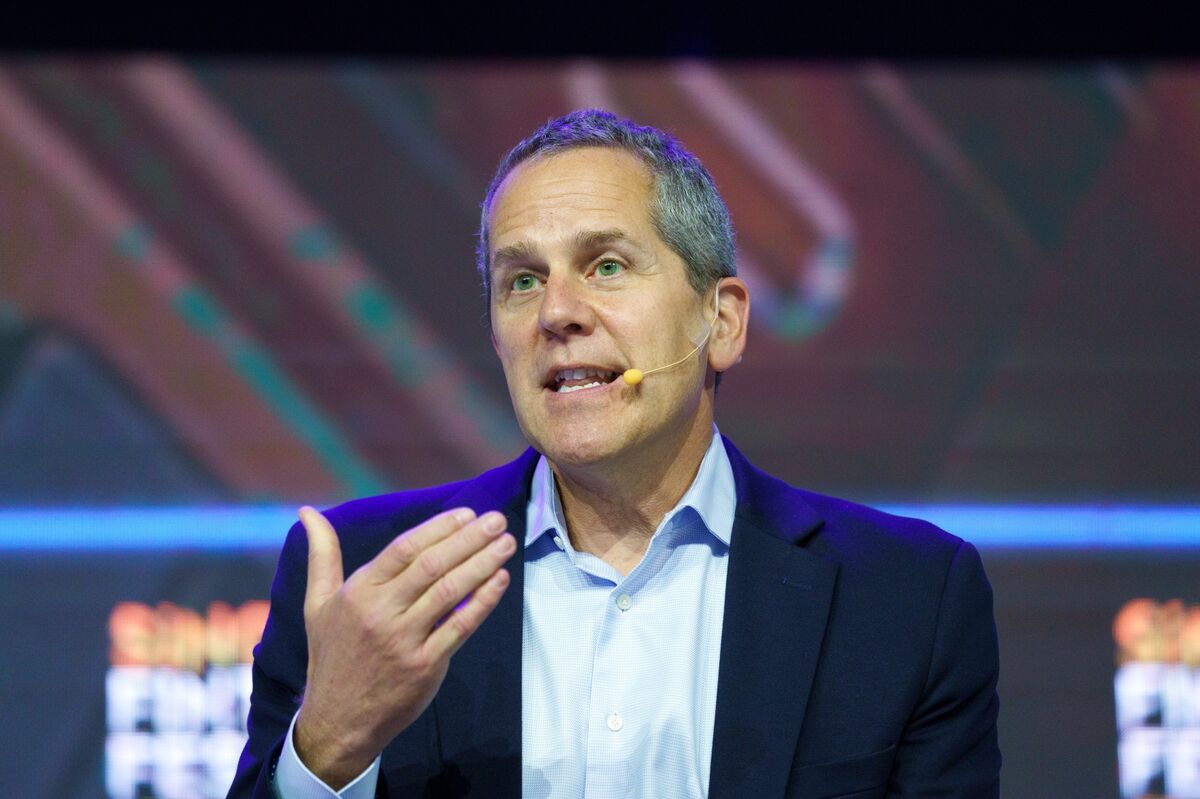
Kevin Warsh won the race for Federal Reserve chairman partly by mapping out a route to lower interest rates. Now, the new Fed chief faces a starkly different dynamic: How to restrain a sudden shift in expectations for higher rates as fellow policymakers warn that inflation is back.
Fed Chairman Kevin Warsh and US President Donald Trump during a swearing-in ceremony in the East Room of the White House in Washington on Friday, May 22, 2026.
Federal Reserve Vice Chair Philip Jefferson said he expects inflation to cool later this year as the effects of tariffs and higher energy costs wear off, though he warned inflationary risks remain tilted to the upside.
Federal Reserve Governor Christopher Waller said he supports making clear the central bank’s next interest-rate move is just as likely to be an increase as a cut, as the energy shock from the Iran war pushes up prices.
President Donald Trump stressed that he wants Kevin Warsh to independently lead the Federal Reserve, as he looked to downplay investor concern that he would pressure the new central bank chief on policy decisions.
Kevin Warsh takes the oath of office from Supreme Court Associate Justice Clarence Thomas during his swearing-in ceremony in the East Room of the White House in Washington on May 22. Photographer: Al Drago/Bloomberg
Investors in the safe haven of G7 debt want protection as the conflict in the Middle East threatens another bout of inflation.
Andrew Bailey, governor of the Bank of England, left, speaks with Scott Bessent, US treasury secretary, during the G-7 finance ministers and central bank governors meeting in Paris, France, on Monday.
Federal Reserve Governor Michael Barr on Thursday pushed back against proposals to shrink the central bank’s balance sheet, describing them as wrong and a threat to financial stability.
Federal Reserve Governor Stephen Miran said he will resign from the central bank effective once incoming Chair Kevin Warsh is sworn into office, or shortly before.
Stephen Miran, governor of the US Federal Reserve, speaks during the Federal Reserve Board open meeting in Washington, DC, US, on Thursday, March 19, 2026. In fresh projections released Wednesday, officials maintained their call for one rate cut this year, according to the median estimate.
Federal Reserve Governor Christopher Waller said the 12 regional Fed banks had agreed to a framework on how to standardize and centralize some functions, such as back-office operations.
Christopher Waller Photographer: Graeme Sloan/Bloomberg
The Federal Reserve needs to improve its execution of monetary policy and how it communicates with investors and the public if it is to protect its independence against ongoing political attacks, according to a think tank of former and current policymakers.
The Marriner S. Eccles Federal Reserve building in Washington.
When President Donald Trump disclosed in April that the US was considering offering the United Arab Emirates financial support through a currency swap line, observers in financial and policy circles were puzzled. Why would the UAE, one of the world’s wealthiest countries, suddenly need economic assistance? Were the discussions connected to the Iran war? Would a deal also benefit the US? And, for those unfamiliar with the esoteric financial tool, what in the world is a swap line?
A tourist group passes skyscrapers in central Dubai. Photographer: Walaa Alshaer/Bloomberg
When Kevin Warsh hosts his first meeting as the new chair of the Federal Reserve, he’ll face an immediate dilemma: Stare down White House demands for immediate interest-rate cuts, or stare down fellow policymakers who remain skeptical of the need to ease.
Kevin Warsh during his Senate Banking confirmation hearing in Washington on April 21. Photographer: Graeme Sloan/Bloomberg
Jerome Powell said he’ll remain at the Federal Reserve as a governor after his term as chair of the central bank ends, putting an end to months of speculation as to whether he planned to stay or go.
Federal Reserve Chair Jerome Powell during a news conference following a Federal Open Market Committee (FOMC) meeting in Washington on April 29. Photographer: Daniel Heuer/Bloomberg
Kevin Warsh, President Donald Trump’s nominee to be the next chair of the Federal Reserve, won the backing of the Senate Banking Committee Wednesday on a 13-11 party-line vote, putting him on track to be confirmed by the full Senate before Jerome Powell’s term ends May 15.
Kevin Warsh, President Donald Trump’s nominee for chair of the Federal Reserve.
Federal Reserve officials are expected to leave interest rates unchanged this week at a gathering that’s being overshadowed by the latest twists in a political drama surrounding the leadership handover at the US central bank.
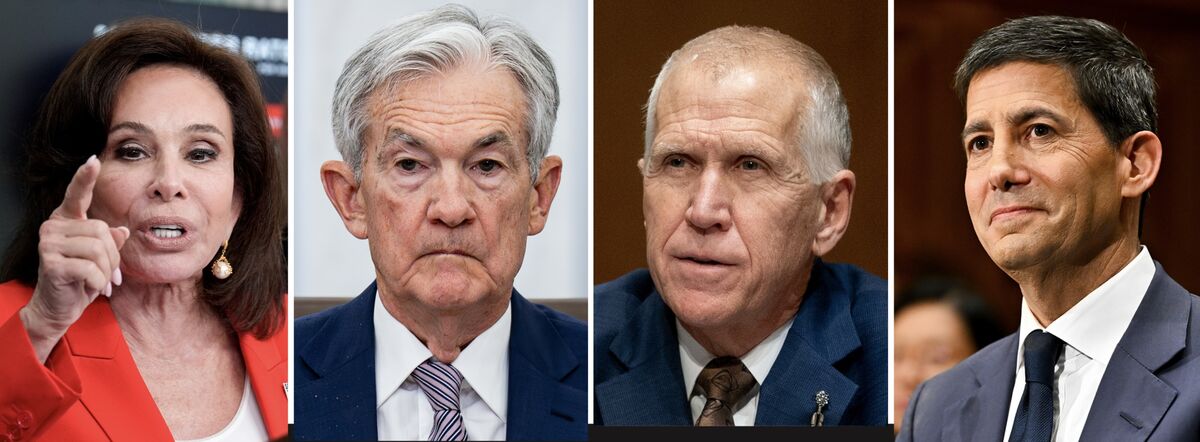
Jeanine Pirro, Jerome Powell, Thom Tillis and Kevin Warsh
The Justice Department is ending a controversial investigation into building-renovation cost overruns at the Federal Reserve, potentially clearing a path to confirmation for Kevin Warsh, President Donald Trump’s pick to be the next chair of the central bank.
Chairman of the US Federal Reserve Jerome Powell Photographer: Al Drago/Bloomberg
The biggest question facing Kevin Warsh was answered before he even reached the committee room Tuesday when President Donald Trump doubled down on a criminal probe that is effectively blocking his own nominee from taking over at the Federal Reserve.
Kevin Warsh, chairman of the US Federal Reserve nominee for US President Donald Trump, during a Senate Banking, Housing, and Urban Affairs Committee confirmation hearing in Washington, DC, US, on Tuesday, April 21, 2026. Warsh’s testimony highlights the fine line he must walk during the hearing between President Donald Trump’s demands for lower rates and reassuring investors that he will defend the Fed’s autonomy in rate-setting.
Here are the key takeaways from Kevin Warsh’s remarks at his confirmation hearing to be the next chairman of the Federal Reserve. He testified before the US Senate Banking Committee on Tuesday.
Kevin Warsh during a Senate confirmation hearing in Washington on April 21. Photographer: Samuel Corum/Bloomberg
Kevin Warsh, Donald Trump’s nominee to be the next chair of the Federal Reserve, vowed to protect the US central bank’s independence if he is confirmed to the role.
The seal of the US Federal Reserve Board of Governors on a podium ahead of a news conference in Washington. Photographer: Al Drago/Bloomberg
Kevin Warsh, President Donald Trump’s nominee to chair the Federal Reserve, will appear before the Senate Banking Committee for a confirmation hearing at 10 a.m. Tuesday. It could be the most contentious such hearing in many decades.

 Anmelden