Hungary’s new finance minister pledged to tap frozen European Union funding within months and to meet all criteria for euro adoption within four years as part of a “radical” economic policy shift after Viktor Orban’s rule.
Hungary’s incoming government said it plans to take emergency steps to help farmers as a dry spell during much of April is leading to a severe drought in the grain-producing country.
Combine harvesters unload harvested corn into trailers on a farm, operated by Lajoskomarom Gyozelem Kft., in Lajoskomarom, Hungary, on Monday, Aug. 29, 2022. Europe is in the throes of a drought that appears to be the worst in at least 500 years, according to a preliminary analysis by experts from the European Union’s Joint Research Center. Photographer: Akos Stiller/Bloomberg
An asset-management fund in the Equilor group of companies part-owned by Hungarian Prime Minister Viktor Orban’s son-in-law profited from financial-market bets on the strongman losing power.
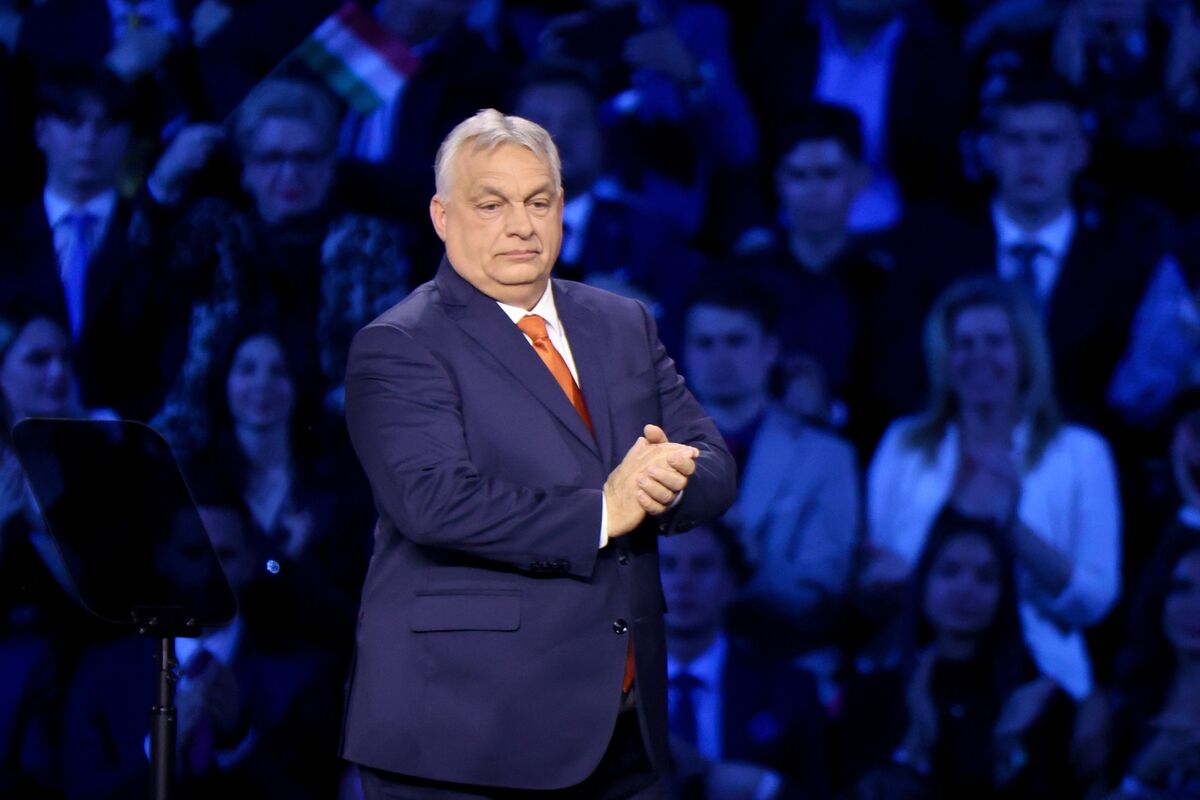
Viktor Orban, Hungary's prime minister, speaks during a closing campaign rally in Budapest, Hungary, on Saturday, April 11, 2026. Orban won repeated endorsements from the administration of US President Donald Trump and emerged as the closest ally of Vladimir Putin in Europe as he sought to stymie sanctions against Russia.
Hungary’s new leader has made adopting the euro one of his top priorities, a step that would mark the largest expansion of the single-currency bloc since Greece joined in 2001.
Peter Magyar on election night in Budapest, on April 12. Photographer: Akos Stiller/Bloomberg
Hungary’s incoming Prime Minister Peter Magyar named the key ministers for his new government who will help shoulder the task of repairing frayed European ties and relaunching a stagnant economy.
Peter Magyar, Hungary's incoming prime minister, second left, with Agnes Forsthoffer, incoming parliament speaker, left, Andrea Bujdoso, head of Tisza party’s caucus, second right, and Peter Toth, lawmaker, in Budapest, on April 20.
Hungary’s forint surged to a four-year high and local stocks jumped to a record after Prime Minister Viktor Orban’s election defeat. The opposition’s landslide victory is buoying markets on the expectation that the result will help unlock European Union aid and revive the economy.
Viktor Orban waves to supporters at the Balna centre in Budapest during a general election in Hungary, on April 12, 2026. Photographer: Attila Kisbenedek/AFP/Getty Images
Hungary’s election rally has pushed the country’s bonds, stocks and its currency to the brink of multi-year highs ahead of Sunday’s ballot, which investors anticipate will end Prime Minister Viktor Orban’s 16-year rule.
With just days to go before Hungarians head to the polls, investors and strategists say there’s more room for markets to rally if polls are correct in showing that Prime Minister Viktor Orban’s 16-year-old experiment in “illiberal democracy” is coming to an end.
Hungarian Prime Minister Viktor Orban arrives to address a "Day of Friendship" event at MTK Sportpark in Budapest, Hungary on April 7, 2026. US Vice President JD Vance is in Hungary to deliver the US President's support to his ally, nationalist Prime Minister Viktor Orban, ahead of tightly contested parliamentary elections scheduled for April 12, 2026. (Photo by Attila KISBENEDEK / AFP via Getty Images)
The rally that’s taken the Hungarian forint to two-year highs is unlikely to be derailed by a potential interest rate cut on Tuesday, the country’s first in over a year.
Hungary’s bonds extended gains after the latest US pledge of financial support for Prime Minister Viktor Orban, raising new questions about the sustainability of the rally, according to asset manager Aviva Investors.
Viktor Orban, right, and Marco Rubio at a news conference in Budapest. Photographer: Akos Stiller/Bloomberg
Hungary’s economic performance underwhelmed late last year as a slump in industrial production persisted, shrinking Prime Minister Viktor Orban’s room to reverse an opposition lead less than three months from key elections.
Vehicle manufacturing in Hungary. Photographer: Akos Stiller/Bloomberg
The forint dropped after Hungarian Economy Minister Marton Nagy renewed his calls for lower interest rates and questioned central bank policies which have caused the currency to strengthen.
The standout developing-nation currency in the year of emerging markets — Hungary’s forint — is looking increasingly vulnerable, according to a growing number of Wall Street analysts.
Hungarian Prime Minister Viktor Orban’s preparations for a financial-market meltdown are baffling investors who see little sign of a looming collapse in one of the world’s best-performing emerging markets.
Viktor Orban in Washington, DC, on Nov. 7. Photographer: Aaron Schwartz/CNP

 Anmelden