Colombia restarted interest rate rises after a court stripped the government of its power to block monetary tightening and the presidential election eased fears over central bank independence.
The city skyline of Bogota, Colombia, on Sunday, July 3, 2022. Dozens of Venezuelan opposition figures, who turned Colombia into their unofficial headquarters in recent years, say the election of Gustavo Petro as Colombia's first leftist president puts them at risk, and they plan to leave. Photographer: Nathalia Angarita/Bloomberg
Colombia is expected to resume raising interest rates after a presidential election helped ease months of political tensions that triggered an institutional crisis at the central bank.
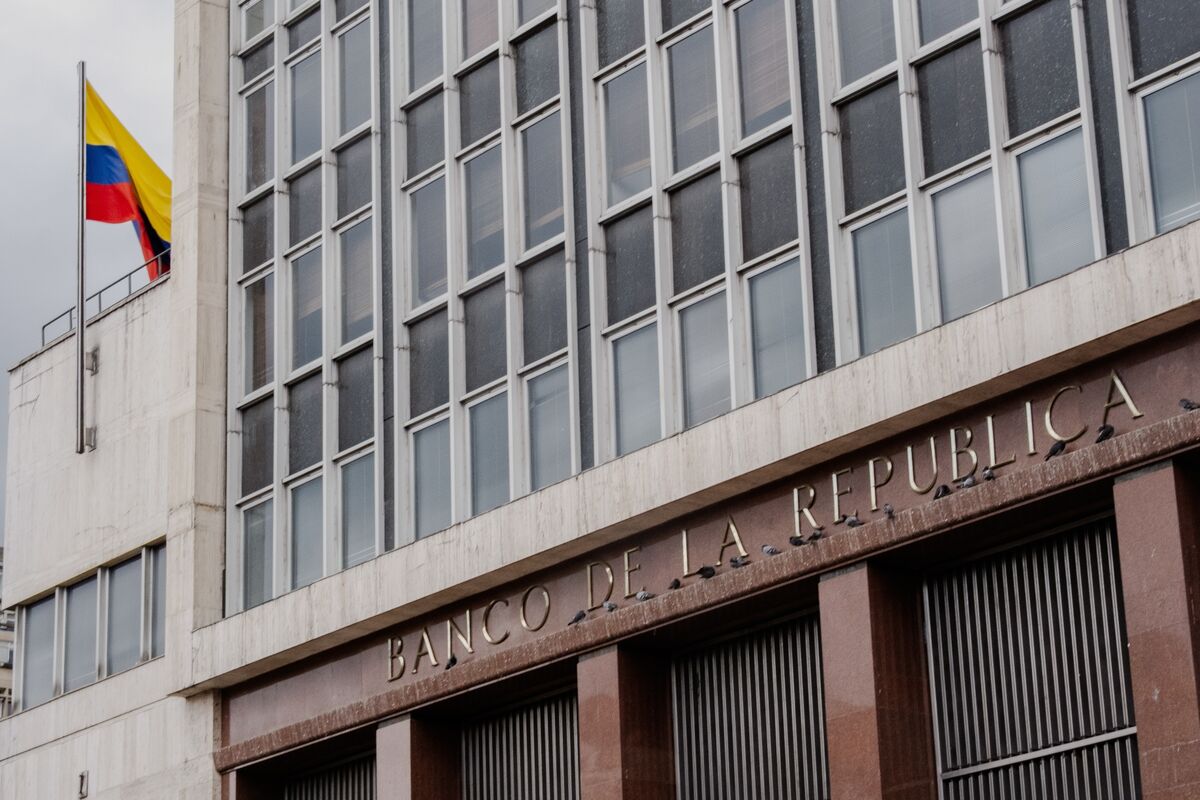
The Colombian central bank in Bogota on March 30, 2026.
Colombian inflation accelerated to its fastest pace since 2024, putting pressure on policymakers to resume interest rate hikes this month.
A shopper counts money at the Alameda food market in Cali, Valle del Cauca department, Colombia, on Thursday, May 14, 2026. Colombia's economy grew faster than expected in the first quarter, potentially boosting President Petro's leftist ally in this month's presidential vote. Photographer: Jair F. Coll/Bloomberg
A Colombian court suspended a rule that required the finance minister to be present at central bank meetings, ending an institutional crisis that gave the government an effective veto over interest rate decisions.
The Colombian Central Bank in Bogota, Colombia, on Wednesday, Dec. 17, 2025. Colombia fiscal deficit may widen to 7.5% of GDP next year without a tax reform that increases revenue, President Gustavo Petro said in a post on X. Photographer: Nathalia Angarita/Bloomberg
Colombia’s central bank still has work to do to tame inflation, though may now be able to slow the pace of interest rate increases, according to co-director Bibiana Taboada.
Bibiana Taboada, co-director of the Central Bank of Colombia
Colombia’s central bank should avoid additional interest rate hikes because tight monetary policy is no longer the correct tool to fight inflation, according to board member Cesar Giraldo.
The Colombian Central Bank in Bogota. Photographer: Nathalia Angarita/Bloomberg
Colombia’s central bank faces one of its most consequential — and potentially disastrous — meetings on Thursday, risking a clash that could paralyze monetary policy.
A Colombian court agreed to study a three-decade-old decree that threatens the central bank’s ability to raise interest rates.
The Colombian Central Bank in Bogota, Colombia, on Monday, Aug. 4, 2025. Colombia's central bank is likely to maintain its forecast for 2.7% growth this year and 3% in 2026.
Colombian Finance Minister Germán Ávila called for nation to raise its 3% inflation target.
The Colombian Central Bank in Bogota, Colombia, on Monday, March 30, 2026. Colombia's central bank will likely deliver a second straight 100bps rate hike to push the benchmark up to 11.25%.
Colombia is planning to repurchase some $4 billion of its bonds, according to public credit director Javier Cuellar, its third buyback of hard-currency notes in the past year. The bonds are outperforming all their emerging-market peers on Tuesday.
Buildings in Medellin, Colombia, on Wednesday, July 16, 2025. Colombian economic activity likely fell 2.2% year on year in May, though manufacturing and construction rose 1.4% in April from the prior month after falling in March and February. Photographer: Esteban Vanegas/Bloomberg
Colombian inflation accelerated more than expected to its fastest pace since 2024, boosting the likelihood that the central bank will continue raising interest rates this month.
Colombia’s leftist government is rolling out a series of subsidies and cheap loans to limit the economic damage it says will result from the central bank’s “outrageous” interest rate policy.
The Colombian Central Bank in Bogota, Colombia, on Monday, March 30, 2026. Colombia's central bank will likely deliver a second straight 100bps rate hike to push the benchmark up to 11.25%. Photographer: Santiago Mesa/Bloomberg
Colombia’s central bank delivered a full percentage-point increase to its key interest rate after Finance Minister German Avila walked out of the policy meeting, underscoring a deepening rift between President Gustavo Petro’s government and the monetary authority.
Colombia Finance Minister German Avila abruptly left Tuesday’s central bank meeting where officials were widely expected to increase interest rates, saying the government would abandon the board unless “certain conditions” were met.
Bogotá junio 13 de 2025. En el Ministerio de Hacienda se realizó una rueda de prensa sobre el Marco Fiscal de Mediano Plazo. En la mesa principal Martha Hernández Arango, Ministro de Hacienda Germán Ávila, Carlos Emilio Betancourt y Javier Andrés Cuéllar. Intervención del ministro de Hacienda Germán Ávila. Foto Néstor Gómez - El Tiempo Crédito: CEET Fotógrafo: NESTOR GÓMEZ (GDA via AP Images)
Colombian President Gustavo Petro says that naming Olga Lucía Acosta to the central bank was his biggest blunder, after she resisted his calls to slash interest rates. For the same reason, others credit her with saving the bank’s independence and the nation’s inflation-targeting model.
Colombia’s government is planning reciprocal tariffs of 50% on imports from Ecuador, intensifying an economically-damaging spat between the ideological foes.
Trucks queue at the border between Colombia and Ecuador in Ipiales, Colombia.

 Anmelden