US consumer spending merely edged up in April as war-driven inflation pressures sapped incomes and pushed the saving rate to an almost four-year low.
Shoppers at the checkout counter at Abracadabra NYC in New York, US, on Friday, Sept. 26, 2025. Halloween spending in the US is expected to climb to a record $13.1 billion this year despite consumer wariness about tariffs and higher costs of living, according to a survey by the National Retail Federation.
The Federal Reserve’s favored top-line inflation gauge is rapidly approaching 4% as a war-driven spike in energy costs generates unease that price pressures will broaden.
A sign displays the price of unleaded gasoline at an Exxon gas station in Washington, DC, US, on Thursday, May 21, 2026. AAA projects that 45 million people will travel at least 50 miles from home over the Memorial Day weekend, which would set a Memorial Day record.
The fallout from the war in Iran continued to ripple across the global economy, complicating the outlook and fueling inflation angst.
Shoppers in Union Square in San Francisco, California, US, on Thursday, Dec. 11, 2025. Holiday spending will surpass $1 trillion this year and set a record despite consumer caution, according to a forecast by the National Retail Federation.
A fresh batch of consumer price data in the coming week is likely to affirm Americans’ growing frustration with inflation.
A driver refuels a vehicle with regular gasoline at a Chevron gas station in Seattle, Washington, US, on Thursday, April 30, 2026. After weeks of fuel inflation across Asia and Europe, higher pump prices are now starting to intensify in the US as war-driven energy shocks show little sign of abating.
Employers in the US boosted payrolls in April by more than projected after an even bigger increase a month earlier, suggesting the labor market may be gaining momentum after near-zero job growth last year.
Workers at a cafe in Washington, DC, US, on Wednesday, March 11, 2026. The Bureau of Economic Analysis is scheduled to release gross domestic product (GDP) figures on March 13.
The European Central Bank is leaning toward lifting interest rates as soon as next month unless there are positive developments on energy prices and ending the Iran war.
Gantry cranes and shipping containers at the PSA International Pte Ltd. Pasir Panjang Terminal at dusk in Singapore, on Sunday, Feb. 1, 2026. Singapore left its monetary policy settings unchanged for a third straight review while raising its forecast for inflation, with the trade-dependent economy set to continue benefiting from artificial intelligence-related demand for chips and other technology.
Business activity in the euro area contracted for the first time since 2024 on a pronounced weakening in the services sector as war in the Middle East suppressed demand.
The La Defence financial district in Paris, France, on Wednesday, June 25, 2025. Worldline shares cratered on Wednesday, wiping out around €500 million ($580 million) of market value on reports that the company allegedly covered up fraud by some of its customers.
The International Monetary Fund trimmed its global growth forecast for 2026 as the oil-price shock from war in the Middle East rippled across economies worldwide.
An attendee wears socks with US dollar signs on them at the Semafor World Economy Summit during the International Monetary Fund (IMF) and World Bank Spring meetings in Washington, DC, US, on Tuesday, April 14, 2026. The International Monetary Fund downgraded its growth projection for the year after the war in the Middle East triggered a major oil shock and included the possibility of a downturn if the conflict drags on and energy infrastructure is severally damaged.
Surging fuel costs stemming from the Iran war are sparking a rapid run-up in inflation and sinking consumer confidence.
Workers refuel a Citilink aircraft, operated by PT Garuda Indonesia, at Soekarno-Hatta International Airport in the Cengkareng district in Jakarta, Indonesia, on Monday, April 6, 2026. Indonesia will slash the value-added tax on economy class tickets for two months to ease the burden of rising fuel surcharges on airfare to mitigate higher energy costs triggered by the Iran war.
Skyrocketing fuel prices due to the Iran war are fanning the embers of transportation costs, which were already rising due to a shrinking pool of drivers in the US.
Drivers refuel tractor trailers with diesel fuel at a truck stop in Tracy, California. Photographer: David Paul Morris/Bloomberg
The sudden increase in US gasoline prices felt by American consumers is set to be on full display in key inflation data due out this coming week.
A driver refuels a vehicle with unleaded gasoline at a Mobil gas station in New York, US, on Tuesday, March 31, 2026. US gasoline topped $4 a gallon for the first time since August 2022, one of the most high-profile reminders to date that even the world's largest economy is feeling the impact of a deepening conflict in the Middle East.
Iran targeted more sites in Arab Gulf states overnight and into Friday, hours after US President Donald Trump issued fresh threats against Iranian infrastructure to pressure Tehran to start peace negotiations.
Traffic move along the highway at dusk in Seoul, South Korea, on Wednesday, April 1, 2026. South Korea may widen restrictions on driving to include the general public if oil prices breach $120 a barrel as it seeks to cushion the impact of the Iran war on its energy supplies.
US employment probably rebounded in March after one of the biggest pullbacks in payrolls since the pandemic, extending a string of volatile readings.
Commuters wait for a SEPTA bus near City Hall in Philadelphia, Pennsylvania, US, on Monday, Aug. 11, 2025. Officials at Southeastern Pennsylvania Transportation Authority, known as SEPTA, warned in a meeting last week that without an infusion of cash by Aug. 14, the system will cut 20% of its service.
Sentiment among the world’s service providers and manufacturers took a synchronized step down during the first month of the Iran war, with business surveys growing pessimistic about economic growth as oil prices surge.
Iranian men gather in front of a small apartment damaged in a military operation on a residential building during the United States-Israeli military campaign, in Tehran, Iran, on March 27, 2026. (Photo by Morteza Nikoubazl/NurPhoto via Getty Images)
The cost of imports into the US jumped in February by the most in nearly four years, reflecting a broad pickup in prices even before war in the Middle East.
Cranes are used to offload containers from a ship at the Port of Savannah in Savannah in March. Photographer: Megan Varner/Bloomberg
The global economy’s first collective health check since war broke out in the Middle East will arrive in the form of business surveys from the US to the euro zone.
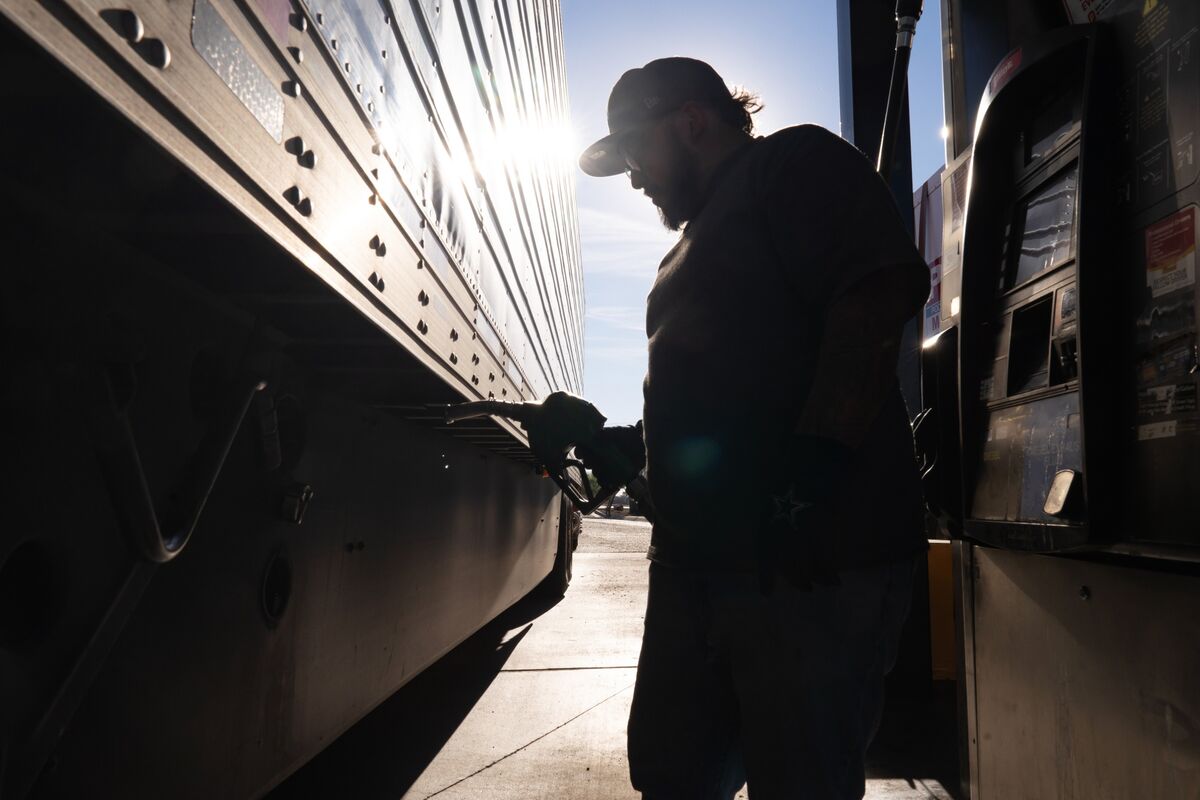
A semi truck driver refuels a truck with diesel fuel at a Pilot gas station in Eloy, Arizona, US, on Wednesday, March 18, 2026. US diesel rose above $5 a gallon for the first time since December 2022, the latest sign of surging fuel price pressures menacing the global economy as the war in Iran continues to disrupt energy supplies.
Monetary policymakers from the US to Europe to Japan all held the line on interest rates this week as they assess the economic fallout from a war-driven spike in energy costs.
The Iran war has reverberated through energy and financial markets, rekindling inflation concerns and risks to economic growth. Unlike last year, when the source of these worries was President Donald Trump’s tariffs, the concerns now are based on fears that sharply higher oil prices could become entrenched.
Prices for unleaded gasoline and diesel fuel at a gas station in Seattle on March 9.
The US said it had stepped up strikes on Iran to unprecedented levels as the war that’s engulfed the Middle East hit the two-week mark and continued to upend energy flows and global markets.
The Phillips 66 Bayway Refinery in Linden, New Jersey, US, on Monday, March 9, 2026. Gasoline, diesel and jet fuel prices have jumped, as the conflict between the US, Israel and Iran chokes off oil shipments through the Strait of Hormuz.

 Anmelden