Suahasil Nazara, Indonesia’s new finance minister, is an experienced insider and familiar face for investors, having served as a deputy over the past seven years.
A parliamentary commission approved Destry Damayanti for a full five-year term as Bank Indonesia’s next governor, a move that stands to calm markets given her promises of continuity after a leadership shakeup.
Bank Indonesia’s prospective governor Destry Damayanti said she would ensure the independence of the monetary authority, even as she pursues closer “synergy” with the government to achieve both stability and economic growth.
Indonesia’s new central bank chief is putting a nascent rupiah rally at risk by shifting away from a tool meant to attract foreign investors to the currency, according to analysts.
Indonesia’s central bank held its policy rate steady in the first monetary decision under acting Governor Destry Damayanti, who stuck close to past guidance and vowed to uphold the stability of the rupiah.
Indonesia’s central bank is expected to hold rates in the first policy meeting led by Acting Governor Destry Damayanti, with investors paying close attention to how she’ll balance currency stability with the President Prabowo Subianto’s growth push.
When Destry Damayanti was appointed Indonesia’s acting central bank governor two weeks ago, one of her first meetings that day was at the finance minister’s office.
Indonesian President Prabowo Subianto is seeking to move quickly to finalize a list of candidates to lead Bank Indonesia, with Acting Governor Destry Damayanti the leading contender to take on the role permanently, according to people familiar with the matter.
Indonesia’s finance minister signaled plans for more stimulus after the economy expanded faster than expected in the second quarter, with household spending and investment cushioning against a challenging global backdrop.
Granted independence after the 1997 Asian financial crisis, Indonesia’s central bank remained one of the few institutions to retain autonomy since Prabowo Subianto became president two years ago. Now it looks set to fall more directly under his sway.
Bank Indonesia said it’s strengthening efforts to stabilize the rupiah, renewing a pledge to support a near record-low currency two days after the central bank’s chief abruptly resigned.
Destry Damayanti, announced as acting chief of Bank Indonesia Monday, is a trained economist whose monetary policy experience may comfort investors rattled by the sudden resignation of Governor Perry Warjiyo.
Bank Indonesia Governor Perry Warjiyo suddenly resigned for unspecified “personal reasons,” unnerving investors who had viewed the central banker as a stabilizing force in an economy whipsawed by the policies of President Prabowo Subianto.
Indonesia’s central bank left its benchmark interest rate unchanged, shifting its strategy from an aggressive monetary tightening campaign to offering a raft of new incentives to support the rupiah.
A narrow majority of economists expect Bank Indonesia to raise interest rates again to support the rupiah and contain inflation, even as the economy slows.
Indonesia’s central bank raised its key interest rate for a third time in about a month, extending its aggressive efforts to stabilize the rupiah and shore up investor confidence.
Bank of Indonesia Governor Perry Warjiyo Photographer: Dimas Ardian/Bloomberg
Two of Asia’s beleaguered central banks are poised to tighten monetary policy further, staying on guard in case inflation and currency risks persist despite a potential deescalation of the Middle East conflict.
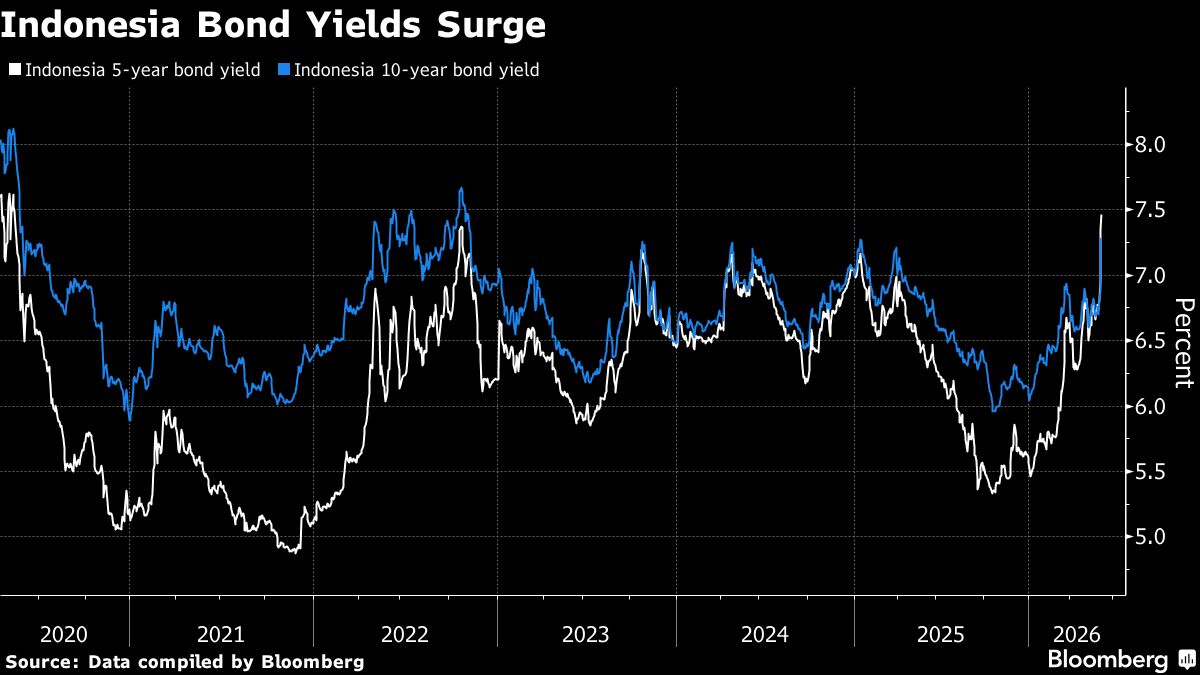
Indonesia’s central bank governor signaled it would allow bond yields to rise and left the door open for future interest-rate hikes during a roughly 90-minute call late Tuesday night with investors, seeking their return to Southeast Asia’s largest economy.
Indonesia’s central bank Governor Perry Warjiyo Photographer: Dimas Ardian/Bloomberg
The surprise hike in Indonesia’s interest rates on Tuesday helped the rupiah rebound from a record low, but analysts say it likely won’t restore long-term investor confidence in President Prabowo Subianto’s management of the economy.
Indonesia’s central bank took aggressive action to reverse a market selloff and support its currency, hiking interest rates in a surprise decision to halt foreign outflows triggered by policy uncertainty under President Prabowo Subianto.
 Anmelden