The biggest force in Peru’s gold industry these days isn’t Newmont Corp. or Buenaventura. It’s the thousands of illegal miners digging across South America’s No. 1 gold producer.
Inflation in Peru’s capital accelerated to the fastest pace in three years in September, remaining stubbornly outside the target range and boosting pressure on the central bank.
Read the story in English En uno de los países con mayor inestabilidad política del mundo, un banquero central ha sobrevivido gobierno tras gobierno como ancla de estabilidad económica, sin que ninguno se haya atrevido a correr el riesgo de perderlo.
In one of the world’s most politically turbulent countries, a central banker has endured as an anchor of economic stability through government after government, none willing to risk his departure.
Peru’s economy rebounded in July, driven by strong results across most sectors, even as unusually warmer weather weighed on fishing, agriculture and related industries.
As a military helicopter roared overhead and soldiers fired the first warning shots, six wildcat miners rushed onto a boat and tore downriver. Another plunged into the water and swam after them, leaving behind a makeshift camp that would soon go up in flames.
Mientras un helicóptero militar ruge sobre sus cabezas y los soldados dan los primeros disparos de advertencia, seis mineros ilegales se suben a toda prisa a una embarcación y huyen río abajo. Otro se zambulle en el agua y nada tras ellos, dejando atrás un campamento improvisado que pronto quedaría envuelto en llamas.
Peruvian growth came in just above expectations in the second quarter, handing President Keiko Fujimori a resilient economy as she starts her five-year term amid unusual weather.
Inflation in Peru’s capital accelerated faster than expected in July as food and transport prices climbed, staying above the target range for a fifth straight month.
Peru’s central bank held its key interest rate at 4.25% for a tenth straight month on Thursday, betting that an uptick in inflation will prove temporary.
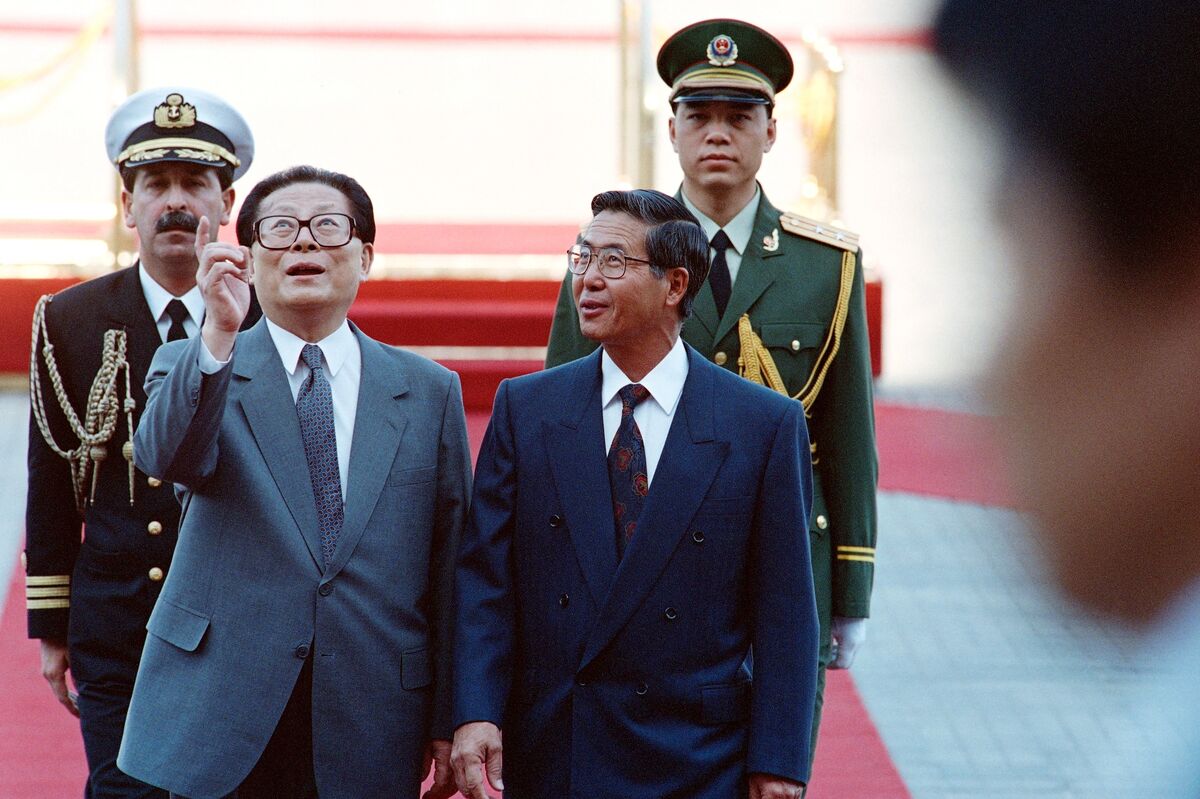
Lea en español Leia em portuguêsAlberto Fujimori’s first trip to Beijing 35 years ago helped turn Peru toward China, anticipating a broader Latin American realignment that Washington is still struggling to reverse.
Peruvian President Alberto Fujimori alongside his Chinese counterpart Jiang Zemin in 1994
Peru’s central bank chief Julio Velarde, seen as a pillar of economic stability in the politically volatile Andean nation, has agreed to stay on for another term, likely extending one of the world’s longest tenures at the helm of a monetary authority.
Peru’s bitterly contested presidential election remained too close to call as leftist candidate Roberto Sánchez nudged ahead of conservative Keiko Fujimori with votes still being counted.
Electoral officials accompanied by a member of the military at a polling station during the runoff election in Lima, Peru, on Sunday, June 7, 2026. Peruvians are heading to the polls on Sunday in what is expected to be a tight presidential runoff, with the model behind one of Latin America's most stable economies at stake.
 Anmelden