❌

Lese-Ansicht

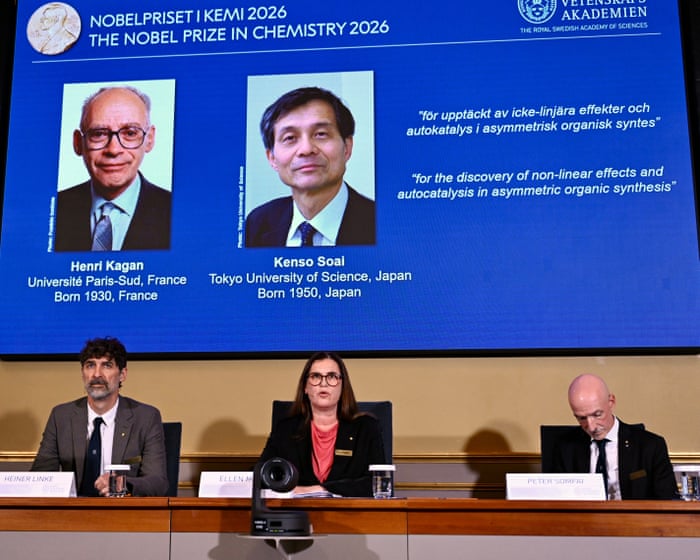
Nobel prize in chemistry awarded for work on mirror-image molecules

Henri B Kagan and Kensō Soai awarded prize for discovery that has aided understanding of how medicines work in the body

The Nobel prize in chemistry 2026 has been awarded to two scientists for discoveries that showed how chemical reactions can produce an overwhelming excess of one of two mirror image forms of a molecule.

Henri B Kagan at Paris-Sud University in France and Kensō Soai at Tokyo University of Science in Japan have been awarded the prize “for the discovery of nonlinear effects and autocatalysis in asymmetric organic synthesis”.

Continue reading...
© Photograph: Xinhua/Shutterstock
© Photograph: Xinhua/Shutterstock
© Photograph: Xinhua/Shutterstock
  •  

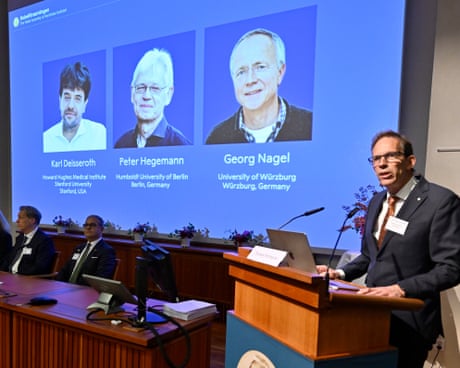
Nobel prize in medicine 2026 awarded for research into mysteries of brain

Three scientists to share 12m Swedish kronor prize for their work on ‘light-gated ion channels and optogenetics’

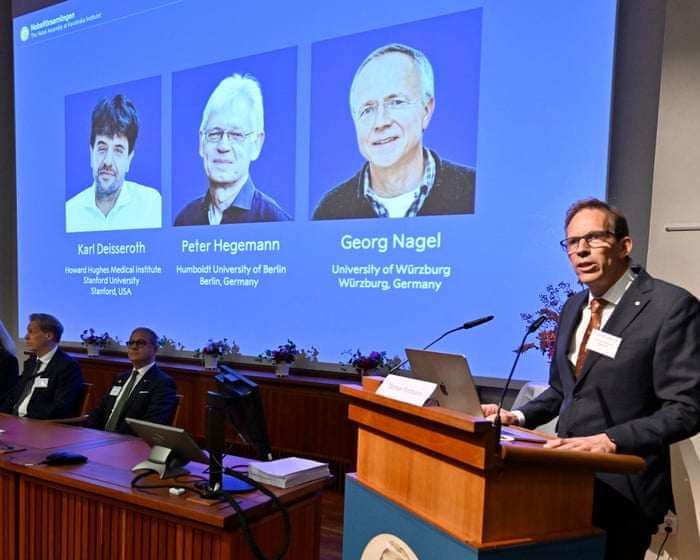
The Nobel prize in physiology or medicine 2026 has been awarded to three scientists for their work investigating the mysteries of the brain.

Karl Deisseroth of the Howard Hughes Medical Institute and Stanford University, Peter Hegemann of the Humboldt University of Berlin and Georg Nagel of the University of Würzburg have been awarded the prize “for their discoveries concerning light-gated ion channels and optogenetics”.

Continue reading...

© Photograph: Pontus Lundahl/EPA

© Photograph: Pontus Lundahl/EPA

© Photograph: Pontus Lundahl/EPA

  •  

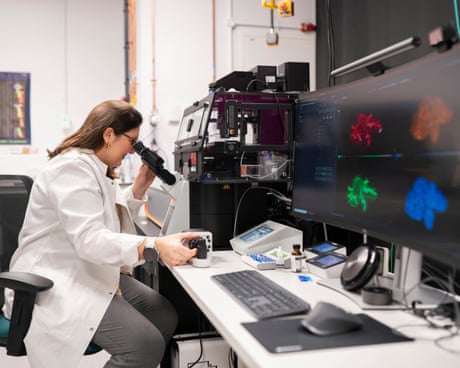
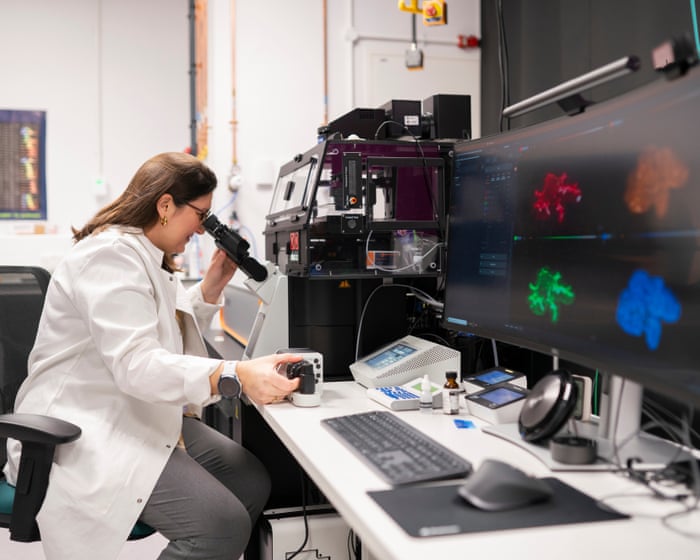
Researchers hope powerful new microscope will reveal ‘root cause’ of incurable bowel disease

No run-of-the-mill tech, ‘Curie’ operates at 10 times the resolution of conventional microscopy and could spur discoveries leading to new treatment

The number of young people living with debilitating and incurable bowel conditions worldwide is growing, but researchers now hope a one-of-a-kind microscope will help them understand such diseases and find new treatments.

According to the British Society of Gastroenterology, more than half a million people in the UK are living with inflammatory bowel disease (IBD), with Crohn’s disease and ulcerative colitis the two main forms.

Continue reading...

© Photograph: Adam Gasson/Adam Gasson / Rosalind Franklin Institute

© Photograph: Adam Gasson/Adam Gasson / Rosalind Franklin Institute

© Photograph: Adam Gasson/Adam Gasson / Rosalind Franklin Institute

  •  

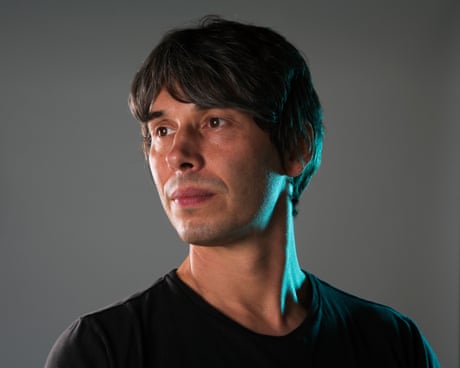
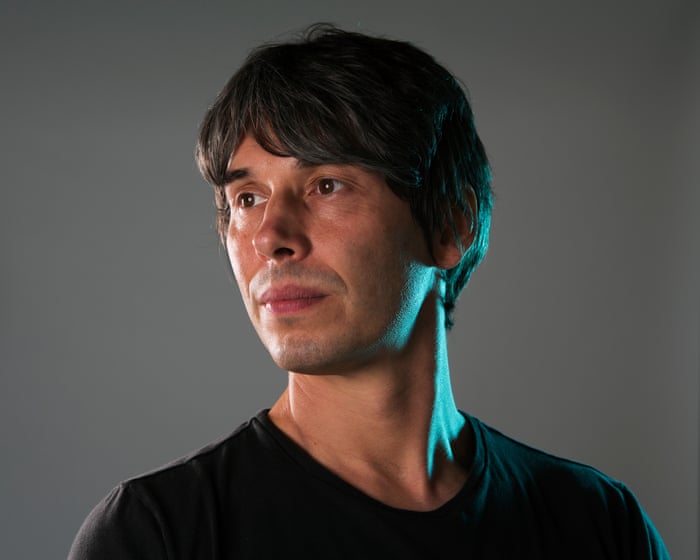
Brian Cox: ‘We don’t know how powerful AI is going to become – it’s both exciting and potentially a problem’

The physicist, BBC presenter and author on snowflakes, art v science and the time Paul McCartney quizzed him about one of Saturn’s moons

What is the inspiration behind your latest live show, Emergence?

It came from a book that I’ve loved for years: The Six-Cornered Snowflake by Johannes Kepler. Kepler is most famous for his laws of planetary motion in and around 1610, but he wrote this little book about New Year’s Eve in 1609, when he was walking across the Charles Bridge in Prague in a snowstorm. He was going to his benefactor’s house and he hadn’t bought him a present. So he writes this beautiful little book about looking at the snowflakes landing on his arm and thinking about the symmetry of them and asking, why are they six-sided?

Continue reading...

© Photograph: Richard saker/The Guardian

© Photograph: Richard saker/The Guardian

© Photograph: Richard saker/The Guardian

  •  

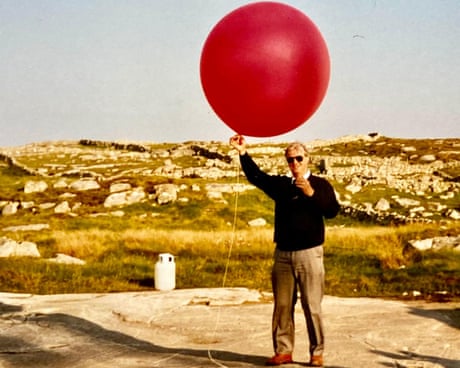
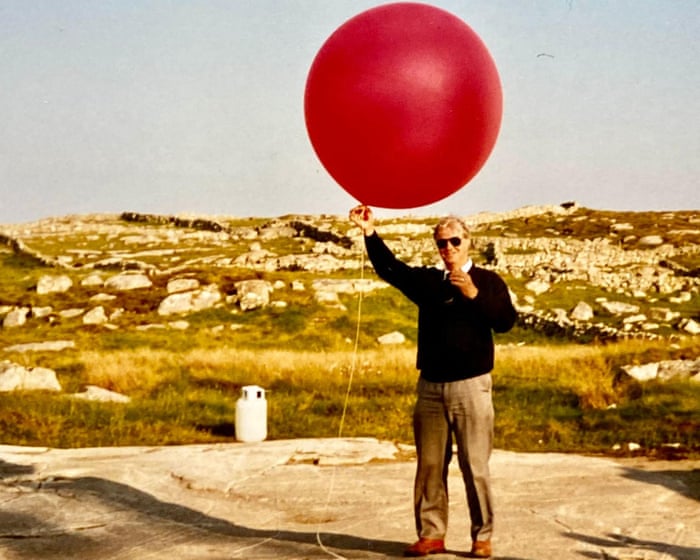
Stuart Penkett obituary

Atmospheric chemist whose laboratory work helped to identify the causes of acid rain and the hole in the ozone layer

Stuart Penkett’s discovery of the chemical processes that cause acid rain transformed our understanding of atmospheric pollution and what was required to deal with it.

Penkett, who has died aged 87, and his colleagues at the Atomic Energy Research Establishment (AERE) in Harwell, Berkshire, published a landmark paper in 1979 in the journal Atmospheric Environment, identifying how sulphur dioxide, primarily emitted from industrial sources, is converted into sulphuric acid in clouds that subsequently falls as rain.

Continue reading...

© Photograph: Gerry Spain/Mace Head Observatory, Galway

© Photograph: Gerry Spain/Mace Head Observatory, Galway

© Photograph: Gerry Spain/Mace Head Observatory, Galway

  •  

‘Reimagining matter’: Nobel laureate invents machine that harvests water from dry air

Omar Yaghi’s invention uses ambient thermal energy and can generate up to 1,000 litres of clean water every day

A Nobel laureate’s environmentally friendly invention that provides clean water if central supplies are knocked out by a hurricane or drought could be a life saver for vulnerable islands, its founder says.

The invention, by the chemist Prof Omar Yaghi, uses a type of science called reticular chemistry to create molecularly engineered materials, which can extract moisture from the air and harvest water even in arid and desert conditions.

Continue reading...

© Photograph: Atoco

© Photograph: Atoco

© Photograph: Atoco

  •  
❌