Xi, Putin and Trump outline priorities that include UN reform, boosting oil supplies and ‘protection of diplomatic immunity’
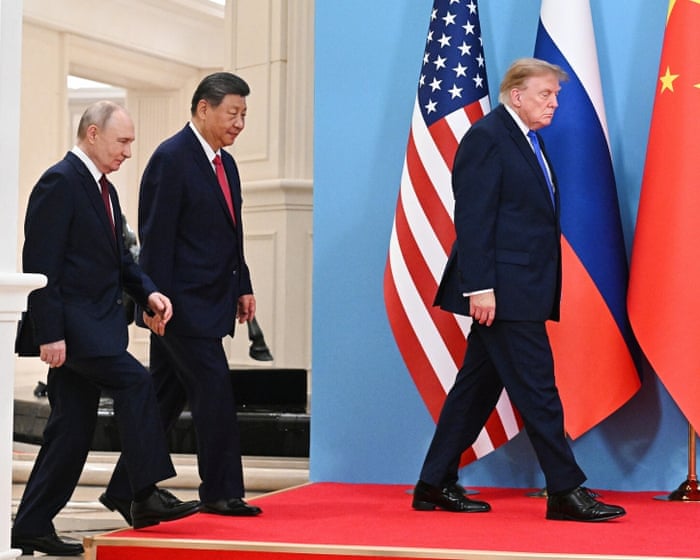
China, Russia and the US say they have agreed a peace statement after an unprecedented trilateral summit, but the declaration made no mention of the wars in Ukraine and Iran caused by two of the participants.
The declaration on Thursday also outlined a set of priorities that included changing the UN, boosting oil supplies and what it said was the protection of diplomatic immunity.
No breakthroughs on major subjects at first trilateral summit between leaders of US, China and Russia
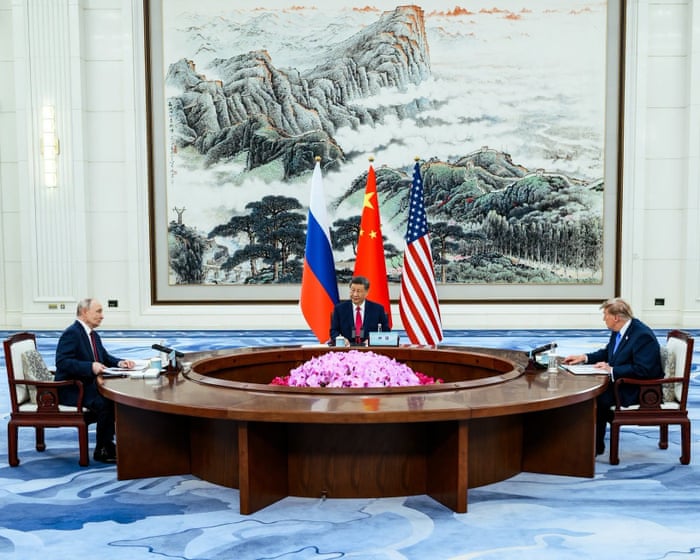
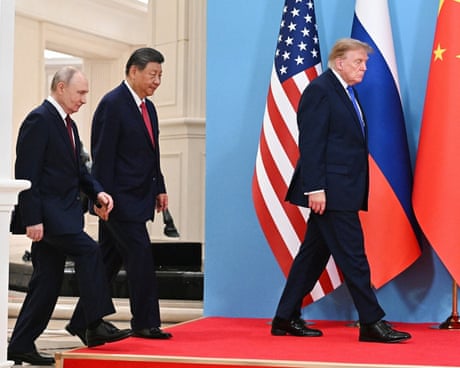
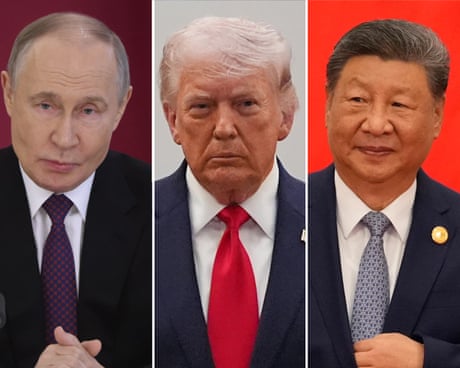
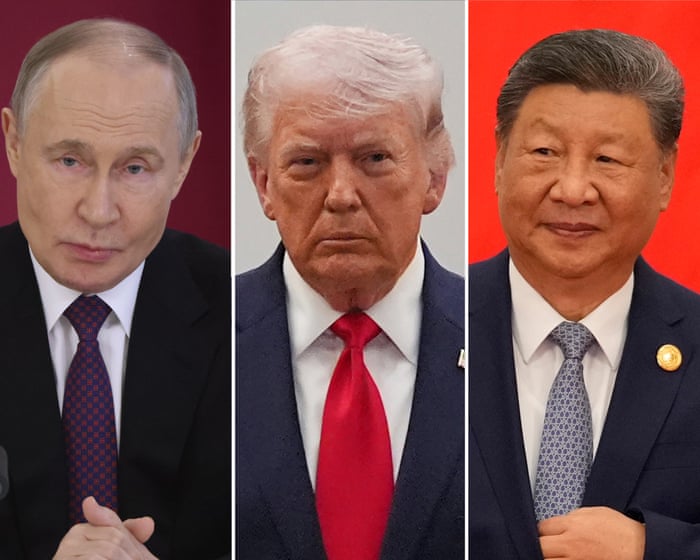
The presidents of the US, China and Russia met on Thursday for an unprecedented trilateral gathering on the sidelines of the Apec summit in Shenzhen. The session lasted more than an hour and Donald Trump, Xi Jinping and Vladimir Putin touched on nuclear weapons, the war in Ukraine and wider international security.
The trio lead the world’s three major nuclear powers and their decisions have far-reaching consequences for global security. However, their meeting in China ended without an announced breakthrough or concrete agreement on the main issues. Here are five key takeaways:
Treasury Secretary Scott Bessent, left, and Commerce Secretary Howard Lutnick have a long-running rivalry that recently spilled into the open over Nvidia.
Beijing stops short of confirming specific agenda, but Trump says denuclearisation, Iran war, trade and Ukraine will be among topics
The meeting of Xi Jinping, Donald Trump and Vladimir Putin in Shenzhen this week will cover topics of “groundbreaking significance” including “safeguarding world peace”, the Chinese foreign ministry has said.
The confirmation of Thursday’s trilateral talks, the first of their kind, will take place on the sidelines of the Asia-Pacific Economic Cooperation (Apec) summit and cement Xi’s status as a global power broker as he presides over events in the glittering southern tech hub of Shenzhen.
The president plans to also discuss the war against Iran, but is not expected to bring up Russia’s war in Ukraine or the scandal that has engulfed Jensen Huang.
The administration appears to be moving toward a long-term economic pressure campaign as President Trump expresses little urgency in securing a nuclear agreement.
President Trump says it is more important for Vice President JD Vance to investigate cities and states run by Democrats than to negotiate an end to the war with Iran.
Like several of his predecessors in other conflicts, President Trump is discovering that every escalation plan and all negotiating strategies are rife with trade-offs.
Trump still considering new assault on Iran nuclear sites – though threats less credible after Vance remarks
Qatar, the lead mediator in the US-Iran conflict, is seeking to persuade Tehran to allow UN nuclear weapons inspectors to visit Iran’s bombed nuclear sites, including those housing the country’s stockpile of highly enriched uranium.
Iran would not be required to make any commitment that the stockpile would be removed from the country, with other options on the table, including reducing the uranium content by down-blending it.
Vice President JD Vance is said to have made the outreach in a letter sent last week via Qatari meditators and delivered Sunday to an Iranian official, Gen. Mohsen Rezaei.
Investigation suggests American company Axon still supplies Israel with Taser weapons despite evidence they have been used to torture prisoners
The soldiers dragthe man into a section of the prison known as Hell’s Wing, a metaphor for its notoriety for acts of brutality. Shoving him violently into a corner, they take a step back before one of them draws his weapon and fires two rubber bullets at his body. The man, a double amputee, collapses to the floor.
After tying him up tightly, the soldiers continue their assault until one of them pulls a stun gun from its holster. The soldier approaches the man, brandishing the gun, before applying it to his body, engulfing him in an electric shock.
Renewed hostilities might not be any more successful than the war’s first phase, and President Trump has repeatedly canceled plans for a return to major combat.
The move will force a vote on the agreement after the midterm elections, though it faces steep odds in the Republican-controlled Congress even amid bipartisan concern about the deal.
This is no scoffing matter. The accelerating proliferation of advanced nuclear weapons is bringing ‘end times’ closer by the day
Humankind has fearfully and sometimes joyfully anticipated the end of the world ever since it began. The Bible’s Book of Revelation speaks of “end times”, a period of tribulation, war, famine, plague, floods and environmental catastrophe that may seem a less absurd prospect today than perhaps it once did. Islam, too, posits a fateful day of judgment or day of reckoning. Christian evangelicals believe that, in the final rapture, a chosen few – the righteous or the “elect” – will be saved while sinners burn. It’s a minority view. Matthew’s gospel predicts most people will defy, ignore or ridicule warnings of imminent Armageddon. Peter, another of Jesus’s disciples, agreed: “In the last days, scoffers will come, scoffing and following their own evil desires.” Yet such worldly scepticism does not mean a universal cataclysm is less likely. It may make it more probable.
Donald Trump’s blanket denials of the dangers ostensibly posed by artificial intelligence, whose uncontrolled development is seen by some as the latest harbinger of apocalypse, could be interpreted as fulfilling Peter’s prophecy. This US president, the nearest thing the world has to a one-man doomsday machine, is a great one for scoffing and evil desires. In Robert Harris’s 2019 novel, The Second Sleep, a worried scientist lists half a dozen ways the world might end. They include devastating climate change, pandemic disease, a giant asteroid collision with Earth, or some other overwhelming calamity. Few heed the fictional scientist’s fears. In the event, what destroys him and almost everybody else is a disturbingly plausible cyber crash – a global digital and internet meltdown.
Simon Tisdall is a Guardian foreign affairs commentator
Newly established commission identifies 17 catastrophic threats to human health but says ‘realistic route to act’ on each exists
Humans could become extinct by the year 2100 due to malicious use of AI or nuclear conflict, according to a new global risk assessment.
They top a list of 17 major threats to human health over the next 75 years, which also includes cuts to aid spending by wealthy countries, the climate crisis and childhood malnutrition.
An intelligence assessment examined Saudi Arabia’s military ambitions as Congress reviews a new civilian nuclear deal between the U.S. and the kingdom.
President Trump has gotten no love back yet from Kim Jong-un. He could turn to Xi Jinping, China’s leader, to help set up a summit when Mr. Xi visits Washington next week.
President Trump and Kim Jong-un on the North Korean side of the Demilitarized Zone in 2019. For Mr. Trump, a summit with Mr. Kim would help him turn the spotlight away from the unpopular war against Iran and toward a leader-to-leader relationship that Mr. Trump has treasured since his first term.
The International Atomic Energy Agency voices ‘serious concerns’ over expansion of Yongbyon facility to enrich uranium
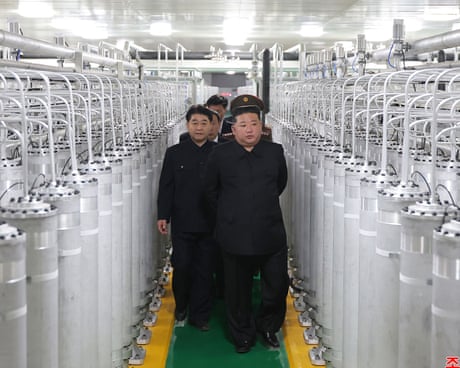
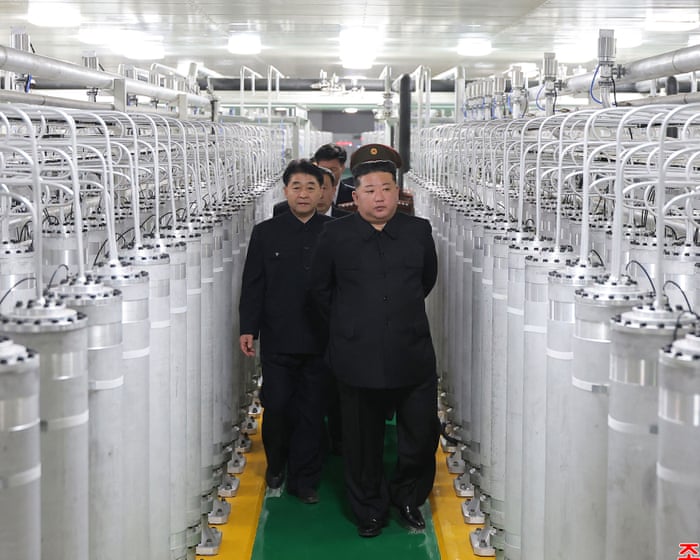
The International Atomic Energy Agency (IAEA) has voiced “serious concern” over evidence that North Korea has built a facility capable of enriching weapons-grade uranium to bolster its nuclear arsenal.
The new building, located at the the country’s main Yongbyon nuclear facility, can house up to 28 centrifuge cascades – machinery commonly used to enrich uranium – according to a report by the nuclear watchdog released this week.
Chief of nuclear watchdog says secret Assad-era facility would have been able to produce fissile material
A nearly complete nuclear reactor built secretly during the rule of the toppled Syrian leader Bashar al-Assad would have been able to produce fissile material for possible use in nuclear weapons, the chief of the UN nuclear watchdog has revealed.
Inspectors from the International Atomic Energy Agency (IAEA) last month visited two sites, one in Deir ez-Zor and a second in an undisclosed location identified to them by Syrian authorities.
A former defence minister has admitted misleading parliament over the existence of crucial medical records relating to nuclear bomb test veterans.
Tobias Ellwood has said he unwittingly gave MPs incorrect information in 2018 when he told them he had been unable to locate information on veterans’ blood tests after being given incorrect information by officials at the Ministry of Defence (MoD).

 Anmelden