❌

Lese-Ansicht

Clay Travis: inside the Maga permadad’s world of sports betting, trans panic and more sports betting

The rightwing media mogul has lost ground to fellow sports bros like Pat McAfee and Joe Rogan. He’s hoping his new venture can recapture some ground

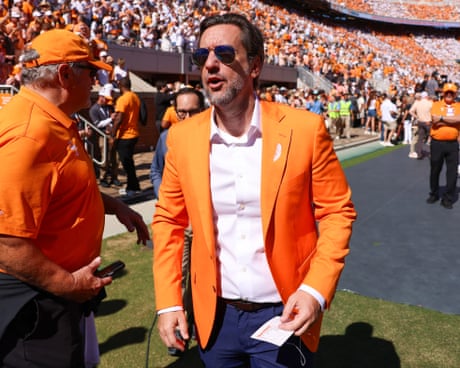
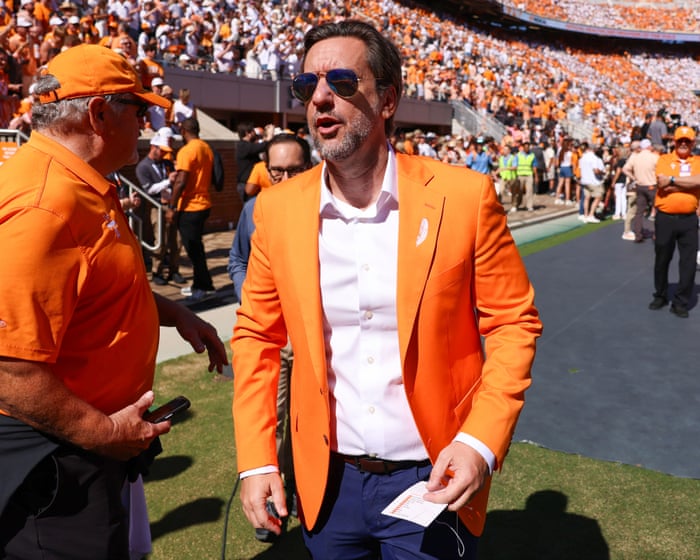
When Maga media blowhard Clay Travis offered $2m to Colin Kaepernick last week to appear on the daily talkshow he hosts with former CIA analyst Buck Sexton, it represented the culmination of a years-long obsession on the right with the onetime NFL star. In Travis’s telling of history, Kaepernick taking a knee during the 2016 NFL season was the event that catalyzed professional sports into the era of “woke” excess from which, he claims, it has been struggling to recover ever since.

But more than simply confirming the right’s longstanding villainization of Kaepernick, Travis’s offer was also a smarmy bid for publicity for his new media venture, Sport & State. Sport & State, which launched in August, is Travis’s bid to get back to his roots as a media mogul who sold the wildly popular Outkick to Fox Sports for a rumored $100m, and reclaim some of the cultural territory lost to fellow sports bros and Magagitators like Pat McAfee, Joe Rogan, Tucker Carlson and Ben Shapiro. But if there’s one thing Sport & State won’t be doing, it’s engaging with anyone beyond the Magaverse. There has been no response from Kaepernick since Travis made his “offer” of $2m to charity in exchange for an interview, which suggests he understands that it was extended more in a spirit of trolling buffoonery than sincerity. No one associated with the left or progressive politics ever appears on Travis’s shows, for the simple reason that they are designed purely for the right to talk to itself. (Some would say the same could be said of the left, although the disregard for dissenting perspectives in the Magasphere seems way more extreme.) More than it heralds a renewal of Travis’s career or an injection of fresh energy into the Trumpist mediasphere, Sport & State is a case study in the stagnation that has taken hold on the right as Donald Trump stares down the barrel of defeat in November’s midterm elections.

Continue reading...
© Photograph: Roger Wimmer/ISI Photos/Getty Images
© Photograph: Roger Wimmer/ISI Photos/Getty Images
© Photograph: Roger Wimmer/ISI Photos/Getty Images

  •  

Fox’s US World Cup summer: wild mispronunciations, Corden’s sad beers and Lowe’s excellence

The broadcaster’s tournament coverage was a mix of flat and fizz. It could also have been a long farewell with World Cup rights up for grabs

Goodbye, then, to Fox, to its band of upbeat Brits and grown men dressed in suits and sneakers. Goodbye to constant cutaways to Gianni Infantino in the stands, his eyebrows a mournful tipi, his nude head sprinkling under the summer sun. Goodbye to Landon Donovan and his special gift for announcing every celebrity sighting (“And there’s Javier Bardem and Penélope Cruz”) as if delivering the results of a colonoscopy. Goodbye to Rebecca Lowe saying “OK, OK” whenever she’s needed one of her on-set personalities to zip it so she can throw to a break. Goodbye to the momentum graph, which only flashed on screen when a match’s momentum needed no explanation; goodbye to “no golden goal” on the scorebug during extra time, referencing a rule that has not been in force at a World Cup for 24 years; goodbye to the connected ball, which never seemed connected when we needed connection most.

Goodbye to Geoff Shreeves, Fox’s middle-aged Oliver Twist chirruping on the sideline for the approval of his American masters. Goodbye to Tom Rinaldi, to his pocket squares and his “lyrical” meditations on balls and planets and stars or whatever. Goodbye to Chef Nick, now forced to rein in the extravagance of his early contributions (kangaroo corndogs, fufu chicken tikka masala) in the face of the tournament’s gastronomically subdued final four. And goodbye to Jameis Winston, the Fox fan correspondent, whose distressingly antic and sweaty stadium dispatches gave him the unvarying appearance of a man being electrocuted in the middle of a baptism.

Continue reading...

© Composite: Getty Images, Guardian design

© Composite: Getty Images, Guardian design

© Composite: Getty Images, Guardian design

  •  

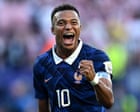
Statesman, comedian and dealer of hard truths: how Kylian Mbappé became the king of this World Cup

The Frenchman is a footballer, flautist and a thespian. There’s no question he is the most thrilling and compelling figure at this year’s tournament

This has been the World Cup of characters, bold fashion statements, and bantz: we’ve had Thomas Tuchel rubber-banding around the England dressing room like a teen at his first all-ages rave, and Iván Barton booting Miguel Almirón from the field as if sentencing him to death. Mauricio Pochettino and his $500 overshirt have brought fresh energy and inspiration to the wardrobes of convex middle-aged men the world over. Jokester Javier Aguirre’s avuncular “fuck you” at Anthony Gordon has pushed bilateral relations between Mexico and England to their warmest point since the British-brokered peace that ended the Pastry War of 1839.

Erling Haaland has shown it’s possible to be Jaws in front of goal and Scooby Doo once the ball is in the back of the net, that there’s nothing about football so important that it can’t make way for some silly bit of online comedy. Even Harry Kane, a man who often seems like he was media trained in the womb, has squeaked thrillingly, if briefly, to life.

Continue reading...

© Photograph: Image Photo Agency/Getty Images

© Photograph: Image Photo Agency/Getty Images

© Photograph: Image Photo Agency/Getty Images

  •  

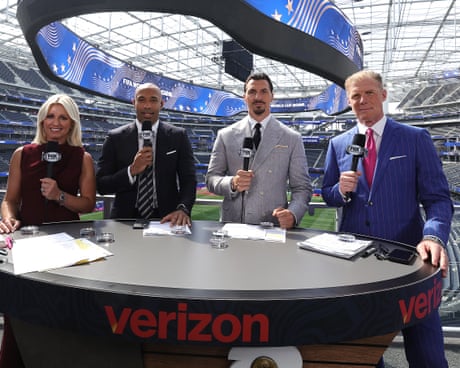
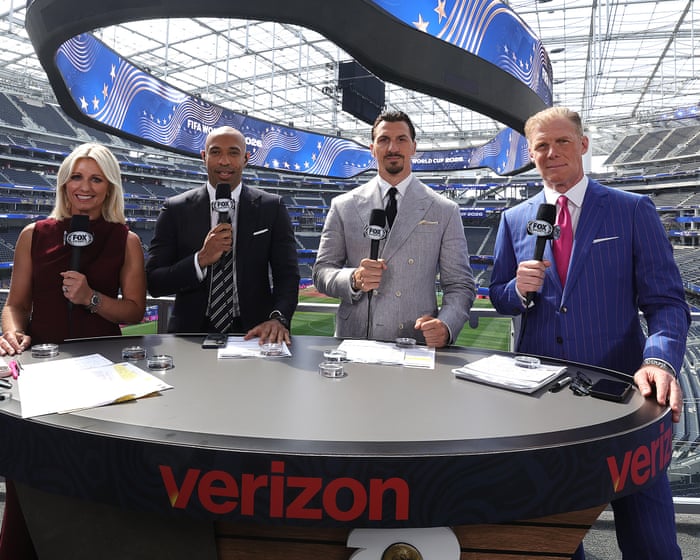
The French aristocrat and the all-American idiot: Henry v Lalas is the World Cup’s most compelling battle

Fox’s broadcast at the tournament has become a story of two contrasting styles. And there is one clear winner

We all know someone like Alexi Lalas. He’s the ranter whose rants never actually say anything, the life of the party at the party no one enjoys attending, the “big personality” who’s always misjudging the size of the room. He’s corporate America’s idea of a fun guy, the type of workplace “character” whose business trip hangover never stops him from being first at the hotel breakfast buffet, hair wet, Untuckit shirt untucked. He would absolutely dominate karaoke night at a conference on infrastructure finance. If only this were the limit of Alexi Lalas’s actual impact on the world, our culture would live in blessed ignorance of his existence. But in the real world Alexi Lalas is not a small-time menace working the floor at an infrastructure conference. In the real world Alexi Lalas is American soccer’s brightest media star, and he is everywhere this World Cup.

When Lalas’s Roger Ramjet jaw thrust into frame on Fox at the start of this tournament, it’s fair to assume that many viewers felt a sense of dread similar to that expressed in the Grand Theft Auto meme: “Ah shit, here we go again.” Lalas’s ubiquitousness every World Cup is American TV’s answer to the Iran war: no one wants it, everyone hates it, and as it drags on, it inevitably becomes a face-saving exercise in damage limitation. But there was also a glimmer of hope: for this tournament Fox has enlisted a pair of elite European strikers, Thierry Henry and Zlatan Ibrahimović, to terrorize Lalas and shake proceedings up. Steered by Rebecca Lowe, this new-look panel has promised a slightly more sophisticated approach to covering the tournament than the yahooing belligerence that was Fox’s stock in trade at the last two World Cups.

Continue reading...

© Photograph: Frank Micelotta/Fox Sports/Getty Images

© Photograph: Frank Micelotta/Fox Sports/Getty Images

© Photograph: Frank Micelotta/Fox Sports/Getty Images

  •  

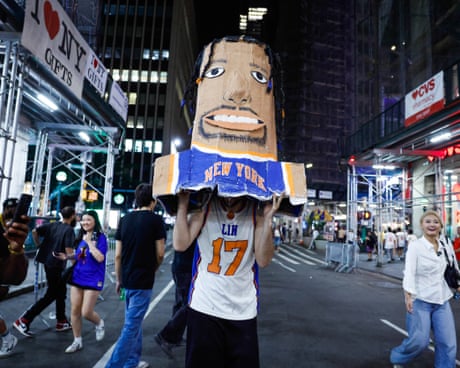
Knicks in five and the NBA is alive: New York’s era-defining title is a win for the believers

For a half century, New York was the center of the universe but the joke of the NBA. In these glamour-filled finals, the franchise finally got its moment

The New York Knicks had been here before. As Jalen Brunson and his band of not-so-merry men stood at the top of this year’s NBA finals, they confronted not just the San Antonio Spurs, their foe on the court, but the very idea of what the Knicks themselves – as a team, as a franchise, as a symbol of New York City – could be. The team’s run to last year’s Eastern Conference finals was thrilling but had the aspect of an underdog romp, and ultimately ended in defeat. Was this the limit of what New York’s fans, Rabelaisian in their rages and saintly in their endless capacity for patience, could expect from their team? Brunson was dogged and clever but perhaps not quite elite, a Stakhanovite toiler in a league built for transcendent talents. Karl-Anthony Towns was elite but perhaps too soft, too sensitive, too “zesty” to carry a team to the NBA’s pinnacle. The questions hanging over the leading pair extended to a team forged in their image. The lineup was good; was it great?

Coach Mike Brown, in his first year with the franchise, had promise but no small amount of baggage, having landed at the Knicks after being dismissed by the Sacramento Kings following a horror start to the 2024/25 season. And then, of course, there was the weight of history: no title since 1973 and a litany of near-misses and false dawns in the intervening decades. New York had watched through the 1980s and 1990s as first Los Angeles, then Chicago (under the guidance of its own son, Phil Jackson, who won the 1973 championship as a Knick) propelled the NBA to global prominence, a narrative in which the Knicks filled the role of a dutiful punching bag. Hakeem Olajuwon’s block on John Starks to kill their hopes in 1994, the tragic heroism of Patrick Ewing, death by Tim Duncan in ’99, and all the fizzled promise of Carmelo and Stoudemire and Linsanity: the memories had faded but the scars lingered. The franchise was destined, it seemed, to remain forever on the fringes, a mournful witness to others’ joy. Could they do it? Surely they couldn’t: the curse of the Knicks had driven the fans, the team, the city itself to despair. Neurosis, not success, was hardwired into New York’s psychology. The center of the universe and the joke of the NBA: the city was Larry Fink off the court, and Larry David on it.

Continue reading...

© Photograph: Kena Betancur/AFP/Getty Images

© Photograph: Kena Betancur/AFP/Getty Images

© Photograph: Kena Betancur/AFP/Getty Images

  •  

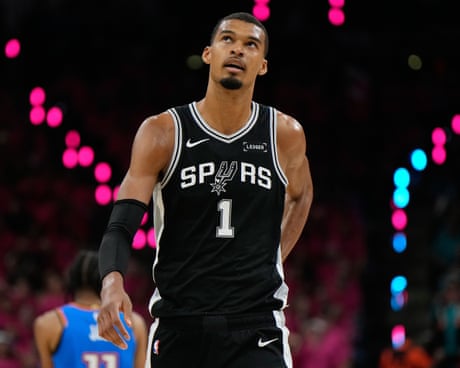
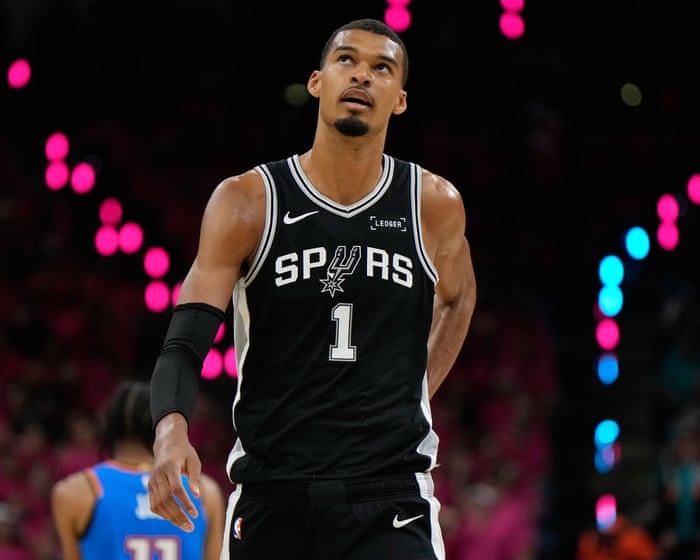
The human in excelsis: why Victor Wembanyama is unlike anyone basketball has ever seen

For years the NBA has wondered what would happen if it had a giant who could do everything. The San Antonio Spurs star has given us an answer

The NBA season began with serious questions about Victor Wembanyama’s ability to last the distance in the playoffs. Could this brilliant ectomorph, a blend of rare height and even rarer skill, stand up to the rigors of a deep postseason run? Would his slim body snap under the intensity of professional basketball’s sternest tests? The results are in: Wembanyama will this week lead the San Antonio Spurs in the NBA finals. At just 22 years of age, basketball’s next superstar has arrived: slightly ahead of schedule, but with every part of his brilliance emphatically affirmed.

“Wemby” landed in America in 2023 as the NBA’s No 1 overall draft pick, an alien in both stature (his official height is listed as 7ft 4in, though many claim he may be as tall as 7ft 6in), nationality (French) and foreign-language proficiency (fluent in English, despite never having lived outside his home country). Sure enough, “The Alien” quickly became his nickname. But the flood of tears with which he greeted his team’s defeat of Oklahoma City in Saturday night’s Game 7 of the Western Conference finals revealed a different side to this outlier of outliers: the human side. More than his freakish physique or the sheer absurdity of the spectacle he presents on court, towering over established giants of the game like some basketballing Burj Khalifa, it’s Wemby’s humanity that makes him such a compulsively interesting and watchable star. He is the alien who longs to be among us.

Continue reading...

© Photograph: Ashley Landis/AP

© Photograph: Ashley Landis/AP

© Photograph: Ashley Landis/AP

  •  

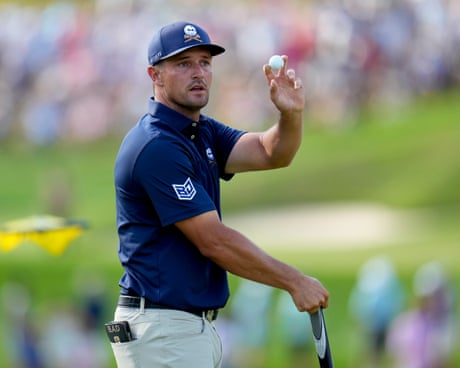
Bryson DeChambeau could give up golf for YouTube in his athletic prime. Is he right?

The two-time major champion has mused about life as a full-time streamer. But sport should be more than just a platform to grow an athlete’s brand

Golf: a feeder sport for aspiring YouTubers? When Bryson DeChambeau, faced with the expiry of his LIV Golf contract at the end of this year and the implosion, possibly even sooner, of the now Saudi-less LIV Golf, mused last week that he might give up life on tour to focus on his YouTube channel, most professional golf watchers scoffed. This was just a bluff, a move to gain leverage as DeChambeau, like every other LIV player, contemplates an uncertain future and negotiates the fraught path back to the PGA Tour.

“I think, from my perspective, I’d love to grow my YouTube channel three times, maybe even more,” DeChambeau said. “I’d love to do a bunch of dubbing in different languages, giving the world more reason to watch YouTube. And then I’d love to play tournaments that want me.”

Continue reading...

© Photograph: Jeff Roberson/AP

© Photograph: Jeff Roberson/AP

© Photograph: Jeff Roberson/AP

  •  

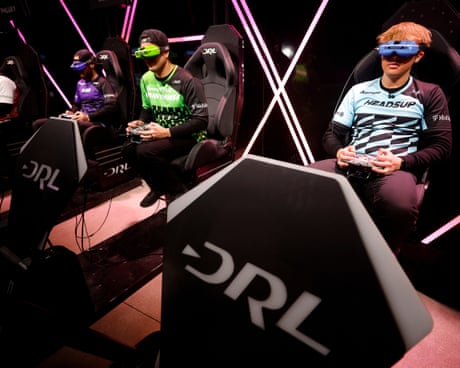
Drone racing to drone strikes: have war and sport become indistinguishable?

The Trump administration’s pushing of the war in Iran reflects a sporting culture driven by clipped-up content, shameless tribalism and a lust for escalation

Among the more surprising continuities of 2026 has been the visual kinship between the Winter Olympics and the US’s illegal and unprovoked war in Iran. High-speed camera drones were a highlight of TV coverage of the recent Games in Milano Cortina, bringing viewers within kissing distance of the action as Olympic athletes hurtled down the slopes and around the tracks in the skiing and sliding events. The incessant screech of the drones aside, the introduction of quadcopter-borne cameras felt like a real step forward in coverage of the winter sports, bringing a (literal) new perspective to events that had become, over recent decades, fairly static as a viewing experience.

No sooner had the Olympics finished than aerial video was back on our screens – only the footage, in this case, was of a far darker variety. In place of the ludicrous hip flexibility of the slaloming skiers and the high-speed cornering of the monobobbers, for the past month our feeds have been flooded with satellite and drone imagery of the US military blowing Iranian aircraft, ships, vehicles, munitions buildings, and citizens to smithereens. The aerial perspective that brought the strength and speed and elasticity and joy of Olympic competition to our screens now transmits the daily horrors of war in easily snackable, two-minute clips on to our phones. In the era of the milkshake duck, it’s almost expected that anything positive in our culture will eventually turn sour – and technology, of course, is ethically agnostic, a tool that can be used for both good and evil ends. But even in a culture as depraved and hypocritical as ours, the seamless transition from drone-supplied footage of Olympic excellence to drone-supplied footage of war crimes has felt genuinely jarring.

Continue reading...

© Photograph: Chris Graythen/Drone Racing League/Getty Images

© Photograph: Chris Graythen/Drone Racing League/Getty Images

© Photograph: Chris Graythen/Drone Racing League/Getty Images

  •  

From Run Nation to Power Slap: what is leading the dumbing down of sports?

From violent collision contests to celebrity-backed offshoots, spin-off sports are finding captive audiences. Their spectacle masks something more sinister

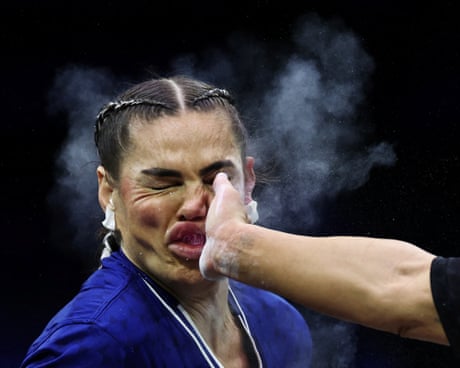
A few weeks ago a clip went viral of a strange new contact sport emerging from the antipodes. Two burly men, one of them holding a football, sprint at each other on a kind of catwalk, waiting for the bloop-bloop-bloop of an electronic countdown before they launch into their runs. Neither wears any kind of padding or protective gear. Surrounded by baying spectators, the men collide in the middle of the track, making impact through shoulders, knees, hips, stomachs: in most instances, one of the runners is knocked flat on his back or face from the force of the collision, and the other stands tall in triumph. “We are literally getting dumber as a civilization,” noted one of the many comments on the clip on X.

Run Nation Championship, as this new sport is known, launched in Australia last year, and is now holding combines ahead of RNC03, its third instalment. Many of the competing athletes seem, from the early video evidence, as wide as they are tall; the risk of injury – to their limbs, to their heads, to their brains – is obvious. But this is all part of the pitch. Like all new mixed martial arts and contact sports, RNC owes an obvious debt to UFC in the way it’s named, structured, and promoted; like UFC and UFC boss Dana White’s newer sport, Power Slap, in which two opponents face each other across a table and slap the side of each other’s faces as hard as they can until one collapses, Run Nation is not so much a sport as an exploration of the frontier of sporting violence, a macabre social experiment to see how far athletes will push their bodies in the pursuit of victory and money.

Continue reading...

© Photograph: Hamad I Mohammed/Reuters

© Photograph: Hamad I Mohammed/Reuters

© Photograph: Hamad I Mohammed/Reuters

  •  

Clapping skis to the pulpy thrash of poles: the Winter Olympics are an ASMR wonderland

The TV screen’s jazz of drags, snaps, pops, and stops during the Milano Cortina Games have shown sport at its most powder-light and loveable

The mountains always promise escape from the squalor of existence at sea level, if not a kind of purification. The fortifying ruggedness of the terrain, the apple-crisp air, the high-albedo dazzle of sunlit snow: at altitude, it seems, everything is thinned to its essence. The Winter Olympics frequently play on this mythology of purity, but rarely has culture’s quadrennial ascent up the switchbacks felt as clarifying as it has this year. Propelling us into heights untroubled by the compromises and tradeoffs that blight sport’s lower zones, Milano Cortina has delivered images so brilliant and sharp they’ve also served to expose how ugly – and morally murky – most non-Olympic team sports have become over the past four years.

As a TV spectacle, the excellence of this Olympiad has been defined as much by absence as presence. No gambling ads, no live betting odds gunking up the screen, no win percentage trackers, no janky little segments in which the hosts joke about what the prediction markets are doing: these Games have brought delight and relief to a tired public’s eyes in equal measure. Cleaned of clutter and slop, sport, it turns out, can still be a thing of wonder and mystery, agony and beauty. Who would have thought?

Continue reading...

© Photograph: Ian MacNicol/Getty Images

© Photograph: Ian MacNicol/Getty Images

© Photograph: Ian MacNicol/Getty Images

  •  

Bad Bunny and jingoism lite: was this the Super Bowl where woke roared back?

The NFL appeared keen to welcome the sport’s non-Maga contingent back into the tent. But the theater and violence of capitalism was still there

Roger Federer smiling wolfishly to the crowd: a return to woke? Adam Sandler hangdog in the Levi’s Stadium stands, Jon Bon Jovi mooching on the sideline like a retired dentist on a cruise, Billie Joe Armstrong belting out American Idiot during the pre-game show under his motionless meringue of fogey-blond hair: were they a sign? A New England Patriots team who were neither favored to win nor widely reviled, then promptly repaid a grateful public by losing: was this the Super Bowl which proved that history really can move on, that America is not fated to remain hostage to the tremors and hatreds of the past? Well, yes and no.

A year after Donald Trump made American football’s showpiece all about him, Sunday’s game in Santa Clara always promised a sort of correction – a cooling of the mood, perhaps even an end to the manipulation of sport for political ends. As always the best way to gauge the success of this mission was as the gods intended: through a TV screen. Trump – saddled with historically low approval ratings, facing a massacre in this year’s midterms, and no doubt wary of risking a public appearance in the deep blue sea of the Bay Area – was absent on this occasion, and he kept the F-22 fighter jets that were scheduled to be part of the pre-game flyover away from Levi’s Stadium too. (Unspecified “operational assignments” were the reason offered for the jets’ withdrawal, which means there’s probably a low-ranking member of the Trump administration putting big money on a US military strike somewhere in Latin America as we speak.) And yet, the absent autocrat still weighed on proceedings, his curdling influence turning every moment and gesture on Sunday into a referendum on the prospects for a post-Trumpian sporting future. Could football be normal again?

Continue reading...

© Photograph: Chris Torres/EPA

© Photograph: Chris Torres/EPA

© Photograph: Chris Torres/EPA

  •  
❌