Trump’s rout could be part of a democratic spring that began in Hungary. But will it extend to the French elections next May?
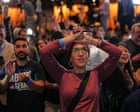
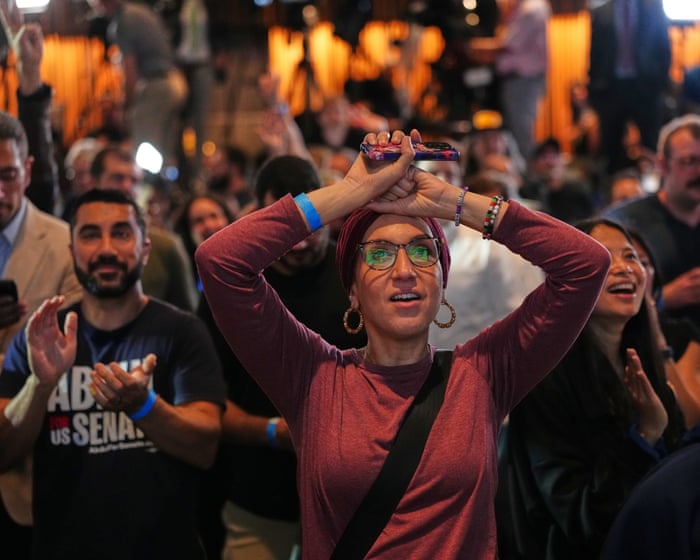
Hungary, Brazil, Serbia, and now the US. So far this year, when their hand has been held to the stove, voters have chosen what the Texas senator-elect James Talarico, the new face of the US’s Christianleft,campaigned on as a “politics of love”: a society where we aren’t at each other’s throats, or a police state at ours.
Is it any surprise that when there is clarity about the choice on offer, voters have started to shrink away from a vision fuelled by billionaire wealth and runaway inequality? Away from oligarchic rule and unapologetic corruption, connivance with aggression, expansion, colonialism and war; environmental degradation and the surrender of the human spirit to a reality mediated by the algorithm.
Alexander Hurst writes for Guardian Europe from Paris. His memoir Generation Desperation is out now
Do you have an opinion on the issues raised in this article? If you would like to submit a response of up to 300 words by email to be considered for publication in our letters section, please click here.
Guardian Europe columnists Rokhaya Diallo and Alexander Hurst answered your questions about the recent protests in France, the role of the French police, foreign influence and the upcoming presidential election.
Michael Wolfcarius asks: I cannot understand why the Guardian is selecting dots instead of joining them. France may have developed into the big story for many reasons, many of which have yet to be discussed, but it is not the only place where seemingly small incidents grew into massive protests, some also quite violent; Spain, Italy, Serbia and Albania come to mind. The crystallising reason may be different but the conditions leading up to it are quite similar. Can you put all these events into perspective, context and relation? There are obviously underlying currents making it difficult for people to refrain from making themselves ‘heard’.
Rokhaya: I agree that these movements deserve to be considered together, while at the same time, recognising their different specific national contexts. Housing in Spain, living costs and public services in Italy and France, and corruption in Serbia and Albania are bringing people onto the streets. These concerns touch the foundations of a decent life and people’s ability to shape their future.
What connects them, in my view, is the widening gap between what people need and what political institutions seem willing to deliver. These incidents that have led to protests are not “small .” Serbia’s movement began after a deadly railway-station canopy collapse, which became a focus for anger over corruption and accountability. My reading is that these protests express a crisis of political responsiveness.
Alexander: I think people in all these places – Albania, Spain, France – feel that the political systems that exist aren’t capable of dealing with the sheer scale and nature of the crises facing us, and they’re responding to a sense of ‘loss of control’ (the Brexit campaign really did strike upon a brilliant slogan) over where their societies are headed. There is a general social sense that has flipped from “this is broken, but things can and will get better”, which gives people a stake in the institutions around them, to “this is broken and things can and will get worse”.
The impact of the arrival of AI has been understated. Not just on labour markets, or on the environment, but ontologically. The investment pitch of the most powerful companies in the world, the ones amassing trillion dollar valuations, isn’t just that X-subset of jobs are replaceable, it’s that human beings themselves are replaceable. That the things we do fundamentally don’t matter, and that their goal is to bring this into being. I think that feeling is there even if we don’t immediately put our finger on it in those terms.
Fixing the broken education system will be just the start. The biggest challenge for an aloof political class is to finally pay attention to an abandoned generation
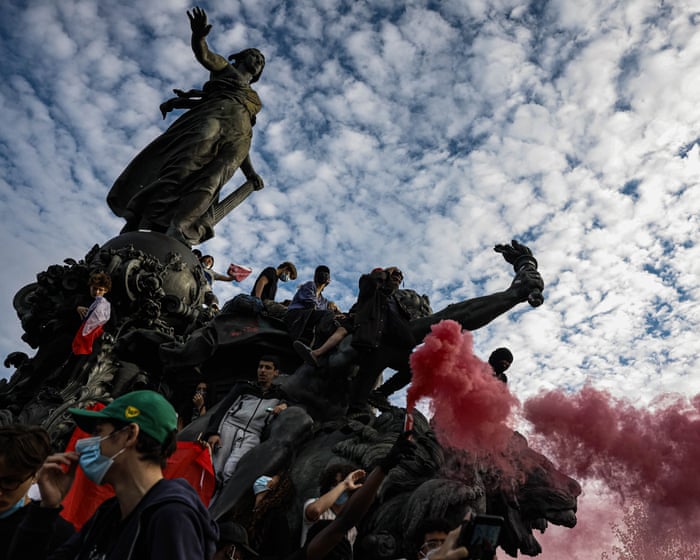
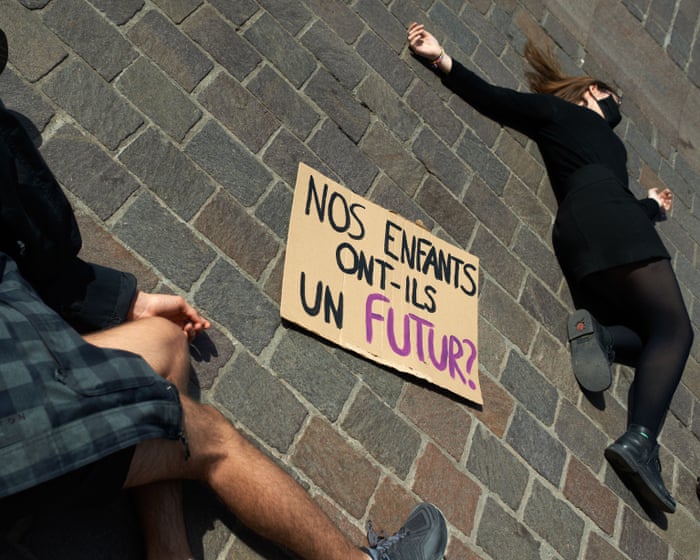
When adolescents protest that the government is failing to uphold their right to an education, and the government’s response is to send in riot police, the government has lost the plot. People outside France may have spent the past week watching the student protests in Paris and other cities, and thought, “Well, France has a long tradition of insurrection” or, “That’s just the French being French.”
But the situation that has provoked the high-school walkouts and teenage anger is most likely not one they would immediately associate with the France of their imaginations. In place of its lost plot, the French government has a collection of anecdotes and statistics that it should be ashamed of: 27th place in the most recent OECD education rankings, schools with ceilings collapsing and rats in classrooms and, in a school in Bagnolet, no drinkable water; an increase in the average number of students per class from 27 in 2010 to over 30 today; half of primary and high schools missing teachers at the start of the school year – many of them with no substitutes or replacements.
Alexander Hurst writes for Guardian Europe from Paris. His memoir Generation Desperation is out now
La France Insoumise gives voice to the left-behind, and progressives approve. But many recoil from a leftwing leader whose foreign policy is stuck in 1985
Théodore Abitbol is a self-described “militant antifascist,” with degrees in political science and comparative literature, and a bookshelf that ranges from the gender and queer theory of bell hooks to the anti-capitalist social analysis of the Marxist theorist Mike Davis.
The 34-year-old is a regular participant in pro-Palestine protests, and has a decade of full-time activism under his belt: unions, strikes, protests, civil disobedience and vast protest encampments used to block construction projects, known in France as ZAD – for “zone à défendre”.
Alexander Hurst writes for Guardian Europe from Paris. His memoir Generation Desperation is out now
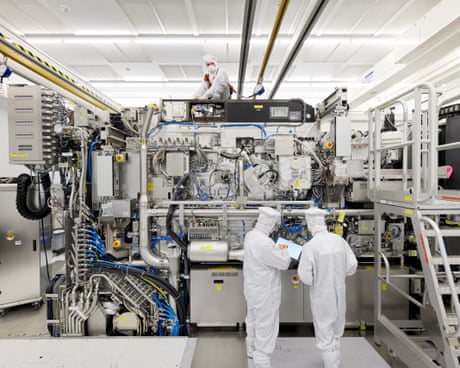
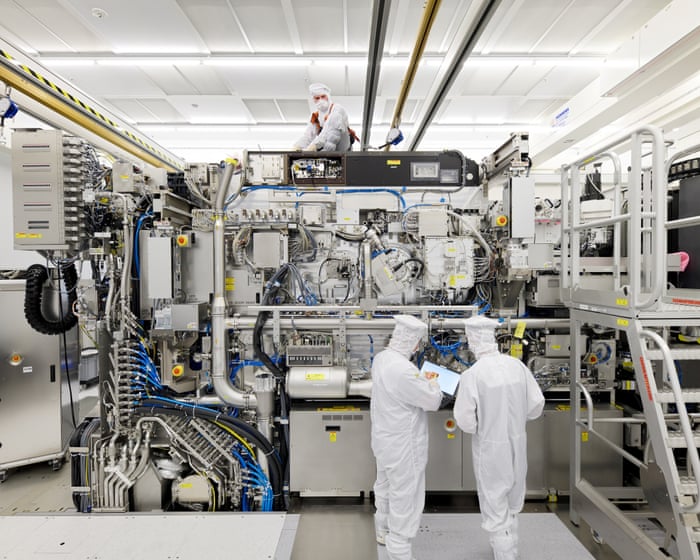
An EU export ban on Dutch tech giant ASML’s machines could force the pause we all need
At this point, it should be clear that AI is a choose-your-own-adventure book where every option ends in disaster. Exploding carbon emissions and ecological collapse? Turn to page 37. Other outcomes include some or all of: the bubble bursting and an ensuing financial crisis; mass unemployment via automation; the end of democracy and the rise of authoritarian surveillance states; raving cults who believe the pattern-matching algorithm is a consciousness; terrorists who create devastating bioweapons; nation states that deploy autonomous weapons systems that act on non-human timeframes; nation states or terrorists that hack all the myriad systems we depend on; or an AI that, conscious or not, pursues directives that are at odds with human wellbeing.
Imagining that people such as Elon Musk, the OpenAI boss, Sam Altman, Palantir’s Peter Thiel and the Trump administration tech adviser Marc Andreessen will lead us to a utopian future of flourishing environmentalism, social harmony and endless leisure requires hallucination and sycophancy so great that that choose-your-own-adventure scenario could only have been written by ChatGPT.
Alexander Hurst writes for Guardian Europe from Paris. His memoir Generation Desperation is out now
Ahead of the Nordic nation’s EU referendum, the Icelandic flag has been co-opted by the far right
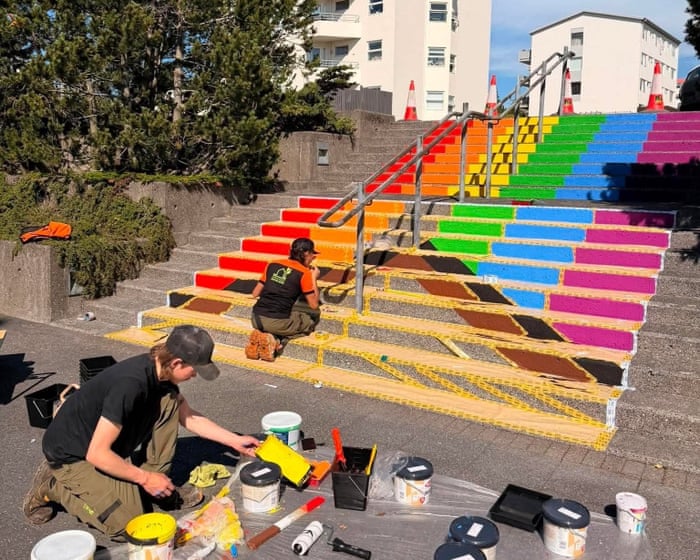
To enter Reykjavik’s Grafarvogur Lutheran church, worshippers and visitors are invited to make their way down 16 steps painted in the rainbow stripes and the white, pink, blue, brown and black chevrons of the Progress Pride flag. The artwork, which can even be seen on satellite pictures, was originally a project of former head pastor Guðrún Karls Helgudóttir, now the bishop of Iceland, and her colleagues. The point was to show support for the LGBTQ+ community’s “need to be visible and accepted”, the church’s current head pastor, Arna Sigurðardóttir,told me.
And then some time in between the barely faded midnight sun of 7 July and the early morning light of 8 July, someone painted over all those colours with just three: blue on the outside, and two thin strips of white encasing a thicker strip of red in the centre.
The Animorphs books taught my generation about digging deep in the face of an existential threat. We need that spirit now more than ever
Recently I found myself thinking about slug-like aliens that crawl through people’s ears and into their brains, with the ultimate purpose of global domination. It would explain a lot about what has gone so wrong with the world, wouldn’t it? And it was why I immediately flashed back to the children’s fantasy series Animorphs when Donald Trump’s health secretary and conspiracy theorist, Robert F Kennedy Jr, admitted to having had a worm in his brain.
While visiting my parents in Cleveland, Ohio recently, I realised that a few books from the children’s fantasy series were still sitting on the shelves in my old bedroom. No fewer than 54 Animorphs titles were published between 1996 and 2001, and a total of 35m copies have been sold. “I may have just landed a job thanks to Animorphs,” my childhood friend Clifton texted me with excitement in the mid-2010s, when we were fresh out of college. “It was an interview for a vegan food cart and the last question they asked me was what Animorph I would morph into. I said an orangutan.”
Alexander Hurst writes for Guardian Europe from Paris. His memoir Generation Desperation is out now
Do you have an opinion on the issues raised in this article? If you would like to submit a response of up to 300 words by email to be considered for publication in our letters section, please click here.
The White House seems committed to ecocide. The EU should harness the power of the single market to force it to change course
Are we understanding it yet? As Europe burns in the west, the south and the north, are we grasping the fact that our economies, food systems, political stability and even our ability to plan for the future, will all be charred in a world on fire?
Paris got a taste of what is in store for us Europeans when, weeks ago, fire ripped through Fontainebleau forest, a bouldering paradise and one of the world’s first natural reserves. But the wildfires currently threatening Bordeaux and Madrid, which experts are calling the most extreme seen in Europe, are apocalyptic in comparison. In the Gironde region around Bordeaux, tens of thousands of hectares have burned, creating an unpredictable “thunderstorm of fire” as the region’s chief administrator called it. More than 200,000 people have been displaced in the largest peacetime evacuations in France’s history. Only the bravery of firefighters, dozens of whom have been injured, is keeping the fires within mere kilometres of Bordeaux and its more than a million inhabitants.
Alexander Hurst writes for Guardian Europe from Paris. His memoir Generation Desperation is out now
The man who led Free France during Nazi occupation was single-minded to the point of obstinacy. But he believed in his own power to make history
How much of our political agency have we sacrificed on the altar of imagined constraints? That question has been troubling me since last week, when I stepped out of the glitteringly art deco Grand Rex cinema in Paris. I had just been to see part one of La Bataille de Gaulle, a two-part epic based on British historian Julian Jackson’s extraordinary biography of Charles de Gaulle. Both Jackson and the film, which focuses on the second world war, present the towering French general as a combination of stubbornness, arrogance and genius.
As a mid-ranking two-star general, De Gaulle had little inherent claim to be the face of France in exile. For four years after fleeing to London in June 1940, he imposed himself next to Churchill, and then Roosevelt. He bullied his way in to top-table discussions thanks to an ego the size of a nation state: a nation state he himself would embody fully. “I recreated France from nothing, from being a man alone in a foreign city,” De Gaulle wrote of his time in London. Immodest, yes, but also right.
Alexander Hurst writes for Guardian Europe from Paris. His memoir Generation Desperation is out now
The conservative tycoon’s grip on media and cinema is unhealthy. An EU fund could protect democracy in perpetuity
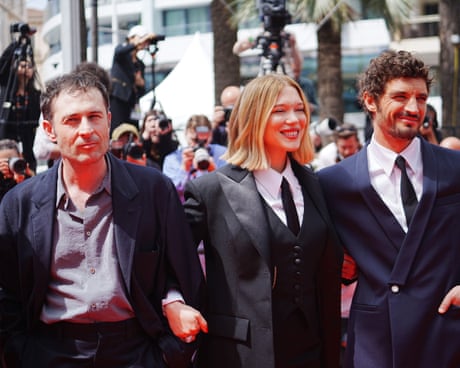
The shadow of Joseph McCarthy’s “red scare” loomed over the storied steps of this year’s Cannes film festival. Echoing the mid-20th-century blacklist, which shut out about 300 suspected communists from Hollywood, the French media group Canal+ announced an effective ban on twice that many French cinema professionals, including actors such as Juliette Binoche and film directors such as Jean-Pascal Zadi and Arthur Harari.Their crime? An open letter denouncing the growing influence on French media and cinema of conservative tycoon Vincent Bolloré, Canal+’s main shareholder.
The Canal+ chief executive, Maxime Saada, justified punishing the signatories on the basis that their claim was an “injustice” against the staff of Canal+ – who were, he said, committed to the organisation’s independence.
Europe punished Russian billionaires over the war in Ukraine. It should do the same to those abetting an ecocidal regime
The ecological disasters of the US-Israel war with Iran are already bad enough. The noxious smoke from bombed oil facilities, spills in the Gulf’s waters, the contamination of farmland and groundwater with toxic chemicals unleashed by explosions and their debris, the millions of additional tons of CO2 spewed into the atmosphere. But as bad as it is, the Iran war hides another conflict: the ecological war that Donald Trump’s US is waging against the rest of the world.
When the EU and UK imposed individual sanctions, travel bans and asset seizures on Russian oligarchs, it wasn’t because most of them were individually responsible for Vladimir Putin’s colonial war of aggression against Ukraine. They were targeted because, as a class, they were viewed by many as inextricable from the apparatus of corruption and levers of power of the Russian state threatening global stability.
Alexander Hurst writes for Guardian Europe from Paris. His memoir Generation Desperation is out now
We’re being sold a world where there’s no room for reflection or spontaneity. This is the Black Mirror stage of capitalism
How fast do you have to strike a match to get it to light? Not the chemistry of the ignition, but the actual speed, in metres per second, that the little piece of wood and its bulbous head have to move to spark the chain reaction behind the flame.
It was a question born of insomnia. And there, in the dark,I did the thing you’re not supposed to do, if your goal is to fall back asleep: I opened my phone. Before I knew it, 3am had become 5am. I learned about the composition of the friction strip (red phosphorus, pulverized glass), and of the match head (potassium chlorate, antimony trisulphide, wax), and that a safety match struck against anything else will not light. I found slow-motion videos of a match strike captured at 3,500 frames per second. But nothing about the speed.
Alexander Hurst writes for Guardian Europe from Paris. His memoir Generation Desperation is out now
Drop into any of the French capital’s ‘third places’ and you’ll find food, culture, community – and an antidote to the disaffection extremists feed on
Paris’s success in removing cars from its streets has been more widely praised than its progress in opening up mixed-use spaces. But the city’s enthusiasm for bringing what urbanists call “third places” to life is exactly why I found myself, just hours after voting in the first round of Paris’s municipal elections, dancing in telecoms company Orange’s former offices in Ménilmontant, the “seventh-coolest neighbourhood in the world”..
The building currently housing Print, a new pop-up, offers a breathtaking view of the Eiffel Tower, poised against the sunset – and, for now at least, it is an ephemeral temple to Millennial culture. It’s a five-storey space hosting photography exhibits, a coffee shop, sourdough pizza, two bars, a red-lit and mirror-adorned dance area and a sunset terrace. As well as pizza and fancy coffee, you can buy hoodies and art and design books – but most importantly, Print contains plenty of space where you can just be, without needing to spend a single euro.
Alexander Hurst writes for Guardian Europe from Paris. His memoir Generation Desperation is out now
From hefty literary magazines to thriving newspaper kiosks and book sales, the French publishing industry refuses to let printed matter die
It took me nine months of 20-hours-a-week French language instruction, and the mycelial network of a year spent in Strasbourg, to feel courageous enough to walk into a bookshop to buy something more challenging than Le Petit Prince. I was immediately humbled: there was an entire new universe, just barely linguistically accessible, and I had no idea who was who, who was writing what or what might interest me.
A year later, I came back to France for graduate school after an 11-month interlude working for an NGO in southern Chad, still feeling like an intellectual toddler in my now two-year-old second language. During the first week of courses, I asked a highly bilingual classmate where in the French media landscape I could find long-form narrative reporting with a literary edge – something comparable to the New Yorker. “You have to read XXI,” he told me, and then a few days later brought me a copy.
Alexander Hurst writes for Guardian Europe from Paris. His memoir Generation Desperation is out now
Back then, France punched above its weight when it came to tech. The EU needs it to rediscover its taste for the cutting edge
In the 1960s, France became the third country, after the US and Soviet Union, to independently place a satellite (Astérix) into orbit, and the only country to send an animal into space and – crucially, for Félicette the catstronaut – bring it back alive. A decade later, the Franco-British Concorde flicked passengers across the Atlantic in three and a half hours and the TGV began to propel them through the countryside first at 250km/h (155mph), and then 320km/h. Then, in the late 1980s, the French space agency designed a crewed spaceplane, Hermès, that corrected for the Nasa space shuttle’s vulnerability by being integrated into its launch vehicle rather than perched atop it.
A concerted buildout of nuclear power left France with one of the least carbon-intensive economies in the world. And then, of course, there was the Minitel. More than a decade before anyone was typing “www” into their web browsers, French users were able to buy train tickets, check film showings, do their banking, play games, find recipes, read their horoscopes, or even log into, yes, erotic chats – la messagerierose, as it was known.
Marine Le Pen’s party is concocting plans to replace a vital, vibrant arts scene with a retrograde movement that would glorify the country’s past
Should you judge the quality of a film based on how many people have been to see it? It’s the type of argument you would expect to hear in the context of the “culture war”; but is it what you would expect to hear from French culture warriors? From a country that uses language quotas to maintain its musicians on broadcast media, has fought to promote its language abroad and has always seen itself as a place that radiates art outwards? After all, this is a country that put on an opera for the 2024 Olympic closing ceremony.
Enter Sébastien Chenu, vice-president of Marine Le Pen’s far-right National Rally (RN). Chenu advanced the box-office success argument as a reason for his party’s proposal to eliminate, Doge-style, France’s National Cinema Centre (CNC) – the public body that subsidises almost every nook and cranny of the country’s heavy-hitting film industry. Let the market take over? Quality as a derivative of quantity? If the RN is perfectly happy to surrender Audiard for Avengers 18 (or whatever), why not apply the logic elsewhere as well?
Alexander Hurst is a Guardian Europe columnist. His memoir, Generation Desperation, is out now
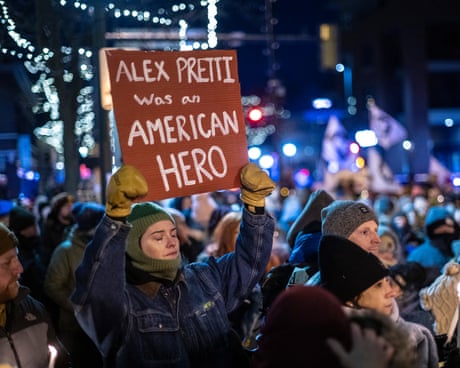
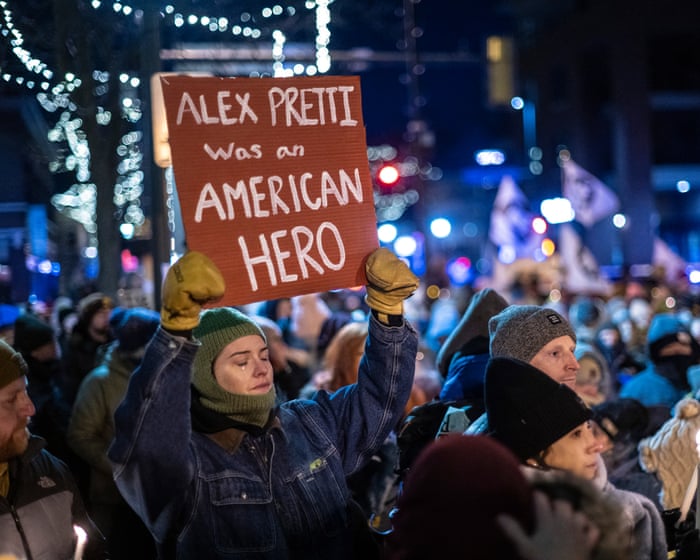
Alex Pretti had courage and empathy. This, not Maga’s conception of male power, is what we must teach young men
The first thing that grabbed me about the Rapture’s 2011 song It Takes Time to be a Manwas the warbly, analogue fuzz of its recurring guitar and piano riff. Once that drew me in, what kept me listening were the lyrics’ hard-marriage of masculinity and empathy. In the final verse, Luke Jenner tells us that: “Well there’s room in your heart now / for excellence to take a stand / And there’s tears that need shedding / it’s all part of the plan”.
For the past year, rightwing voices have waged war on empathy. According to Elon Musk, empathy is “the fundamental weakness of western civilisation”. Others go further, calling it “toxic”, “suicidal” and even “sinful”. Certainly, the macho wing of the Maga right sees no place for it amid its (mis)appropriation of medieval history and imagery that is visible everywhere from the face paint and horned headdress of the “QAnon shaman”, convicted for his role in the US Capitol siege,to the tattooed arms and body of Donald Trump’s secretary of war, Pete Hegseth.
And yet, consider the ideal of chivalry held by medieval knights: generosity and suspicion of profit, courtesy, honesty and the bind of your word, hospitality, abiding by the rules of combat and granting mercy to your adversary – whose life a knight takes only as a last resort. I say this not because I think the medieval knight should be the new standard for modern men, but to point out that Maga men would fail, miserably so, to live up to their own ideals.
Alexander Hurst is a Guardian Europe columnist. His memoir, Generation Desperation, is published in January 2026
Do you have an opinion on the issues raised in this article? If you would like to submit a response of up to 300 words by email to be considered for publication in our letters section, please click here.
In the US, comedy has long filled the space vacated by partisan news media. Now France is following its lead
Sometimes the freedom and openness of comedy means it is better able to respond to world events than news media. Take South Park’s raucous, unhinged and visually disturbing depictions of Donald Trump – most recently, cheating on Satan (who is carrying his spawn) with JD Vance in the White House. Fair enough: Trey Parker and Matt Stone very much own this terrain.
But there’s no reason why satirical TV programmes such as The Daily Show should have to take on the role of news provider, investigative journalist and critic. And yet, over the past three decades, the failings of the US corporate media to adequately cover the country’s dilapidated politics has pushed people such as Jon Stewart into filling the void.
The problem was identified as long ago as 2000 by the US economist Paul Krugman. He castigated the press for being “fanatically determined to seem even-handed”, to the point they were unwilling to call out outrageous untruths. “If a presidential candidate were to declare that the Earth is flat,” Krugman wrote, “you would be sure to see a news analysis under the headline Shape of the Planet: Both Sides Have a Point.”
It was this context that provided American satire’s cathartic triumph in the first years of the 21st century. The Daily Show began conducting harder-hitting interviews than most primetime TV shows. Stephen Colbert rose to prominence by playing a fake conservative talkshow host, in an open parody of Bill O’Reilly’s mid-2000s show on Fox. And then John Oliver pioneered “investigative comedy”, frequently doing a better job of breaking scandalous stories than the news programmes he was satirising.
Alexander Hurst is a Guardian Europe columnist. His memoir, Generation Desperation, is published in January 2026
How do you retain a space of democracy in a world that is reverting to violent conquest? By building a protective moat of federalism around it
‘He keeps encouraging me … to choose between Europe and the US. That would be a strategic mistake for our country,” Keir Starmer said in response to Ed Davey’s question in the House of Commons last week, about whether a US move against Greenland would mean the end of Nato.
What about Europe, though? As Danish and Greenlandic ministers prepared to face JD Vance in the White House, the question was would Europe finally choose between Europe and the US? Will its leaders have the courage to tell the full truth – that the US isn’t simply abandoning its allies and destroying the international order but is now in the position of active and hostile predation by force – and more importantly, to act on it? To offer Denmark moral and material backing, and Greenland a future of self-determination and membership, rather than subservience to US resource plunder?
Donald Trump has already set the tone by saying the US will seize Greenland “one way or the other”, and no part of the triumvirate around him is trying to hide their imperial intentions any more. Not the nepotists and grifters amassing ever greater private fortunes. Not the white supremacist ideologues drawing inspiration from Ein Volk, Ein Reich, Ein Führer! to post “One Homeland. One People. One Heritage”, via official US government social media accounts. Not the techno-nihilists salivating to mine every bit of Greenland’s mineral resources and rule their own neofeudal city states on its coast.
When Trump says that the only constraint on his exercise of power is “my own morality”, that means there is no constraint. Like Vladimir Putin, he will keep grabbing until someone imposes a limit on him.
Alexander Hurst writes for Guardian Europe from Paris. His memoir, Generation Desperation, is published this month

 Anmelden