As archaeologists find treasure trove along new floodplain, conservationists say another Nova Kakhovka would be ecocide
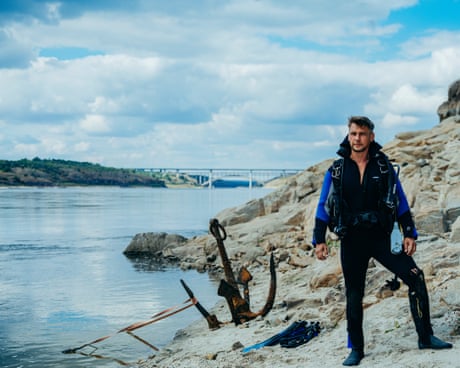
On a warm September day, a group of underwater archaeologists and researchers were boiling water for tea on their campfire on the banks of the Dnipro River, tents pitched on the sandy shoreline. They were three weeks into an archaeological expedition of the waters around Khortytsia – a rocky island 12.5km long and 2.5km wide that lies just downstream of the city of Zaporizhzhia, in south-eastern Ukraine.
High above the island, a Shahed drone whined on its way. A Ukrainian interceptor, and small-arms fire from the ground, tried, unsuccessfully, to bring it down. The archaeologists ignored it. This is life as normal, 28 miles (45km) from the combat zone in Russia’s war on Ukraine.
A Ukrainian publishing boom sparked by the 2022 invasion is now under threat from the force and frequency of Russian attacks
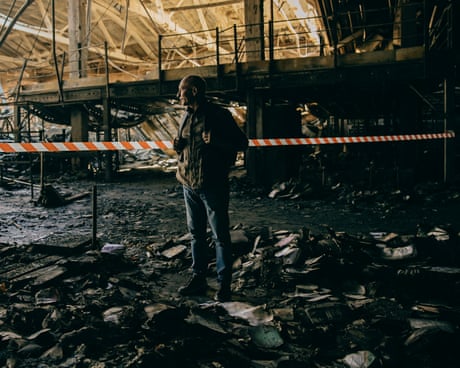
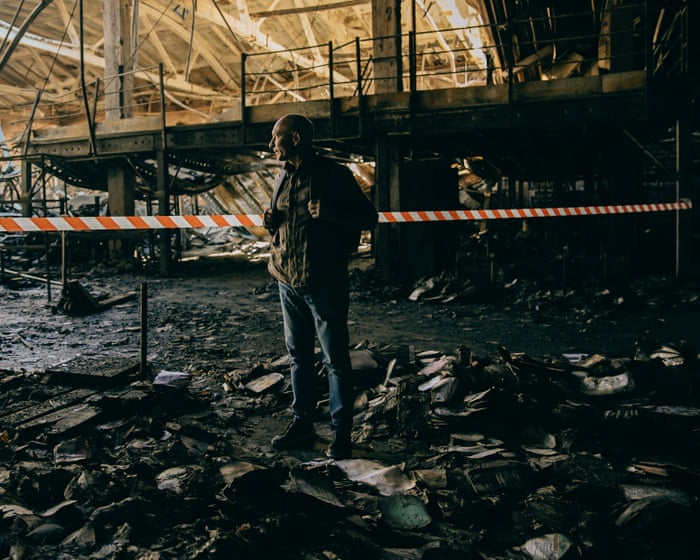
On a Saturday morning in August, Viktor Kruglov, the co-founder and chief executive of the publisher Ranok, was at his headquarters in Kharkiv – the eastern Ukrainian city that, along with Kyiv, is the centre of the country’s publishing and printing industry. Built 15 years ago on the site of a former bread factory, the footprint of the premises is about 10,000 sq metres (107,640ft). Books were stacked 12 metres high on rank after rank of shelves.
Kruglov, along with five senior colleagues, were on the warehouse floor to discuss the approaching school year. The warehouse was holding 628,000 new schoolbooks. “It was the high season of distribution,” he said, “so we were checking all our processes: how to do it more successfully, how to do it in time.”
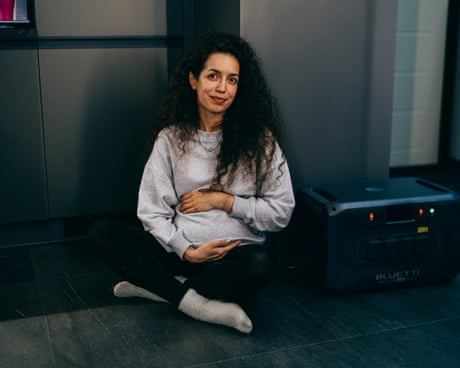
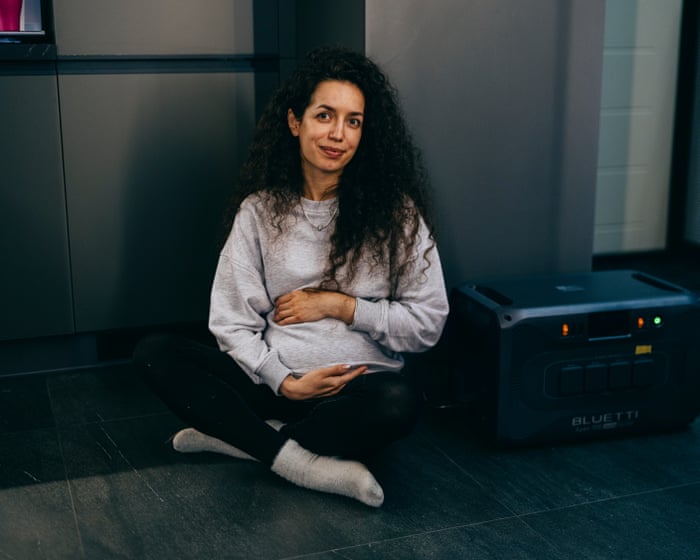
Residents of Ukraine’s capital prepare for power cuts, drones and bitter cold by stocking up on generators, food and ‘dry showers’
It felt like the last day of summer. On a Sunday afternoon in late September, people in Kyiv strolled through the city’s botanical gardens, admiring the late-flowering dahlias. Later, the terraces in the Podil area – a neighbourhood full of bars, patisseries and bookshops – filled up with customers in search of a cocktail.
The idyll was an illusion. As the day darkened, the air defence began its rumble and boom. When a projectile fell with an explosive smack on a bar table, the drinkers flinched and then laughed. It was only a conker from the chestnut tree overhead. Nursing a glass of rosé, writer Myroslav Laiuk talked about the picnic he and his wife had had the previous evening, in a park in the Obolon district – prosecco in proper glasses, cheese and charcuterie. Then a drone was shot down above their heads. Very pretty, he said, with a smile. Shooting stars. Time to make a wish.
Mark Rutte says attack that narrowly missed Boris Johnson and David Petraeus shows Vladimir Putin’s desperation
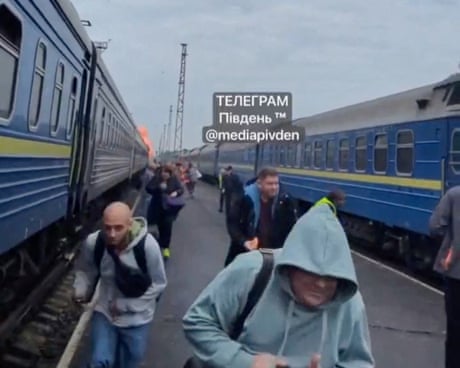
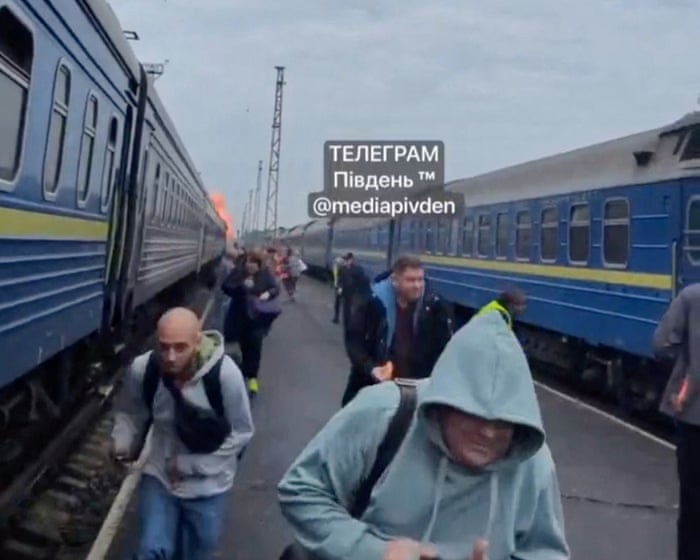
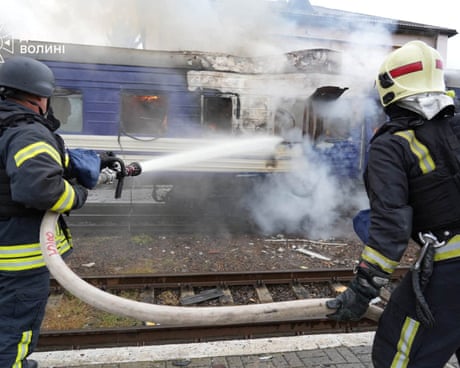
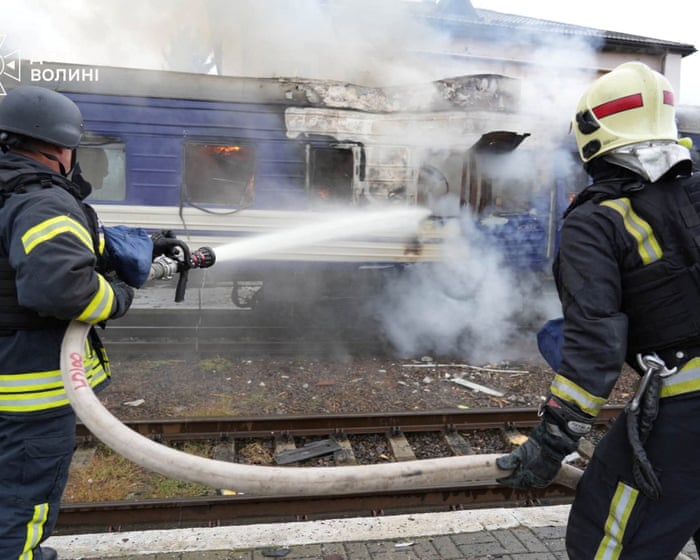
The head of Nato has said a Russian drone attack on a train close to Ukraine’s border with Poland would not deter Kyiv’s western backers.
Mark Rutte said the strike on a passenger train showed how desperate Vladimir Putin had become. “He thinks that he can stops us from supporting Ukraine and that he can undermine our unity. He is wrong. Our answer is to increase support,” the Nato general secretary said.
Ukrainian Railways says former British PM and David Petraeus crossed into Poland shortly before drone attack near border
A train carrying Boris Johnson and the former CIA chief David Petraeus may have been the target of a Russian drone strike that hit a train engine near the Poland-Ukraine border, according to Ukrainian Railways.
Ukraine’s foreign minister, Andrii Sybiha, described the attack as “Putin’s terror knocking directly on the doors of the EU and Nato”.
The tapestry is drawing crowds to the British Museum – and each person who sees it will draw a different meaning from this epic, vivid artwork
I have seen the Bayeux tapestry four times since childhood, and loved it on each viewing, for the sheer miracle of its survival and the glorious vividness of its detail. But the fourth time, earlier this week, was different – how could it not be?
Tapestrymania has taken hold in London. The textile has been proffered as a diplomatic symbol, the occasion for crowned heads and presidents to mingle and speechify. And, assuming you agree that it was embroidered in England by Englishwomen’s hands (since many scholars argue it was likely stitched in Canterburyrather than Bayeux, Normandy – the tapestry’s home),it is charged with the potency of return, rather than simply of arrival.
Fury at Russia’s death and destruction has fuelled art, action and resistance. But eventually, rage’s fire is all-consuming
Twice, I have heard Ukrainians perform Verdi’s Requiem. Once in Lviv, last Maundy Thursday, and once last month, under the great dome of St Paul’s Cathedral in London. In St Paul’s, performed by the Ukrainian Freedom Orchestra with the Philharmonia Chorus, the great Dies irae– “day of anger” – unfurled in an operatic gale of fury, reverberating so powerfully around Wren’s lofty spaces that the music felt like thunder echoing between mountain peaks.
In Lviv, where it was performed by a Ukrainian chorus and orchestra, the evening began with a call to remember the war dead. Lviv’s lay a mile up the road: 153 graves when I first visited in autumn 2022, and by this year more than 1,000. Ranks and ranks of soldiers killed in their 20s, 30s and 40s, each grave planted with flowers and plants, flags flying above. On that occasion, Dies irae – in the more sober acoustic of the Lviv Philharmonic Hall – seemed to contain the furious ache of grief. Certainly I have never heard a more wrathful day of anger.
From killings in Gaza to the alleged use of a sonic weapon on a vigil in Belgrade, the Lebanese-British artist reveals how his work for activist group Earshot is inseparable from his art
Lawrence Abu Hamdan has a double identity. He is an artist who, in 2019, jointly won the Turner prize; and one of his works is, for my money, among the most striking on show at this year’s Venice Biennale. But he is also the director of a young NGO, founded in 2023, called Earshot, which investigates human rights abuses using sound evidence. In less euphemistic language, that means, on occasion, investigating horrific killings. He and his team might analyse the direction and position of bullets Israeli soldiers have fired at emergency workers in Gaza, or build evidence that a sonic weapon was likely used to disperse a mass silent vigil in Belgrade.
The foundational work he did in this field was a project with the London-based research agency Forensic Architecture for Amnesty International. Back in 2016, he interviewed rare survivors of the unimaginably barbaric conditions in Syria’s Sednaya prison. There was a paradox at play in this murderous place – prisoners were held in complete darkness, and enforced silence, killed for making any sound. Listening was both the inmates’ only source of information, and a tool for survival and resistance. Their acute sonic memories of screams of distress and pain; keys turning in locks; bread being slapped down outside their cells; even of lice being snapped – helped Abu Hamdan and his colleagues build a picture of the prison architecture and its conditions, nearly a decade before it was opened to the light after the fall of the bloody Assad regime.
From Homer’s epic to conflicts in Ukraine and Gaza, we can see how poetry fills the gap when ordinary ways of writing or speaking aren’t enough
The biggest sales of poetry since records began are expected this year. The reason? The movies, of course. UK print sales of The Odyssey increased by 1,400% in the four weeks to 25 July compared with the same period last year. In the US, year-to-date sales of The Odyssey are up 76% so far. Christopher Nolan is doing miracles for Homer – whatever problems one might have with the movie (and Emily Wilson, who made the most popular recent translation, has a few).
Strip out the Odyssey factor, though, and poetry is still doing exceptionally well, driven by writers whose work is often mildly denigrated as “Instapoetry”, such as Lucas Jones. His is a kind of versifying that delivers immediate uplifting aphorisms rather than either the kind of dense, allusive play with language that might reward repeated reading; or the sort of limpid, performable music that propels a well-translated Homeric epic. But even so, the poets of Instagram reach for something that can’t quite be expressed through everyday speech. And readers respond to it.
Soon after my first visit to Ukraine four years ago, I began language lessons. It taught me more than I ever expected
Almost as soon as I returned from my first reporting trip to Ukraine, in October 2022, I decided to start Ukrainian lessons. Not as an act of solidarity, exactly, but as a marker that I was committed to returning. I wanted to know some Ukrainian in order to feel less helpless, to edge towards a better understanding of what I was reporting, and to be more courteous to those whom I encountered. And I hoped, in time, to be able to pull myself through a piece of poetry in the original.
I began meeting Olha, my teacher, by weekly video call later that autumn. She was in Ivano-Frankivsk, her home town in the far west of Ukraine, I was in London. With endless patience and humour, she led me by the hand through the unfamiliar letters of her language, those elegant, sensuous shapes of the Cyrillic alphabet.
There’s no denying the power of the film on the big screen. But how far should modern moral sensibilities influence adaptations of classics?
Everyone knows how dumb it is to be this person: the one who mourns the film adaptation of a favourite text because it misses out this scene, or misreads that particularly beloved character, or has a slightly “inauthentic” take on some detail. Of course I’m talking about Christopher Nolan’s film adaptation of the Odyssey, a poem I have loved since I was a teenager. I enjoyed the movie, in common with a huge number of other people. It seems remarkable, even dizzying, that the adaptation of a nearly 3,000-year-old poem took $264m (£196m) at the box office over its opening weekend, has sent translations of the Odyssey surging up the bestseller charts, and is sold out (for instance) at London’s BFI Imax screen deep into September. We are living in an Odyssey time, amid an Odyssey frenzy.
There is no point trying to be a purist about a beloved classic text. Whoever reads the Odyssey, including Nolan, inescapably does so through the prism of their prejudices, informed by the conditions of their own place and time. Since the Odyssey is the result of decades, maybe centuries, of non-literate oral poets working with memory and improvisation, there’s no precise “original” place or time to return to, anyway. But what I can’t help doing is observe the choices Nolan has made and think about their consequences – because there are always divides in the road, paths not taken by any adapter.
Christopher Nolan’s take on the Odyssey is set to break box-office records. What made the director so determined to adapt the ancient Greek epic? And why does a poem from 600BC hold a vice-like grip on pop culture? Warning: contains 2,600-year-old spoilers
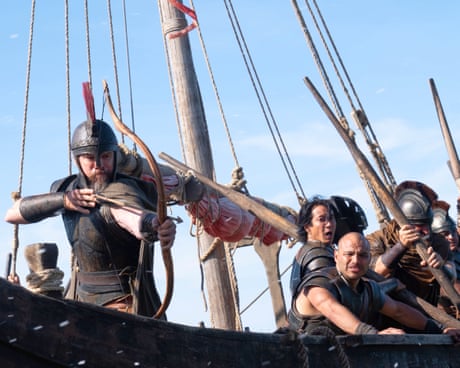
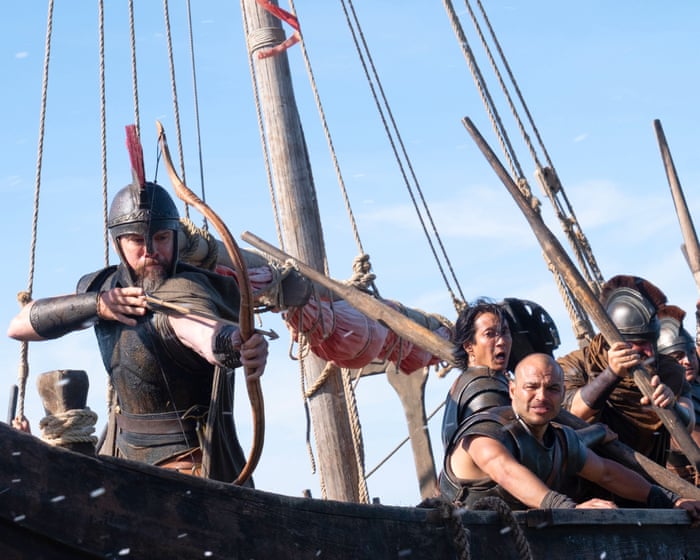
Christopher Nolan’s Odyssey movie has all the hopes of a summer blockbuster pinned to it, and all the promise – as the trailers have showed – of magnificent effects, shocks and thrills. You will be taken inside the cave of the terrifying one-eyed giant, the Cyclops Polyphemus, who likes to dine on human flesh. You will visit the dim and misty shores of the land of the dead, where no warm-blooded human should ever tread. You will flee the pounding tread of cannibals. You will be tossed on stormy seas sent surging by vengeful gods.
And all of this spectacular adventure, for sure, is part of the Odyssey, one of the first great works of world literature, which was written down soon after the Greeks acquired the technology to do so, probably in the 600s or 500sBC. The ancient Greeks attributed the poem to a man called Homer, often described as a blind bard from the island of Chios.
In the midst of unexploded Russian rockets and buzzing drones, Ukrainian winemakers are keeping vines and hope alive
As winemaker Mykhailo Molchanov pottered about trimming foliage from his vines on a warm early-summer day, his dog Direktor at his heels, it was hard to imagine a more idyllic scene.
The Molchanovs’ organic vines are planted directly into the richly biodiverse grassland for which southern Ukraine is renowned – hence their label’s name, Steppe Wines – amid the silvery feathergrass and wild salvia.
There are images that flicker in the mind before sleep: the loss, the resilience and then the strange mundanity of it all
What was it like? Is the question I am often asked when I return from working in Ukraine, where I have been travelling regularly since 2022. There’s an understanding implicit in the question that the answer will not – not quite – lie in the accumulation of reporting. For good reasons the reporter keeps her eyes steady and focused outward, collecting the essential information, conveying it as clearly and smoothly as possible. The reporter reins in and disciplines her subjectivity, while, ideally, recognising its existence and understanding its contours. The reporter knows that the facts of the matter are the thing.
At the same time, feelings and impressions cannot wholly be untangled from the facts. Feelings are inevitable, if you are functioning as a human in any sense at all. They are the tentacles of empathy that reach out in an attempt to understand people and situations. Feelings have an epistemic role – a part to play in acquiring knowledge. Nevertheless, they must be tidied into the background. Respect for your readers and your subjects demands it; the rituals and rules of journalism demand it.
Charlotte Higgins is the Guardian’s chief culture writer
Ukrainian Lessons by Charlotte Higgins (Cape, £22) will be published in August. To support the Guardian, order your copy at guardianbookshop.com. Delivery charges may apply
Ukrainian Lessons: Art in a time of war with Charlotte Higgins and guests
On Wednesday 30 September, join Charlotte Higgins and our panel of acclaimed Ukrainian writers to reflect on the profound connections between war, art and life. With Olia Hercules, Sasha Dovzhyk, Olesya Khromeychuk, and Shaun Walker. Book tickets here
Do you have an opinion on the issues raised in this article? If you would like to submit a response of up to 300 words by email to be considered for publication in our letters section, please click here.
People have absorbed violence and terror into their lives. Somehow, they keep going – quietly rescuing, evacuating, replacing, mending, adapting … and sometimes saving tiny animals
It was a glorious balmy night, and I was walking home from dinner. I’d just eaten fried red mullet from the Black Sea on a pavement terrace, listening to the cries of the last swifts as darkness crept over the city. A couple of blocks from where I was staying, there was a curious sight: a couple and their dog were standing over a hedgehog, which was standing seemingly irresolute in the road. I wasn’t sure the couple were doing the right thing by shining their phone torches at the poor creature, but their intentions were clear enough: they were trying to protect it and chivvy it out of the way of the traffic. As a car bore down, I flung myself into the street, like a latter-day Roberta from The Railway Children, and waved my arms to get the driver to stop. At the same time, the couple’s dog gave an encouraging bark to the tiny animal, which scuttled across to the opposite pavement, and into the safety of a yard.
Everything always feels heightened in Kyiv, and I was apt to overthink into this moment many metaphors of escape, protection and destruction. Hedgehogs, by the way, are a surprisingly common sight in Kyiv. So too are the “hedgehogs” made from metal beams welded together in a three-dimensional star-shape, a highly effective obstruction for tanks. (The other favoured tank obstructors are known as “dragon’s teeth”, because of their resemblance to monstrous molars rising from the ground.)
First lady and affected families in audience for highly charged performance of excerpts of Mothers of Kherson
It was hard to imagine an opera with a subject more potentially traumatic – or cathartic – for the assembled audience. The occasion, in the grand and gilded spaces of the National Opera of Ukraine, in Kyiv, was the premiere of excerpts of Mothers of Kherson, an opera about the abduction of Ukrainian children by Russian occupiers – a continuing, raw story of real-life loss and agony.
The opera was originally intended to be about the Maidan protests of 2013-14. But the American librettist George Brant, the author of the hit play Grounded, switched course in 2023 when the stories of abducted children hit the news.
Visitors flock to Book Arsenal in Ukraine’s capital as wartime writing takes centre stage
It was a literary festival, all right, but if your reference for such things is Hay-on-Wye and Edinburgh, or Melbourne and Sydney, or New York and Washington DC, then at Kyiv Book Arsenal you might think you had slipped through a crack in the universe and landed in an alternative reality.
For a start, they were so young, the audience members. Dressed in their considerable best, they clutched their bags of books bought directly from publishers’ stalls and stopped to hug their friends – the festival providing the perfect opportunity for a people-watching passeggiata through its venue, the city’s vast 18th-century military arsenal.
On Monday night residents faced the third heavy assault on Ukraine’s capital in less than a month, as Putin appears to be trying to take advantage of a shortage of US-made air defence systems
In the northern residential suburb of Vynohradar – a district of modest apartment blocks – residents were quietly and calmly getting on with salvaging, clearing and dealing with what remained of their apartments after Monday night’s massive missile attack on Kyiv. Dozens of rockets and hundreds of drones had been let loose on the city, leaving five people dead.
A woman drinking coffee in her apartment, which was damaged in the night attack on the UNIT.City residential complex
Russia’s recent assault killed two people, injured 90 more and significantly damaged many of the capital’s museums
For four years, Vitalina Martynovska and her team had been working on a complete transformation of Kyiv’s National Chornobyl Museum.
The new sleek displays were designed to tell a fresh story about the reactor explosion of 26 April 1986 – the most serious nuclear accident in history, a factor that contributed to the collapse of the Soviet Union, and an event that continues to shape Ukraine’s identity today.
The decline of the glossy magazine industry as depicted in the sequel made me cry – but I shed no tears for how it was back then
I didn’t think The Devil Wears Prada 2 would make me cry, but it did. All the fashiony high camp, all the sharp one-liners of the first movie (“By all means, move at a glacial pace, you know how that thrills me”) deliquesce into melancholy for a struggling media industry in the second film. We meet the older Andy Sachs (Anne Hathaway) – the put-upon assistant of Runway editor Miranda Priestly (Meryl Streep) in the original movie – when she and her newspaper colleagues are receiving an award for investigative reporting. Except that at precisely that moment they are laid off, by text message. Perfectly realistic: swathes of the Washington Post, including Pulitzer finalists and correspondents in war zones, suffered a similar fate (in this case, sacking by email subject field) in February.
I didn’t think it would make me feel so nostalgic, either. The original Devil Wears Prada came out in 2006. Watching this thinly disguised portrait of American Vogue then was fun. I had served my apprenticeship at Condé Nast, at British Vogue and The World of Interiors, and I felt some vague kinship with Andy and her terrible blue jumper, who arrives a sceptic, goes native, then leaves for her true calling at a progressive newspaper. But now, 20 years on, other feelings crowd in. As my former Vogue colleague Louise Chunn wrote in the New Statesman recently, in the 1990s we had no idea we were working “at the high watermark of the circulation and power of the glossy magazine industry”. When those enormous, thick-papered tomes thunked down on our desks at Vogue House (which they literally did, hand delivered) they were so solid, so reassuring, so full of the promise of glamour and gorgeousness, that we thought it would go on for ever.

 Anmelden