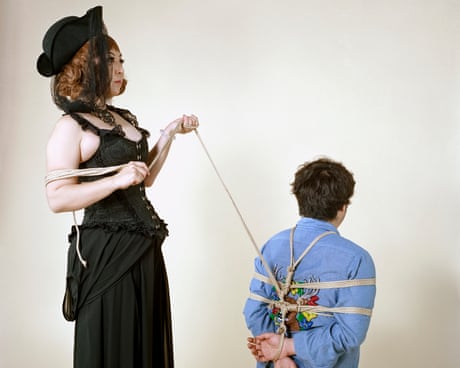
‘Karen is a Japanese dominatrix and “rope artist” who ties up her clients in a way that echoes how samurai bound their prisoners. Clients are mostly men with high-pressure jobs’
Ten years ago, my dad called to say he had found these amazing images hidden under piles of maps and stuff in an attic in our family home in Piemonte, northern Italy. He had come across a leather-bound album of 53 black and white photographs: portraits of Japanese “native types”, reflecting the 19th-century colonial way of representing people, cultures and views of Japan.
It turned out we had a treasure in our hands: it was an album of photographs by Felice Beato, the first foreign photographer to arrive in Japan in 1863 at the end of the Edo period and on the eve of the Meiji era.
Bourse de Commerce, Paris There are 700 works from François Pinault’s collection on display – more than half of them by Irving Penn – but it’s a blinkered selection and annoyingly didactic
‘Beware … of assuming the sterile attitude of the spectator, for life is not a spectacle” scream the words of Aimé Césaire – writ large and bold by Barbara Kruger, in a giant installation, The History of Tears, that fills Bourse de Commerce’s spectacular Rotunda. Kruger’s angry, menacing, viscerally charged work – words as images, and large-scale video clips of people seething with self-hate – is a thrilling setup for Remember Me, an exhibition that promises a take on 200 years of photography through 700 works by more than 70 artists drawn from the collection of the French billionaire François Pinault. That excitement quickly dissipates as the exhibition moves on.
This is the biggest photography show ever held at the Bourse de Commerce. Remember Me has two main problems: first, it tries to say too much with too few artists. For a start, nearly 450 of the 700 or so works are by Irving Penn. It leans heavily on classical, conventional approaches, styles and familiar names, and that creates a very obvious skew in the perception of what photography is, does, and how it is presented.
From Delhi to New York, from the street to the bath house, he has captured clandestine moments, risked his freedom – and even referenced Romantic painters. Ahead of a major show, the photographer relives his landmark shots
‘I’ve been very promiscuous,” Sunil Gupta says, reflecting on his experiments with photography since the 1970s. Gupta, who was born in India, brought up in Canada and moved to the UK in 1978 after two years studying in New York, has documented and described queer lives for five decades. In his work, he’s quietly tried to find new ways of seeing, exploring the potential of photography to blur fiction and reality, public space and intimate, clandestine moments. His work explores the ways we love and relate to one another, set against the ever-shifting tides of politics and society.
He photographs with love – but it hasn’t been without risk. An exhibition in India was once shut down by the government, and in his early days in the UK, when he was working with fellow photographer Tessa Boffin, he recalls curators “physically shrinking away when we walked in the room – two queers in leather were too much for them! But we were quite aggressively upfront with our sexualities, we weren’t shy about it.”
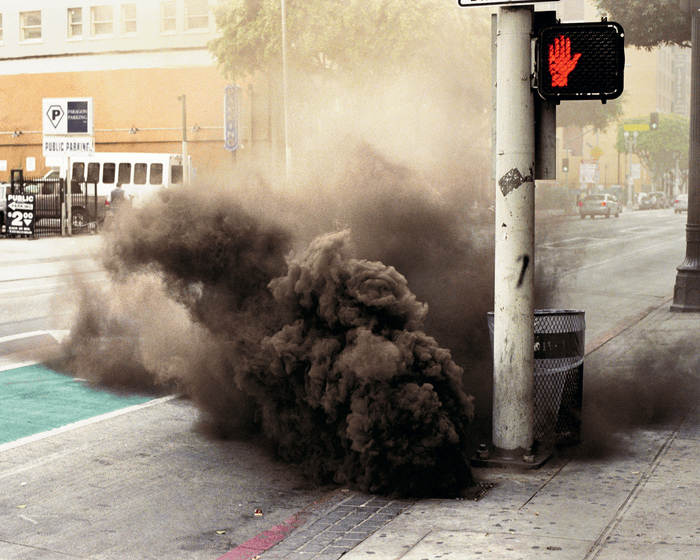
‘The black cloud emerged from a grate in the street. I guess something underground was on fire. It was hilariously cinematic – just one of those eerie, spontaneous things that happen in a city’
This image was taken in 2011 or 2012, just after I had moved to Los Angeles. I was downtown, an area I don’t go to that much, walking around with my camera. Some black smoke started to emerge from a grate in the street – I guess something underground was on fire. It was hilariously cinematic, as if some sort of devil was going to appear. It was really just one of those eerie, spontaneous things that happen in a city. There is a very powerful feeling of surrender when I am photographing. I have to submit to the authority of ignorance when I’m out there.
I grew up in San Jose, which is a sprawling American suburb – there’s no city about it. I came to LA because I was depressed where I lived, and I had just met my future wife, who didn’t want to live in San Jose either. LA is not really a city, it’s hundreds of places. You can drive 15 minutes and be in a completely different environment – the beach, the mountains. There’s a weird sentience to the city, if you let it take you. I get an inexplicable desire to just get in the car and go.
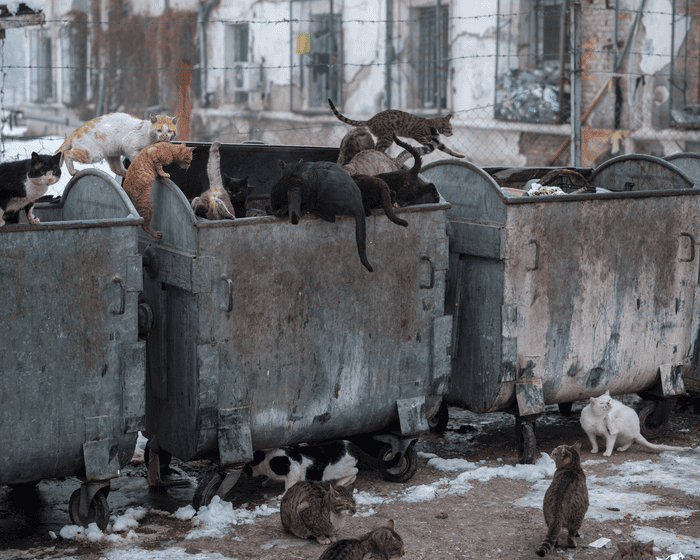
‘The men in this jail in Bulgaria used to adopt these stray kittens. But pets can be a problem. They get killed as punishment or for revenge’
Belene prison, in northern Bulgaria on the border with Romania, is the most heavily guarded facility of its type in my country. It is on an island, so escape is near impossible, and has the largest number of people serving life sentences for murder in any Bulgarian prison.
This image describes a sad, terrible story. There are a lot of stray cats on the island, as well as pigeons and mosquitoes. The prisoners used to adopt stray kittens and keep them as pets. When I started my project, For the Grace of God, at the prison, many prisoners had pet cats. But in a prison, this can become a problem – prisoners kill each other’s pets as punishment or for revenge. So now it’s forbidden. It’s even the same with flowers – some think of the flowers as friends, they nurture and grow them in the sun, but then other prisoners destroy them. Anything a prisoner can create a relationship with can be destroyed. Part of their punishment is to be alone, without any family, or any attachments to anything.
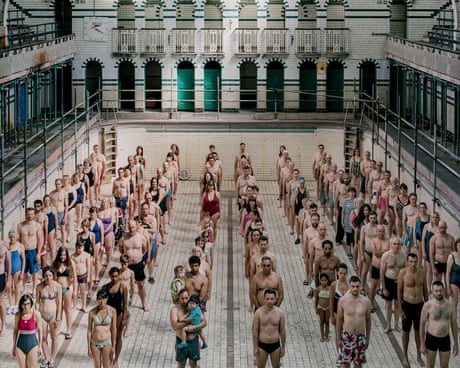
‘I was thinking about the Terracotta Army when I took this shot of Birmingham swimmers in their local pool, which faced closure. They had to stand there for an hour, waiting for the sun to come out’
I took this image in Birmingham on 20 July 2014 – part of my first professional photography project. I had moved to the city in 2013 and I would pass this building every day on the bus on my way to the city centre. I remember looking at the facades and being impressed and intrigued by the three different entrances – what were once the first class, second class and women’s entrances.
One day I decided to get off the bus and find out what the building was. The door was open, and a nice lady welcomed me in and started to explain its history. It is the Moseley Road Baths, an Edwardian-era community building. In 2014 the second pool was still operating but the gala pool, where I took this image, was already empty. The building was in need of restoration and, without funding, the council planned to shut it down for good. The woman I met there told me lots of stories about the place – people who had come to learn to swim, how it had served as a casualty station during the second world war, and how it had even been used as a dance hall. It was a very charming place with an incredible history: as soon as I saw the gala pool, I knew I had to fill the majestic empty space.
‘Manal suffered severe burns to her arms and face after a missile explosion in Iraq. Yet in many ways she seemed just like a regular young girl’
When I started to take photographs about 18 years ago, I was more interested in the aesthetics. Then came a moment when I realised the power of the camera as a tool. On 3 October 2013 there was a huge shipwreck off the coast of Lampedusa. More than 250 migrants from Eritrea lost their lives. I was sent to cover the event, and it was during that assignment that I understood I was interested in telling stories about social injustice, about people’s lives post-conflict.
At first I worked mostly on stories about refugees in Sicily, where I am from, but a few years later I had the opportunity to travel to the Middle East with a friend, the journalist Marta Bellingreri, who is an expert on the region. She was living in Jordan and I joined her there for six months . That is how our project, The Hospital of All the Wars, about the patients at the Médecins Sans Frontières Al-Mowasah hospital in Amman, began.
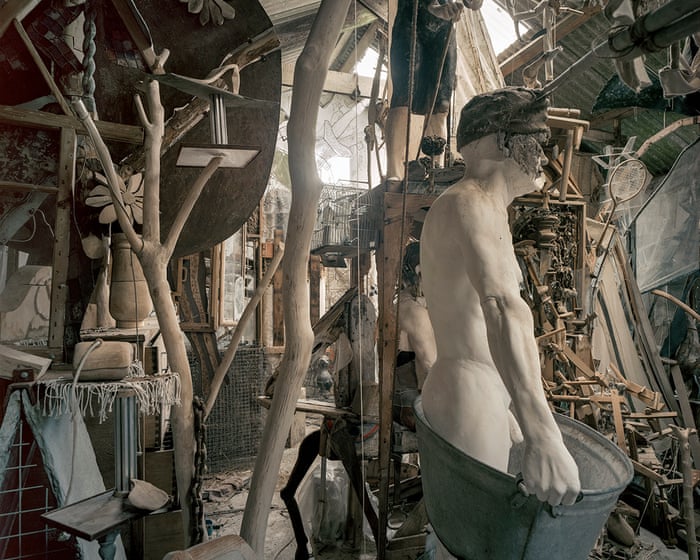
Ray Exworth spent his life filling Cornish sheds with breathtaking sculptures – but wouldn’t let anyone in to view them. Now, after his death, his secret body of work has been revealed
Ray Exworth spent six decades creating one of Britain’s most extraordinary bodies of sculpture – and almost nobody has seen it. Hidden inside a labyrinth of sheds on a remote Cornish smallholding, his vast, obsessive constructions have remained locked away from the world, visited only by a fortunate few. Even his wife Susie, 92, was largely kept out. “I could not visit without an invitation!” she recalls.
Exworth, who died in 2015 aged 84, had just one major exhibition in his lifetime, at the Whitechapel Gallery in 1975. Since then, the man who might belong among Britain’s most notable artists has disappeared almost entirely. His works – sprawling, intricate and wildly ambitious, assembled from an array of salvaged materials – have remained exactly where he left them: filling seven studio sheds and a scattering of shipping containers, unseen.
It’s the world’s most prestigious photography show, but Les Rencontres de la Photographie really flies thanks to the jaw-dropping work of eccentrics, amateurs and complete unknowns • The best of Arles 2026 – in pictures
On 16 June 1963, a mechanic from Albuquerque named Paul Villa was allegedly invited – via telepathic messages from an alien crew – to photograph their spaceship. The result was an image of the flying object in the sky. Villa’s account is similar to that of a Swiss man, Billy Meier, who saw his first flying saucer aged five, and has taken more than 1,400 photographs of them since. One of Meier’s flying saucer photographs features in the famous poster that hangs in Fox Mulder’s office in the X-Files. Added to Meier’s image are the words: I Want to Believe.
We Are Not Alone: Alien Images is one of the standout shows of Les Rencontres de la Photographie in Arles this year, the world’s most prestigious photography festival. The show draws on dozens of examples from private and public archives that present visual “documents” of UFOs, unexplained phenomena and close encounters with aliens. Most of the photographs were made between the 1960s and 1980s, when reports of UFO sightings were at a peak – and in the US, the place that boasted the highest number of UFO sightings in the last century. Of course, all of the pictures turn out to be the result of rudimentary tricks (dangling a dish on a string in front of the camera), cases of misidentification or uncanny accidents of the analogue film. They might be amateur and faked, but they still pull you in thanks to their fascinating, idiosyncratic storytelling.
P21 Gallery, London Resonant black and white photographs show Palestinian refugees and the sites today of the homes they were forced to leave during the 1948 Arab-Israeli war
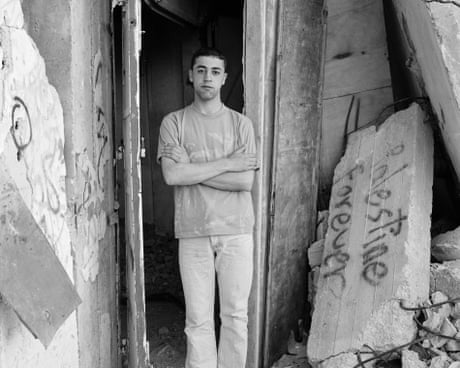
These places were once filled with conversation, smells of cooking, laughter, comfort. Now I’m staring into a silent, rubble-strewn abyss. Eyewitness accounts that accompany documentary photographer Alan Gignoux’s black and white portraits of Palestinian refugees and the homes they were forced to leave refer repeatedly to the abundance that once came from these razed fields – olives, grains, figs, carob and grapes. Where there was life, now there is nothing. The vast losses seem etched into the faces of Gignoux’s subjects, even as they look back at his camera with defiance.
All Gignoux’s subjects have either been exiled by the Nakba – the mass displacement of Palestinians in the 1948 Arab-Israeli war – or are their descendants. They now live in refugee camps in Jordan, Lebanon, the West Bank or Gaza. Gignoux promised each of his subjects that he would to return to their homes on their behalf, and photograph them. The series gives a detailed view of what happened in different villages in 1948, the circumstances under which people left and the repercussions across generations.
National Portrait Gallery, London The actor’s life in pictures, from mousey-haired teen to American icon to her shocking death at 36, beams with the charm that defined a century. But why aren’t we shown more of what lay behind the smile?
I wanted to hate the National Portrait Gallery’s new blockbuster show, Marilyn Monroe: A Portrait. It represents two things that really should be binned: anniversary exhibitions (it marks Monroe’s 100th birthday) and exhibitions of celebrity portraits. Anniversaries rarely signify anything other than the passing of time, which is an inevitable and uninteresting fact of life. As for exhibitions of celebrity photographs – they’re like anniversary shows, only with faces.
And yet … I didn’t quite hate this show, and the reason is Monroe herself. We first see her as Norma Jeane Baker, a regular-looking teenager with mousey brown hair, in a self-portrait taken in a photo booth in 1940. She then becomes the radiant, uncontainable, insanely glamorous film star, cheesecake pin-up and actor seen here in photographs, paintings, and excerpts from her films.
She’s famous for sculptures that seem both solid and liquid. Now she has created a show amidst the ‘downfall of America’ inspired by a phrase from a comedy routine that came to obsess her
A few weeks ago, Roni Horn, 70, was removed from her flight, just before takeoff from the US to Germany. A male steward was so irritated when he asked her to adjust her seat – and she politely refused to move it any further, since it was already as upright as she could get it – that he had the flight stopped and Horn was escorted off, where she gave a report to stunned police. “I was in business class, just for context,” she says.
The artist and writer went back home, to the island on Maine where she lives, and cancelled the first part of her European trip. That was two weeks ago. Then she flew directly to London, in time for her first solo exhibition here in a decade – Seizure of Hope at Hauser and Wirth.
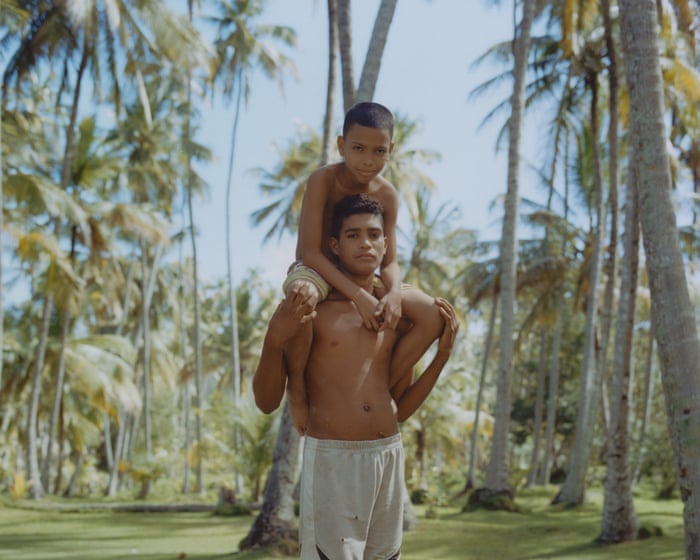
‘I left Venezuela after someone held a gun to my head. But I returned to show what beauty it has – like these two boys coming back from a fishing trip at an amazing beach’
My parents encouraged me to leave Venezuela. The situation in the country at that time, the mid-2010s, had started to get really hard, with food and medicine shortages – and violent robberies were becoming a regular thing. A lot of people had started to leave and my parents were worried that if I stayed something bad would happen. I had already seen my mum robbed and I’d had a gun held to my head, but that was normal. I was lucky enough to be able to go to England. But when I arrived, to study at Huddersfield University, I had the feeling many immigrants have – of not belonging, questioning who I was and where I was from. I understood what I was losing, too, and it hurt.
I remain deeply connected to Venezuela and whenever I go back to visit my parents we always go to the beach. My whole family loves the ocean: it’s how I spent a lot of my childhood. I started shooting there, too, hanging out with kids, spending time with young people and seeing what they were going through, but I also felt I could give something back. The kids had so much fun during those shoots.
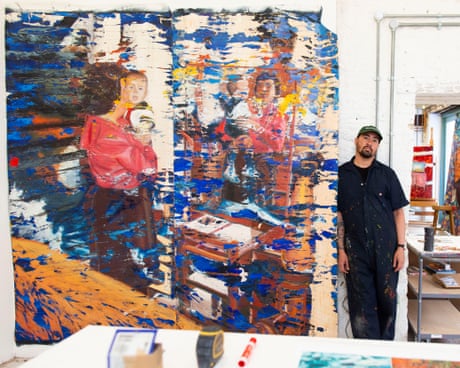
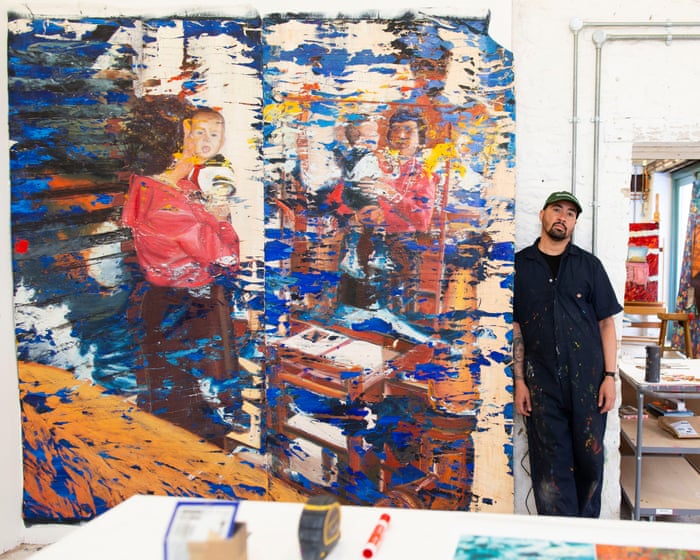
The artist’s dreamlike paintings, inspired by his childhood home, led to an invitation from a global icon. Now he’s opening a casita in Bruton. What will the locals think?
Angel Otero is on the brink of tears. He’s describing the feeling of being part of fellow Puerto Rican artist Bad Bunny’s La Casita – a set the musician used on stage during his 31-show residency on the island last year, a recreation of a typical single-storey home found across Puerto Rico and the wider Latin American diaspora.
“When I was invited, of course, I accepted,” Otero tells me, standing in his temporary studio in Somerset. “Although I tend to shy away from things like that. The replica is a very similar setting to the one I grew up in, and I had multiple feelings when I got there. Of course, there’s the spectacle of being on the stage of a significant artist of our time, who is from my island. But it also transported me into the subject I’ve been working on for so long. It was a sort of validation, seeing people enjoying the culture, people specifically from my kind of upbringing.”
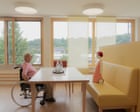
‘The first resident that Emma – a social robot – was introduced to was called Peter. After that, Emma assumed they were all called Peter, which everyone found hilarious. Then she broke down’
One morning in July 2025, I arrived in the small, quiet town of Albershausen in south-west Germany. It has only around 4,000 inhabitants. I went to visit a care home where they were piloting a social robot named Emma. A group of residents sat in a circle while Emma stood in the middle. She’s the height of a toddler, with big googly eyes, and was wearing a red hat knitted for her by one of the careworkers. The first resident she was introduced to was called Peter and, after he introduced himself, Emma assumed they were all called Peter, which everyone found hilarious. Then Emma broke down suddenly and the illusion was shattered.
Later on, Emma was working again, and I found her in the dining room with Waltraud, the resident in this photo. It was a calmer, more focused moment. I decided to sit them across from one another at eye level, Waltraud facing Emma. There was a soft light in the room and they both seemed very present with one another. There are also paradoxes in the picture: the large windows showing the landscape outside, contrasting with the inside, which is ordered and clinical. In the middle you have an encounter between an elderly woman and a machine designed for companionship. They began speaking about picking flowers, about their favourite flowers – Waltraud is passionate about them, and Emma has an endless amount of knowledge due to her artificial intelligence. She can remember past conversations and recognise faces, too.
Jeu de Paume, Paris The peerless chronicler of everyday absurdity did not live to see this exhibition, but it is a dazzling final chapter, showing his irresistible good humour growing darker
I didn’t know Martin Parr very well, but the last time I spoke with him, two months before he died in December last year, he told me about his forthcoming exhibition at Jeu de Paume. He wasn’t subtle in adding that the Guardian never reviewed his exhibitions. I wonder now if he knew that the exhibition, titled Global Warning, would be his swansong. I wonder whether he knew he’d never get to see it.
Parr was always popular in France. It might be because the French loved his ability to mock the English, but in the end Parr mocked everyone, including himself. When his work was criticised in the UK as classist or sneering, Parr could cross the channel and seek refuge in a nation where no one seemed to read his work that way. The show at Jeu de Paume is set to be the museum’s most visited on record.
‘US soldiers would look for “suspected terrorists” in Iraqi homes and usually find nothing. This could be my grandma’s living room – it shows that insane violence can continue amid normal life’
I took this picture during my first time in Iraq, 20 years ago. It was the first entry in a body of work about the US post-9/11, at home and at war, which has occupied a good chunk of my professional life for the last two decades. I had turned 25 the week before and it was a formative journey on a personal level. It was the first time I experienced war, and my understanding of my country and its relationship to the world developed in the crucible of this extremely violent situation, which was descending into civil war while I was there.
I had been embedded in Iraq with the US military for six weeks or so at this point, and had taken some good pictures. But this one was different and it still means something to me today. It was the first I had taken that wasn’t overtly channelling the history of war photography – which largely focusses on violence, horror and victims. Those are important things to show, but I wanted to understand this particular conflict, and how my position as an American of the same generation as those fighting could help me interpret it for the public. I guess the image crystallised something I had seen – this vast machine of military might mobilised in the Middle East; the momentum of all these young men with powerful weapons patrolling cities in search of people identified as enemies of America, enemies of democracy.
★★★★★ / ★★★★★ Photographers’ Gallery, London Gottschalk documents lesbian life in the 60s and 70s, while this year’s Deutsche Börse prize ranges from appalling scenes from women’s prisons to an exploration of invented facts
When Donna Gottschalk came out as gay to her mother, she replied: “You’ve chosen a rough path.” It was New York in the 1960s, homosexuality was illegal and, as the photographer reflects in a video piece included in her new exhibition We Others: “There were no happy gay people.” A photograph of Gottschalk’s mother in the beauty salon she ran in the notoriously crime-ridden Alphabet City appears at the start of the show, in which the images are accompanied by texts by the French writer Hélène Giannecchini, recording the photographer’s memories of the people and events depicted.
Gottschalk picked up a camera at 17, so these pictures also constitute her own awakening, as she accepted her identity and became involved with the Gay Liberation Front. It starts with family. Here is a painfully poignant image of Gottschalk’s sister, Myla, aged 11, the picture of innocence and peace, asleep in bed in the family’s apartment in a tenement building.
From butch alter egos to radical images of motherhood, the photographer rises to the challenge of capturing her community in imposing and glorious style
Catherine Opie has done for butches what Hans Holbein the Younger did for the Tudor nobility. Since she graduated in the late 1980s, amid the Aids crisis, Opie has made portraits of her community, friends and family, adopting unflinching realism, saturated colours, and dramatic tonal contrasts from the 16th-century portrait painters. Many of Opie’s most famous portraits – included in her new exhibition at the National Portrait Gallery – use these devices deliberately, a declaration that these people deserve, as the title of the show underlines, to be seen.
Opie has always been interested in construction – how we can be transformed by costume, posture, pose, role-play. This show is a testament to that, and her love of tattoos, piercings and body modifications (she does live in LA, after all). She’s especially drawn to the performance and presentation of masculinity – in the 1991 series Being and Having, one of the earliest bodies of work in the show and still one of Opie’s best known. She has 13 lesbian friends dress up as their masculine alter egos – Opie also appears as her own, Bo. They don a range of fake moustaches and are photographed close, so their faces fill the frame against an egg-yolk yellow background, the glue attaching the hair to their faces clearly visible. Their nicknames are engraved into name tags, like they’re trophies.
‘The Peugeot 103 is iconic in Morocco: a symbol of social mobility. But my rider, a living sculpture, is so overstimulated he can’t choose which way to go – and ends up going nowhere’
This image, Parabomobile, shows a living sculpture I created. A man is riding through the desert on a road near Marrakech that is still partly under construction. He rides a Peugeot 103 motorcycle and carries 21 satellite dishes – each pointing in a different direction. But the person driving the motorbike is so overstimulated, he cannot choose which way to go – and ends up going nowhere.
It is part of a wider multidisciplinary project, Paraboles, that is an inquiry into Moroccan people’s identity, our imagination and the way we see the world. It can feel to Moroccans – and those in other postcolonial countries – that their minds have been colonised as well as their land.

 Anmelden