❌

Lese-Ansicht

‘We now live without this violence’: the Colombian farmers giving up coca for palm oil

Subsidies and a crackdown on armed groups are helping smallholders rebuild their lives, leaving behind decades of conflict and fear

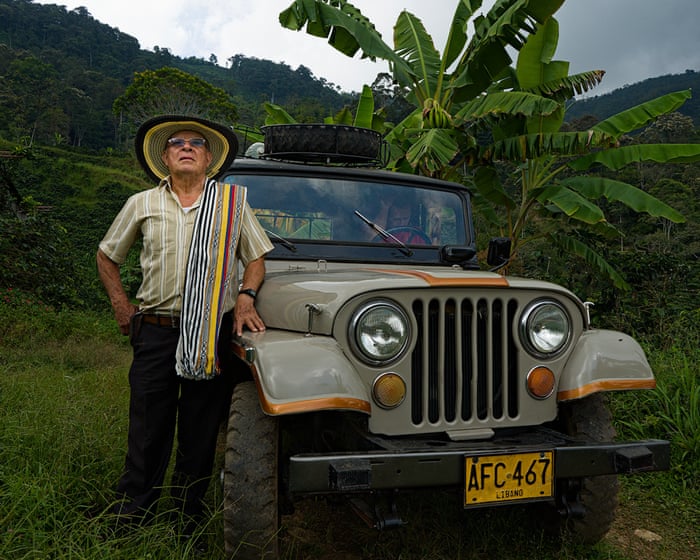
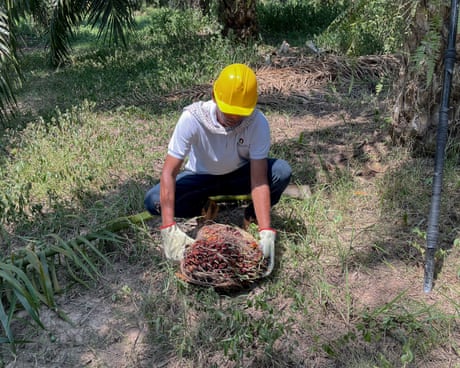
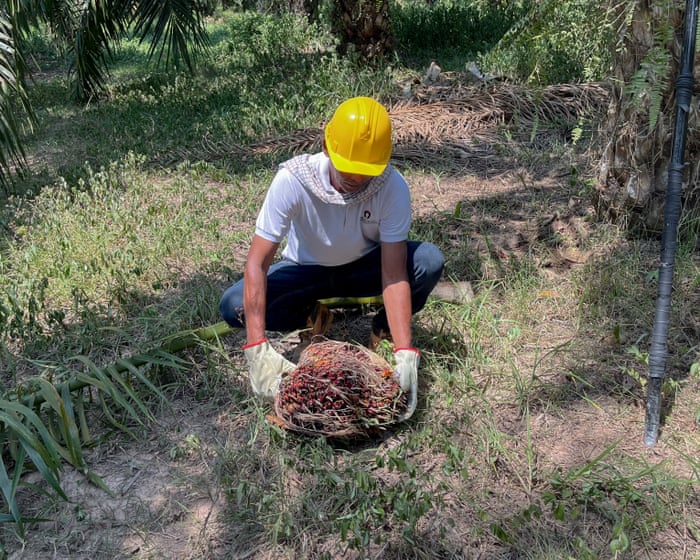
Surrounded by towering oil palm trees on his farm in the small village of Caño Barbú, near San Pablo in northern Colombia, Yoger Payares uses a malayo – a pole-mounted iron tool with a hook – to hack at the fronds of one, freeing a bunch of its vibrant reddish-orange fruit so it falls to the ground.

Today, Payares proudly works in the oil palm industry. But for more than a decade, just yards away, he grew coca leaves, becoming embroiled in the illicit industry in 1990 after leaving his job as a cattle farmer.

Continue reading...
© Photograph: Suzanne Bearne
© Photograph: Suzanne Bearne
© Photograph: Suzanne Bearne
  •  

Invisible poison: living with mercury pollution in the Colombian Amazon – in pictures

Rainforest communities face a silent crisis as mercury from gold mining contaminates their food and water

Continue reading...

© Photograph: Luis Bernardo Cano/Luis bernardo Cano

© Photograph: Luis Bernardo Cano/Luis bernardo Cano

© Photograph: Luis Bernardo Cano/Luis bernardo Cano

  •  

Why farmers see Colombia’s knife-edge election as a battle for the Amazon’s future

Many small-scale landowners now include conservation measures alongside everyday farming. But progress is precarious, and the threat of guerrilla violence and poverty remain whichever candidate wins

Like most people settling in the area, Pablo Peña was seeking to escape violence and make a living from a patch of land when he moved to Guaviare in central Colombia. While his life has been strongly marked by conflict and deforestation, more than 30 years on he now focuses on community work and conservation.

Peña first visited Guaviare during his mandatory military service. Years later, in 1994, he settled down to farm in Guaviare’s Calamar, a town in a remote corner of the Amazon.

Continue reading...

© Photograph: Antonio Cascio/The Guardian

© Photograph: Antonio Cascio/The Guardian

© Photograph: Antonio Cascio/The Guardian

  •  

‘This is what I was born for’: the drought-ridden Colombian town that took on Coca-Cola Femsa – and won

While La Calera faced severe water rationing, local springs were being drained by the drinks giant’s franchise. So the residents fought back

When a severe drought struck La Calera near Bogotá, many of its residents lost their water for drinking, cooking and farming and faced up to 15 days of strict water rationing each month. Yet the area is home to Chingaza reservoir, which supplies about 70% of the drinking water for Colombia’s capital.

As the drought stretched from April 2024 to April last year, people began to look more closely at how their water was being managed.

Continue reading...

© Photograph: Alfie Pannell/The Guardian

© Photograph: Alfie Pannell/The Guardian

© Photograph: Alfie Pannell/The Guardian

  •  

Could gold mining help Colombia’s armed groups to finally lay down their weapons?

In Nariño, guerrilla groups are swapping arms for legal mining as part of the country’s peace accord. But as presidential elections loom, armed rivals and delays threaten to derail progress

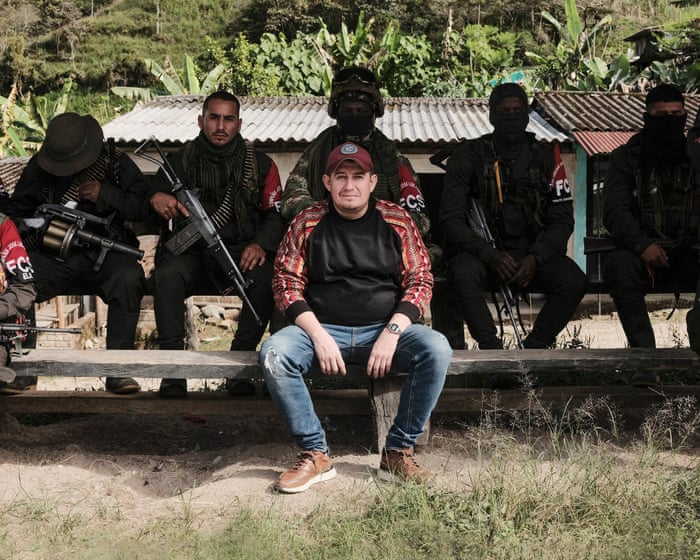
Dressed in civilian clothing with Pasto Indigenous motifs across his sleeves, Royer Garzón, a guerrilla commander and delegate at the peace negotiation table, sits alongside about two-dozen combatants on a small stand beside a concrete sports field in one of Nariño’s state-recognised Indigenous collective territories in Colombia.

Most wear military fatigues and rubber boots, matching a huge red-and-white banner reading FC Sur-ELN – Frente Comuneros del Sur, or National Liberation Army, the guerrilla group they once belonged to – an identity they have not lost.

Members of Comuneros del Sur. The group is estimated to have about 250 fighters in the Nariño department

Continue reading...

© Photograph: Alex Kemman

© Photograph: Alex Kemman

© Photograph: Alex Kemman

  •  

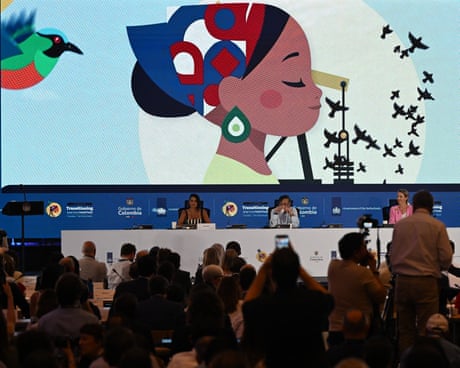
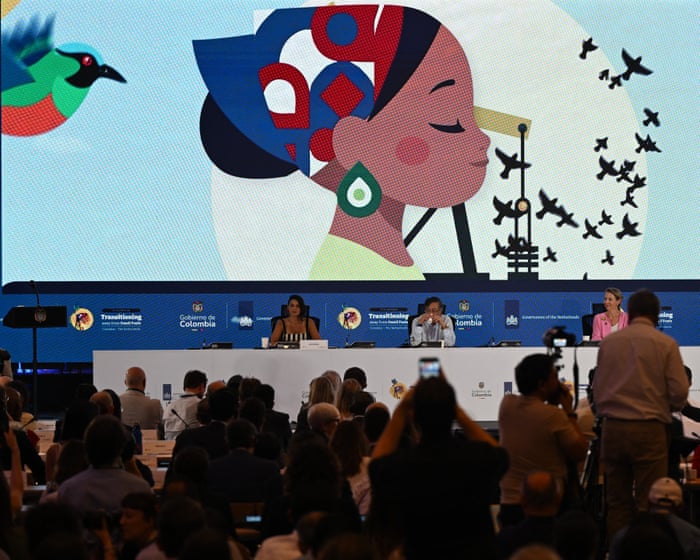
‘Suicidal’ model of capitalism leading to war and fascism, climate summit told

Colombia president Gustavo Petro tells 57-country talks on a green energy transition that fossil fuel interests could destroy humanity

The world is threatened by a “suicidal” model of capitalism that is leading to war, fascism and the potential extinction of humanity, Colombia’s president has said, as he convened 57 governments to address the climate crisis.

Gustavo Petro blamed fossil fuel interests for taking ever more desperate measures to prevent a transition to green energy. “There is inertia in the power and the economy of this archaic form of energy – fossil fuels – that lead to death. Undoubtedly, that form of capital can commit suicide, taking with it humanity and [other] life,” he said. “The question that needs to be asked is whether capitalism can truly adapt to a non-fossil energy model.”

Continue reading...

© Photograph: Raúl Arboleda/AFP/Getty Images

© Photograph: Raúl Arboleda/AFP/Getty Images

© Photograph: Raúl Arboleda/AFP/Getty Images

  •  

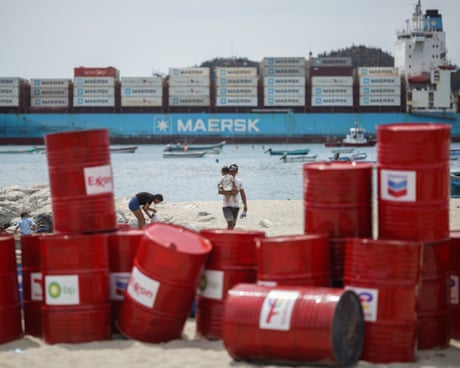
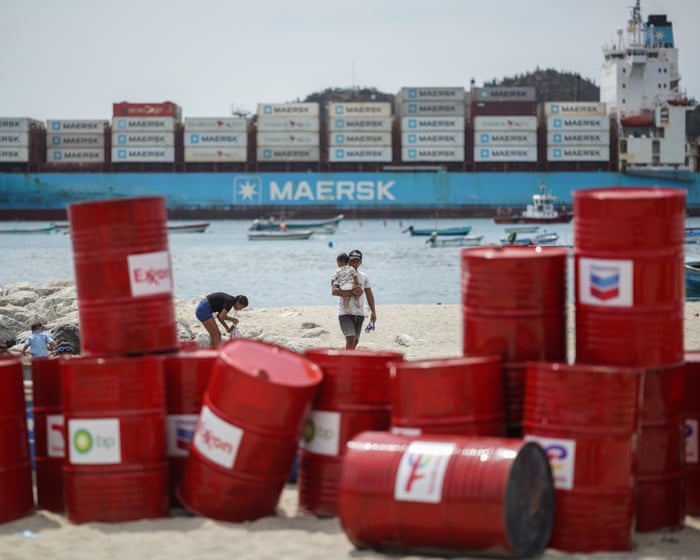
Middle East crisis could cost world $1tn while oil firms make ‘obscene’ profit, analysis finds

Climate group calls for urgent windfall tax on excess fossil fuel profits, as delegates tell Colombia conference their nations are suffering

The Middle East oil and gas crunch will impose as much as a trillion dollars of additional costs on the global economy while petroleum companies rake in spectacular profits from elevated fuel prices, analysis has revealed.

The uneven distribution of risk and reward comes amid rising concern that the US-Israeli attack on Iran is worsening inequality, poverty and hunger across a world that has become dangerously dependent on fossil fuels.

Continue reading...

© Photograph: Iván Valencia/AP

© Photograph: Iván Valencia/AP

© Photograph: Iván Valencia/AP

  •  

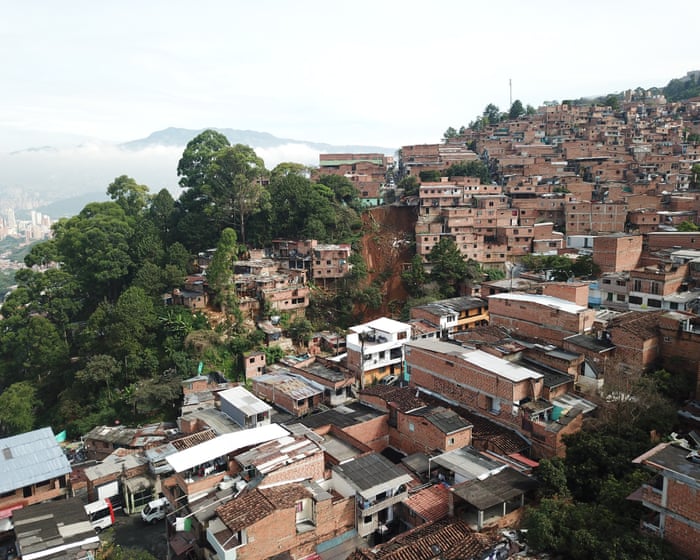
Rainwater harvesting and eco-gardens: how one Colombian neighbourhood helped a whole city plan for climate change

From rainwater harvesting to tree nurseries, communities in Medellín are taking steps to increase their landslide and flooding resilience

In his home on a steep hillside in the neighbourhood of Golondrinas in Medellín, Róbinson Velásquez Cartagena stands proudly next to two large tanks of water – a rainwater harvesting system he designed and built to help reduce the risk of flooding and landslides.

It is one of the nature-based solutions that Velásquez and others in the community have proposed as part of a disaster risk and climate crisis adaptation plan for Comuna 8, a growing informal settlement of 150,000 people in Colombia’s second-largest city.

Continue reading...

© Photograph: Handout

© Photograph: Handout

© Photograph: Handout

  •  

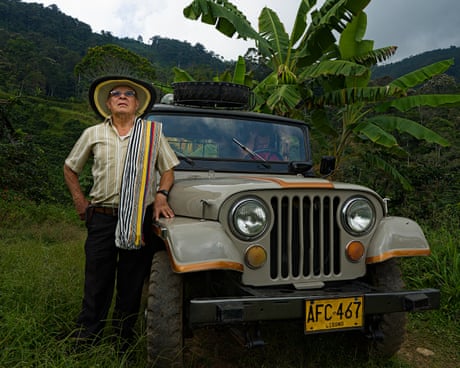
Historic harvests and sky-high prices – so why can’t Colombia’s coffee-growers hire pickers?

Though coffee is one of the world’s most important commodities, little of the profit trickles down to the farmers, while workers are abandoning the countryside in search of more lucrative jobs in the city

Mary Luz Pérez Arrubla and her brother, Rodrigo, are fourth-generation farmers cultivating coffee on steep Andean slopes near the town of Líbano, in the rich agricultural region of Tolima. Along with the rest of Colombia, the family has enjoyed a historic harvest amid surging global coffee prices, which hit record highs for the second year in a row in 2025.

Severe US tariffs imposed on Brazil and Vietnam, – the world’s two largest coffee producers – as well as poor harvests there, helped drive the surge. Both countries were hurt by the El Niño phenomenon, a cyclical weather pattern characterised by dry spells and aggravated by the climate crisis.

Continue reading...

© Photograph: Anastasia Austin/The Guardian

© Photograph: Anastasia Austin/The Guardian

© Photograph: Anastasia Austin/The Guardian

  •  

Venezuelan man says his rose tattoos got him deported to El Salvador’s brutal prison: ‘I thought my life had ended’

Trump administration accused Luis Muñoz Pinto of being part of the Tren de Aragua gang. Now living in Colombia he hopes to clear his name and study engineering in the US

It was the busiest hour of the evening in Bolivar Square, one of the most iconic spots in Bogotá, Colombia’s capital. Amid the buzz of smiling tourists, however, Luis Muñoz Pinto sat very still, his head in his hands, as memories of his deportation from the United States to a Salvadorian prison flooded back.

Muñoz Pinto, 27, was one of more than 250 Venezuelan men accused by the Trump administration of being part of the dangerous Tren de Aragua gang and deported from the US to the brutal terrorism mega-prison called Cecot in El Salvador last March.

Continue reading...

© Photograph: Nathalia Angarita/The Guardian

© Photograph: Nathalia Angarita/The Guardian

© Photograph: Nathalia Angarita/The Guardian

  •  

‘If we see you again, we kill you’: how a Colombian wildlife hotspot turned into a death zone

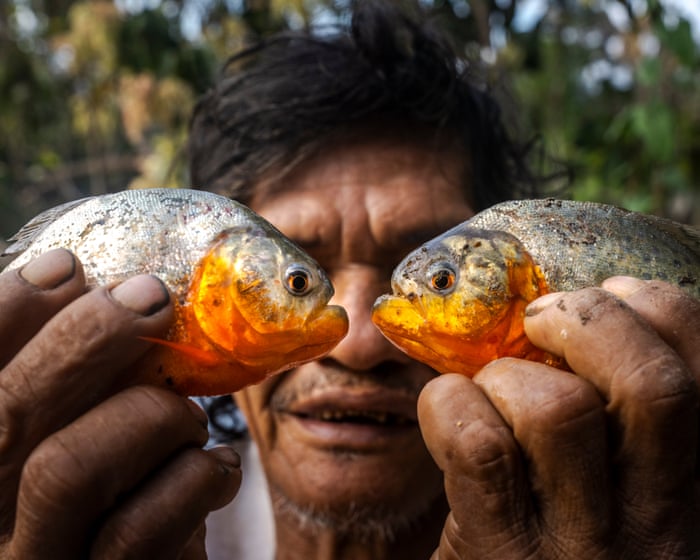
Armed groups and a state-owned refinery’s oil leaks have displaced Barrancabermeja’s fishing community and poisoned a paradise once full of manatees and jaguars

Standing on her wooden canoe, a machete in her hand, Yuly Velásquez hacks away at reeds matted with blackened sludge. Close by, a burst oil pipe has released a slick of crude into the San Silvestre wetlands in Barrancabermeja, Colombia’s oil city, choking the water and its wildlife.

“The destruction is immense,” says Velásquez, president of Fedepesan, a sustainable fishing organisation. “For the fish, the animals and flora, it means immediate death.”

Continue reading...

© Photograph: Harriet Barber

© Photograph: Harriet Barber

© Photograph: Harriet Barber

  •  

They survived conquistadors and settlers. Now the Arhuaco are facing an even greater threat

Colombia’s Sierra Nevada has become a strategic prize for drug traffickers and paramilitaries, leaving its Indigenous people threatened with ‘physical and cultural extinction’

Around a fire in a ceremonial hut in the Sierra Nevada de Santa Marta, the Arhuaco people make a pledge. Tying traditional cotton threads around their wrists, they promise to guard the land beneath them – and then they ask for protection.

“Our culture has been preserved for thousands of years,” says Ati Quigua, an Indigenous leader. “We are a peaceful community, but now violence is coming to our land.”

Continue reading...

© Photograph: Raúl Arboleda/AFP/Getty Images

© Photograph: Raúl Arboleda/AFP/Getty Images

© Photograph: Raúl Arboleda/AFP/Getty Images

  •  

‘Cocaine, gold and meat’: how Colombia’s Amazon became big business for crime networks

Armed groups have moved in to the space left by the Farc after the civil war, cutting down rainforest to control land and build thousands of kilometres of smuggling routes

High above the Colombian Amazon, Rodrigo Botero peers out of a small aircraft as the rainforest canopy unfolds below – an endless sea of green interrupted by stark, widening patches of brown. As director of the Foundation for Conservation and Sustainable Development (FCDS), he has spent years mapping the transformation of this fragile landscape from the air.

His team has logged more than 150 overflights, covering 30,000 miles (50,000km) to track deforestation advancing along the roads, illicit crops and the shifting frontiers of human settlement. “We now have the highest road density in the entire Amazon,” says Botero.

Continue reading...

© Illustration: Steve Ball/Guardian Pictures

© Illustration: Steve Ball/Guardian Pictures

© Illustration: Steve Ball/Guardian Pictures

  •  

Can a wildlife paradise on a Colombian island survive the arrival of a military base?

It took 40 years to turn Gorgona into a biodiversity haven and model marine protected area. Now a new coastguard station has sparked fears of militarisation and ecological ruin

For more than 15 years, Luis Fernando Sánchez Caicedo had dedicated himself to human rights in Colombia, supporting young people and advocacting for Afro-descendant and campesino – small farmer – communities in the Pacific region. A prominent local leader and adviser to the area’s administration in Nariño, he was also a longtime collaborator with the Institute for Development and Peace Studies (Indepaz), working to promote dialogue in a country torn apart by decades of war.

That all ended in September when the boat carrying him and the mayor of Mosquera, Karen Lizeth Pineda, was fired on, reportedly by the Colombian navy. Sánchez was killed and the mayor’s bodyguard was seriously injured in the attack.

Continue reading...

© Photograph: Antonio Cascio/The Guardian

© Photograph: Antonio Cascio/The Guardian

© Photograph: Antonio Cascio/The Guardian

  •  

‘Drug trafficking, extortion, kidnapping’: the lawless rush for rare earth minerals in Venezuela

Guerrilla groups have seized control of mining areas, exploiting Indigenous people and fuelling environmental ruin on the border with Colombia

For months, Brig Gen Rafael Olaya Quintero, commander of the Orinoco naval force, has been chasing tin and coltan traffickers across the waterways at Colombia’s border with Venezuela.

His mission has become more urgent since the global shift towards clean energy has generated an unprecedented rush for rare earth elements and critical minerals. These materials are vital components in electric vehicle batteries, wind turbines, fighter jets and guided missiles, with demand also driven by increased defence budgets in the EU, US and China, and throughout the world.

Continue reading...

© Photograph: Bram Ebus/Amazon Underworld

© Photograph: Bram Ebus/Amazon Underworld

© Photograph: Bram Ebus/Amazon Underworld

  •  
❌