❌

Lese-Ansicht

The world of today looks bad, but take hope: we’ve been here before and got through it – and we will again | Martin Kettle

As I write my last regular column for the Guardian, my thoughts turn to the lessons and hope we can take from history

From Greenland’s icy mountains, from India’s coral strand, as the old hymn has it, we seem to inhabit a world that is more seriously troubled in more places than many can ever remember. In the UK, national morale feels all but shot. Politics commands little faith. Ditto the media. The idea that, as a country, we still have enough in common to carry us through – the idea embedded in Britain’s once potent Churchillian myth – feels increasingly threadbare.

Welcome, in short, to the Britain of the mid-1980s. That Britain often felt like a broken nation in a broken world, very much as Britain often does in the mid-2020s. The breakages were of course very different. And on one important level, misery is the river of the world. But, for those who can still recall them, the 1980s moods of crisis and uncertainty have things in common with those of today.

Martin Kettle is a Guardian columnist

Continue reading...

© Composite: Artwork by Alex Mellon and Guardian Design. Source Photographs by Alamy/Getty Images/Bettman Archive/Reuters/SPUTNIK/KREMLIN POOL/EPA/MirrorPix/REX

© Composite: Artwork by Alex Mellon and Guardian Design. Source Photographs by Alamy/Getty Images/Bettman Archive/Reuters/SPUTNIK/KREMLIN POOL/EPA/MirrorPix/REX

© Composite: Artwork by Alex Mellon and Guardian Design. Source Photographs by Alamy/Getty Images/Bettman Archive/Reuters/SPUTNIK/KREMLIN POOL/EPA/MirrorPix/REX

  •  

Andrew Clements, Guardian’s classical music critic, dies aged 75

An outstanding critical voice, his deep knowledge and love of music was evident in everything he wrote

The Guardian’s long-serving and much admired classical music critic Andrew Clements died on Sunday aged 75 after a period of illness.

Clements joined the Guardian arts team in August 1993, succeeding Edward Greenfield as the paper’s chief music critic. His appointment was clinched by a personal recommendation to the editor from the late Alfred Brendel, who argued for Clements to get the job on account of his deep understanding of contemporary music. For the next 32 years, Clements ranged across all fields of classical music in his writing for the Guardian, and often beyond.

Continue reading...

© Photograph: Antonio Olmos/The Observer

© Photograph: Antonio Olmos/The Observer

© Photograph: Antonio Olmos/The Observer

  •  

Need cheering up after a terrible year? I may have just the story you’re looking for | Martin Kettle

A single act of kindness reminded me that, despite so much evidence to the contrary, the better angels of our nature are not necessarily doomed

Perhaps you are searching for reasons to be cheerful at the end of what has been a particularly dispiriting year? In that case, read on. In November, I was on a train travelling into London. When I got off the train and headed for the ticket barrier, I realised I didn’t have my wallet. I knew that I had it when I boarded. I made an undignified scrabble and search through my coat, jacket and trouser pockets that deserved the comic skills of a Charlie Chaplin or Jacques Tati. There was, though, no mistake. I had somehow managed to leave my wallet on the train.

A nice station attendant took the details and said he would pass the message down the line. I left him my mobile number. But it was rush hour, the man pointed out, and the chances of getting the wallet back had probably vanished with the departing train. Meanwhile I rang my bank and eventually succeeded in cancelling my cards. I felt horribly stupid, old and embarrassed. I went for a drink with friends and felt sorry for myself.

Martin Kettle is a Guardian columnist

Continue reading...

© Illustration: Thomas Pullin/The Guardian

© Illustration: Thomas Pullin/The Guardian

© Illustration: Thomas Pullin/The Guardian

  •  

Europe is holding the line against Trump’s and Putin’s plans for Ukraine. But it won’t be able to for ever | Martin Kettle

In the 21st-century imbalance of power, Europe and Nato have neither the arms nor the wealth to impel Russia or the US to take its peace settlement seriously

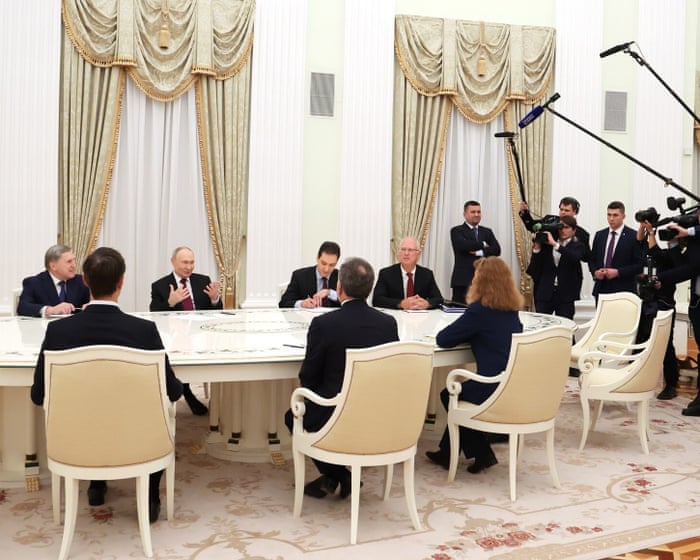
The failure of this week’s peace talks between Vladimir Putin and Donald Trump’s envoy Steve Witkoff fits into a now well-established pattern of standoffs on Ukraine during Trump’s second term. But the dynamic that produced these talks may be becoming more entrenched. The US and Russian interests driving the process have not changed, while the conflict on the ground is intensifying. The lack of progress this week means there will be another attempt to end the war soon, and perhaps another after that, until, one day, there is some kind of US-backed deal to halt the conflict on terms broadly favouring Russia.

The geopolitical algorithm driving this effort is too consistent to ignore. It has been repeated ever since Trump re-entered the White House in January. On the campaign trail, Trump had claimed he could stop the war in a day. That was never going to happen. But from 12 February onwards, when Trump first talked directly to Putin about Ukraine, the intention and approach have not altered. There is no reason to suppose they will do so now. Indeed, Tuesday’s impasse may spur them on again.

Martin Kettle is a Guardian columnist

Continue reading...

© Photograph: Anadolu/Getty Images

© Photograph: Anadolu/Getty Images

© Photograph: Anadolu/Getty Images

  •  

Rachel Reeves’s budget has inflamed, not calmed, Britain’s febrile mood | Martin Kettle

The chancellor’s statement will be remembered for the many taxes it raised, rather than the big one – income tax – it did not

Rachel Reeves’s chancellorship was already balanced on a knife-edge, even before the 2025 budget. After she delivered her second budget statement, it still is. Even more than usual, Wednesday’s speech was full of significant fiscal changes, altered spending commitments and adjusted economic forecasts, most of them accidentally (and, for journalists, conveniently) released a short while in advance by the obviously misnamed Office for Budget Responsibility. Politically, however, almost nothing has changed at all.

Reeves arrived in the Treasury last year offering what she, like Keir Starmer, had promised as the Conservative years ebbed: competence, stability and, above all, a focus on economic growth. Her problem, despite her upbeat assessments, is that she has delivered none of them. Nothing about the 2025 budget guarantees any early change in that, however defiantly Reeves spoke about reversing the OBR’s reduced new growth and productivity forecasts.

Martin Kettle is a Guardian columnist

Continue reading...

© Illustration: OPINION ILLUSTRATION Nate Kitch on Labour's first day of election campaigning/The Guardian

© Illustration: OPINION ILLUSTRATION Nate Kitch on Labour's first day of election campaigning/The Guardian

© Illustration: OPINION ILLUSTRATION Nate Kitch on Labour's first day of election campaigning/The Guardian

  •  
❌