❌

Lese-Ansicht

To reverse the ‘greenlash’, Europe’s Green parties should embrace Polanski’s boldness | Tarik Abou-Chadi

Be more strident and ambitious, take on economic inequality, and progressive voters will reward you as they have the UK’s Greens

  • Tarik Abou-Chadi is a professor of European politics at the University of Oxford

European Green parties have been through a phase of stagnation and crisis in recent years. Long gone seem the days of the “green wave” across Europe. Back in 2019, Green parties secured their best-ever result in the European parliament elections, with 74 seats. In the same year, Green parties also scored record results in Switzerland, Belgium and Austria. Shortly after, they were part of governing coalitions in Finland, Germany, Ireland and Austria.

But more recently, there has been much discussion of a “greenlash”: a backlash against climate policies and other green projects throughout Europe. Across the continent, Green parties dropped out of nearly all government coalitions, and these parties’ recent election results have often failed to meet expectations. With apparently declining enthusiasm for the climate movement, and the decreasing salience of climate breakdown at the ballot box, Green parties are debating how to turn their fortunes around.

Tarik Abou-Chadi is a professor of European politics at the University of Oxford

Do you have an opinion on the issues raised in this article? If you would like to submit a response of up to 300 words by email to be considered for publication in our letters section, please click here.

Continue reading...

© Photograph: Denise Baker/Getty Images
© Photograph: Denise Baker/Getty Images

© Photograph: Denise Baker/Getty Images

  •  

Europe’s housing crisis is fuelling the rise of the far right. Our research shows how to address it | Tarik Abou-Chadi, Björn Bremer and Silja Häusermann

The mantra of ‘build, build, build’ misses something crucial: that few can afford these new homes

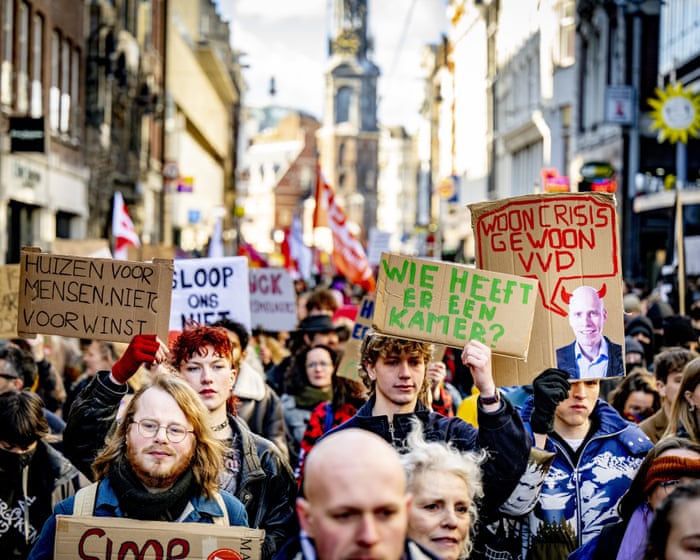
Housing costs across Europe have become a growing burden for many households, both for those trying to buy and those trying to rent. Over the past decade, property prices have surged faster than incomes in many European countries. The same is true for rents, which have increased exponentially in large cities but have also increased substantially in suburban areas and smaller university towns.

Given how much housing costs affect Europeans’ quality of life, it is comparatively absent from the agenda of progressive political parties. When politicians do emphasise housing, the focus is usually solely on building more houses. Former German chancellor Olaf Scholz, for example, promised to build 400,000 new homes in Germany every year – a goal his government failed to reach by some distance. At the same time, far-right parties such as the Freedom party (PVV) in the Netherlands or Chega in Portugal have made the housing affordability crisis into a campaign issue. Their equation is simple: housing should be available and affordable only for nationals.

Tarik Abou-Chadi is a professor of European Politics at the University of Oxford; Björn Bremer is an assistant professor at the Department of Political Science at Central European University in Vienna; Silja Häusermann is a professor at the Department of Political Science at the University of Zurich

Do you have an opinion on the issues raised in this article? If you would like to submit a response of up to 300 words by email to be considered for publication in our letters section, please click here.

Continue reading...

© Photograph: Hollandse Hoogte/REX/Shutterstock

© Photograph: Hollandse Hoogte/REX/Shutterstock

© Photograph: Hollandse Hoogte/REX/Shutterstock

  •  
❌