From retailers to banks, carmakers to councils, the bold pledges for carbon-neutral economies are being watered down or scrapped
Almost a year since Donald Trump returned to the White House with a rallying cry to the fossil fuel industry to “drill baby, drill”, a backlash against net zero appears to be gathering momentum.
More companies have retreated from, or watered down, their pledges to cut carbon emissions, instead prioritising shareholder returns over climate action.
The huge sum shows that while the Koch network may not hold significant power at high levels of the Republican Party, it remains a financial juggernaut.
Charles Koch in 2019. The Koch family network now downplays its commitment to campaigns and elections, but it has continued to spend money on politics.
The main dark-money group backing Kamala Harris and Joe Biden raised a staggering $613 million last year, while its pro-Trump counterpart brought in $275 million, new filings show.
Both Donald J. Trump and Kamala Harris benefited heavily from so-called dark money in 2024, but Democrats leaned more on the practice of funneling money through nonprofit groups that do not have to disclose their donors.
An investigation by The Times found the administration’s change in enforcement benefited the industry, including companies that had ties to the president.
The dispute before the court involved a Republican effort to lift limits on how much money political parties can spend in coordination with candidates.
In 2010, in the landmark case Citizens United v. Federal Election Commission, the Supreme Court struck down legal limits on independent political spending by corporations and unions.
Many years ago, I was encouraged to put my name forward to chair a significant government board. It seemed like a long shot to me, I wasn’t in anyone’s club, but my supporters were insistent. I agreed to let my name go into the mix.
It was a surprise then when the chair of the selection committee called a few weeks later and said with an apologetic tone: “Sorry Julianne, it’s just not your turn.”
Julianne Schultz is deputy chair of the Sydney writers’ festival board
A Trump-aligned political group is quietly spending millions to help state Republicans have a friendlier House map in 2028 — not in 2026, as with all of his other redistricting efforts.
A Trump-aligned nonprofit group has put $4.35 million toward supporting a proposed ballot measure that would repeal Utah’s anti-gerrymandering law, potentially giving Republicans an extra House seat in 2028.
The former lieutenant governor is the best-known candidate in a crowded field, but some state Democrats have cooled on him since he lost a Senate bid in 2022.
Mandela Barnes, the former lieutenant governor of Wisconsin, is a progressive who has maintained a large fund-raising network since his 2022 Senate race.
Dawn Butler leads calls for humanitarian visas and fee waivers for vulnerable relatives of UK nationals affected by storm
British MPs have joined campaigners calling for more aid and humanitarian visas for Jamaicans to enter the UK after Hurricane Melissa demolished parts of the country, plunging hundreds of thousands of people into a humanitarian crisis.
The UK has pledged £7.5m emergency funds to Jamaica and other islands affected by the hurricane, but many argue that the country has a moral obligation to do more for former Caribbean colonies.
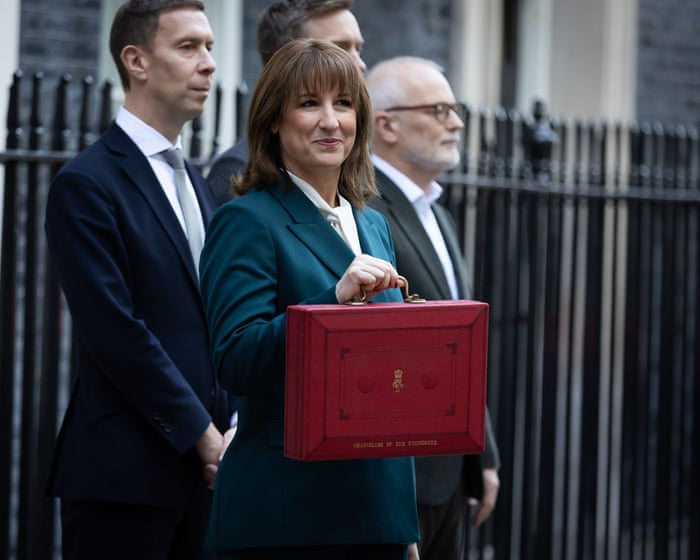
Rachel Reeves targeted Britain’s wealthiest households with a £26bn tax-raising budget to fund scrapping the two-child benefit policy and cutting energy bills.
On a chaotic day that involved key details of her budget accidentally being released early by the Office for Budget Responsibility (OBR), the chancellor defended the measures, saying she was “asking everyone to make a contribution to repair the public finances”, but that she wanted the wealthiest to pay the most.
As artificial intelligence companies prepare to pour money into the midterm elections, some in the A.I. world are hatching plans of their own to curb the industry’s influence.
Jack Clark, a co-founder of Anthropic, an A.I. company that favors more guardrails for the technology. Some of the company’s employees have discussed how to become more involved in political advocacy.
Wealthy countries should triple funds for countries to tackle climate impacts, but deforestation and critical minerals blocked from final deal
The world edged a small step closer to the end of the fossil fuel era on Saturday, but not by nearly enough to stave off the ravages of climate breakdown.
Countries meeting in Brazil for two weeks could manage only a voluntary agreement to begin discussions on a roadmap to an eventual phase-out of fossil fuels, and they achieved this incremental progress only in the teeth of implacable opposition from oil-producing countries.
Three representatives of developing countries speak candidly about meetings behind closed doors in Belém
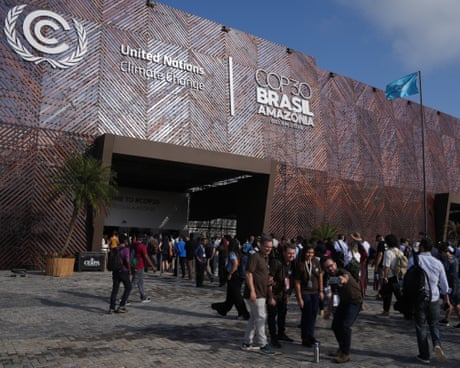
In the negotiating rooms at the Cop30 climate conference, representatives from vulnerable countries work to get the best deal they can. Here, three of them reveal what happens behind closed doors.
Climate crisis talks look likely to stretch well into the weekend in Brazil, with countries still far apart on the crucial issues of phasing out fossil fuels and cutting carbon.
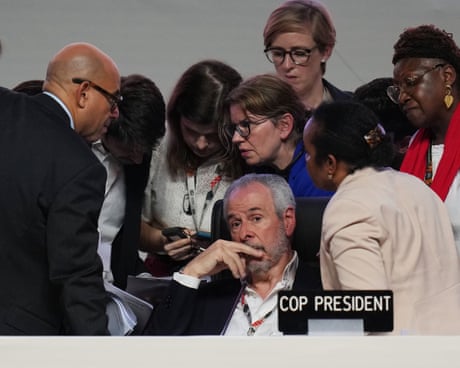
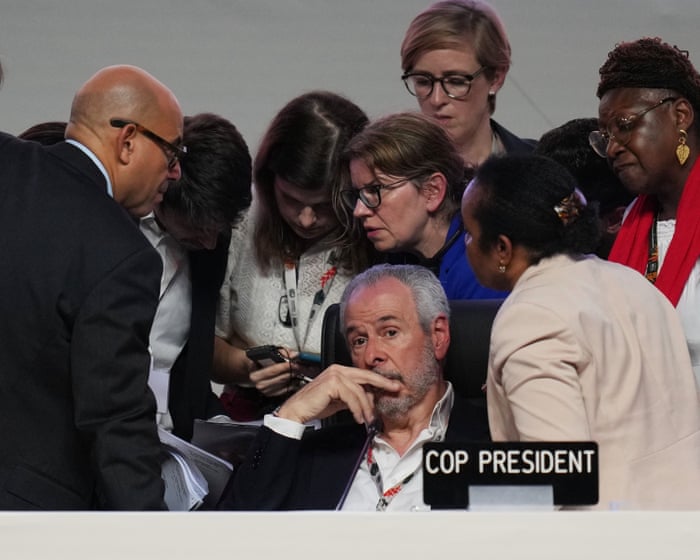
The Cop30 president, André Corrêa do Lago, urged ministers and high-ranking officials from more than 190 countries to find common ground: “We need to preserve this regime [of the Paris climate agreement] with the spirit of cooperation, not in the spirit of who is going to win or is willing to lose’” he said. “Because we know if we don’t strengthen this, everyone will lose.”
Exclusive: Summit leadership releases new text despite 29 nations threatening to block progress without commitment
A new draft text on the outcome of the Cop30 climate talks has been published that contains no mention of a phase-out of fossil fuels, despite countries supporting such action having threatened to block any agreement without it.
The Guardian revealed on Thursday night that at least 29 nations supporting a phase-out of fossil fuels at the climate summit had sent a letter to the Brazilian Cop presidency threatening to block any agreement that did not include such a commitment, in a significant escalation of tensions at the crunch talks. The leaked letter demanded that the roadmap be included in the outcome of the talks, which are due to end on Friday but are likely to continue into the weekend.
UN secretary-general António Guterres earlier used speech at Belem summit to urge countries to find compromises in final hours of negotiations
Inside the halls of Cop30 you see people from all around the world, and it can be easy to forget that there are many people who remain unrepresented.
On Thursday morning, Magne Tony was standing with compatriots from French Guiana outside the entrance to the conference centre, trying to push pieces of paper into the hands of arriving delegates and observers headed: “Our Amazon is dying”.
The main problem is that France are in 9,000 kilometres from Amazonia, from South America, and they’re taking decisions. [But] they don’t really know what is the problem really. They’re taking the decisions from their own mind and the problem is that they’re far from reality.
That’s why we decided to alert the people in the world about [our] problems: water coming up, getting enough to eat, more heat – in some parts of French Guiana, people don’t have water.
These crises, a consequence of Western capitalist madness, primarily affect the most vulnerable: women and communities dependent on forests and rivers. But they also concern all of humanity: French Guiana is part of the Amazon, a regulator of the global climate and essential to planetary balance.
We remind you that French Guiana is the last colony in South America without self-determination. We will not be able to protect our environment or guarantee our food and energy self-sufficiency, essential for our collective survival, as long as decisions are made in Paris without consulting the affected communities or taking into account local specificities.
Senator Ron Wyden, an Oregon Democrat, wants to examine how the nation’s largest bank handled the reporting of more than $1 billion in suspicious transactions.
Representative Sheila Cherfilus-McCormick misused $5 million in Covid-related funds during the pandemic in part to finance her campaign, according to the Justice Department.

 Anmelden