Even as the president considers an attack, his State of the Union address offered little more than a brief repetition of vague talking points from recent days.
Gen. Dan Caine, the chairman of the Joint Chiefs of Staff, left, and other military leaders listening to President Trump deliver his State of the Union address in the Capitol on Tuesday.
China has opposed the ‘smearing of its nuclear policy’ while insisting Beijing would not ‘engage in any nuclear arms race’
The US has accused China of dramatically expanding its nuclear arsenal, while doubling down on claims that Beijing had conducted secret nuclear tests.
Washington said the lapsing of New Start – the last treaty between top nuclear powers the US and Russia – earlier this month presented the possibility of striking a “better agreement” that included Beijing.
The remarks differ from what Gen. Dan Caine, the chairman of the Joint Chiefs of Staff, is said to have told the president in high-level White House meetings.
The top negotiators plan to meet in Geneva on Thursday for last-ditch talks, debating a new proposal that could create an off-ramp as two carrier groups massed within striking distance of Iran.
President Trump’s threat is the latest example of how he is trying to force Iranian leaders to see that they have no choice but to give up every aspect of their nuclear program.
Proposal will be at heart of offer to US as Trump considers whether to attack Iran
Iran is refusing to export its 300kg stockpile of highly enriched uranium, but is willing to dilute the purity of the stockpile it holds under the supervision of UN nuclear inspectorate the IAEA, Iranian sources have said.
The proposal will be at the heart of the offer Iran is due to make to the US in the next few days, as the US president, Donald Trump, weighs whether to use his vast naval buildup in the Middle East to attack the country.
Trump orders massive buildup of naval forces in Middle East, leading to fears of an imminent war
Iran’s foreign minister has said he expects to have a draft counterproposal ready within days after nuclear talks with the US this week, while Donald Trump said he was considering limited military strikes.
The US president has ordered a massive buildup of naval forces in the Middle East, including repositioning aircraft carriers and other warships, leading to fears of an imminent war. But it is not clear if the military movements are intended as an intimidation tactic to put pressure on Iran to make concessions on its nuclear programme.
Reports say move could come this weekend as White House urges Iran to ‘make a deal’ with Trump on nuclear program
The US military is ready for possible strikes on Iran as soon as this weekend, multiple news outlets reported Wednesday citing unnamed sources.
However, the reports said, Donald Trump has yet to make a final decision on whether to carry out an attack. The president has repeatedly demanded Iran cease its nuclear program, and has warned he intends to use force if no deal is reached.
The Iranian minister, Abbas Araghchi, said both sides had agreed on a “set of guiding principles.” President Trump has called on Iran to make an immediate accord or face a possible U.S. attack.
German chancellor rebuts idea of American unilateralism and says ‘democracies have partners and allies’
The US acting alone has reached the limits of its power and may already have lost its role as global leader, Friedrich Merz, the German chancellor, warned Donald Trump at the opening of the Munich Security Conference.
Merz also disclosed he had held initial talks with the French president, Emmanuel Macron, over the possibility of joining France’s nuclear umbrella, underlining his call for Europe to develop a stronger self-standing security strategy.
Israeli leader was expected to advocate for more forceful US intervention during sixth visit to current White House
Donald Trump has said that he is still seeking a deal with Iran to prevent it from seeking a nuclear weapon following a three-hour meeting with Benjamin Netanyahu in which the Israeli leader was expected to advocate for a more forceful intervention by the US military.
Netanyahu’s sixth visit to the White House since Trump returned to office ended without any public remarks between the two leaders. The results of the hastily arranged meeting were announced by Trump in an online post.
It remains to be seen whether the three big nuclear powers are headed into a new arms race, or whether President Trump is trying to spur negotiations on a new accord now that a last Cold War treaty has expired.
With the end of the New Start treaty, we face a potentially catastrophic arms race. It can still be prevented
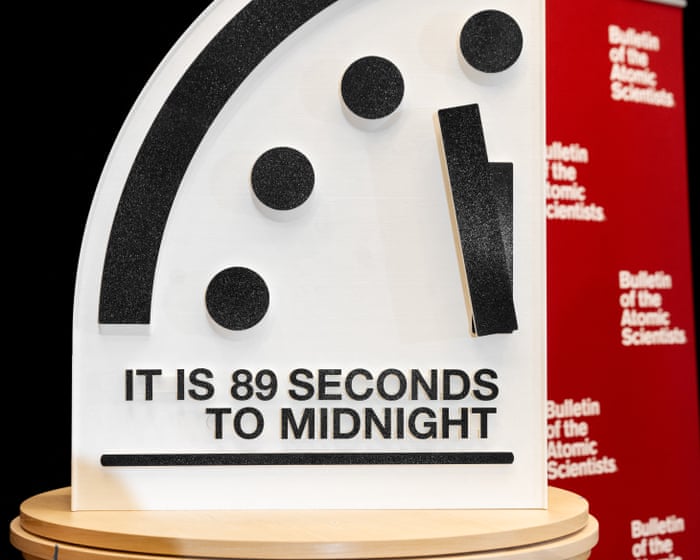
The risk of nuclear war is greater now than in decades – and rising. The Bulletin of Atomic Scientists recently set its famous Doomsday Clock closer to midnight, indicating a level of risk equivalent to the 1980s, when US and Soviet nuclear stockpiles were increasing rapidly. In those years, massive waves of disarmament protest arose in Europe and the United States. Political leaders responded, the cold war ended, and many people stopped worrying about the bomb.
Today, the bomb is back. Political tensions are rising, and nuclear weapons have spread to other countries, including Israel, India, Pakistan and North Korea. China is rapidly increasing its nuclear arsenal. The US-Russia arms competition may accelerate soon with the expiration on 5 February of the last remaining arms control agreement, the New Start treaty. To prevent the growing nuclear threat, we need a new global peace movement.
David Cortright, a visiting scholar at Cornell University’s Reppy Institute for Peace and Conflict Studies, was the executive director of Sane, the Committee for a Sane Nuclear Policy, during the 1980s
Workers at a uranium conversion facility in Isfahan, Iran, in 2005. Analysts say Iran’s position on enrichment reflects the country’s intense pride in a nuclear program that has become a symbol of Iranian independence.
New Start expires on Thursday. That leaves no limits on US and Russian nuclear arsenals
Let’s be honest: America needs another nuclear weapon about as much as Donald Trump deserves a Nobel peace prize.
Yet on Thursday, the last remaining nuclear arms control treaty between the U S and Russia will expire. When the New Strategic Arms Reduction Treaty – New Start – goes away, there will be no limits on US and Russian nuclear arsenals for the first time in more than 50 years.
Edward J Markey represents Massachusetts in the US Senate. He is a co-chair of the bicameral congressional nuclear weapons and arms control working group
António Guterres urges two powers to quickly sign new deal as New Start expires
The UN secretary general, António Guterres, has urged the US and Russia to quickly sign a new nuclear arms control deal, as the existing treaty expired in what he called a “grave moment for international peace and security”.
The last nuclear treaty between the two powers, the New Start agreement, ended on Thursday, formally releasing both Moscow and Washington from a raft of restrictions on their nuclear arsenals and triggering fears of a global arms race.
Ending of New Start treaty will remove mutual limits on the world’s two biggest nuclear arsenals
The New Start treaty between the US and Russia will expire on Thursday, removing the last remaining mutual limits on the world’s two biggest nuclear arsenals.
The milestone will be a death knell for more than five decades of arms control at a time of surging global instability, contributing to a general collapse of the rules-based international order established after the second world war.

 Anmelden