❌

Lese-Ansicht

Minab school bombing: how the worst mass casualty event of the Iran war unfolded – a visual guide

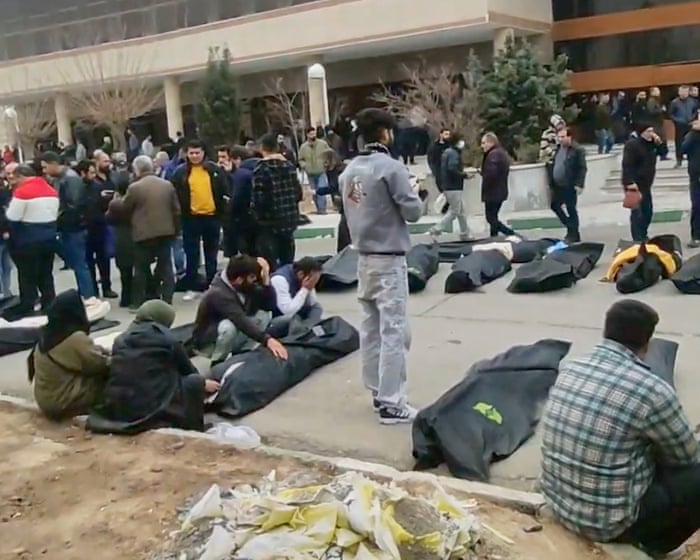
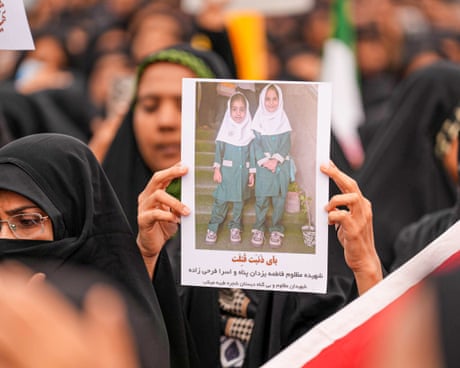
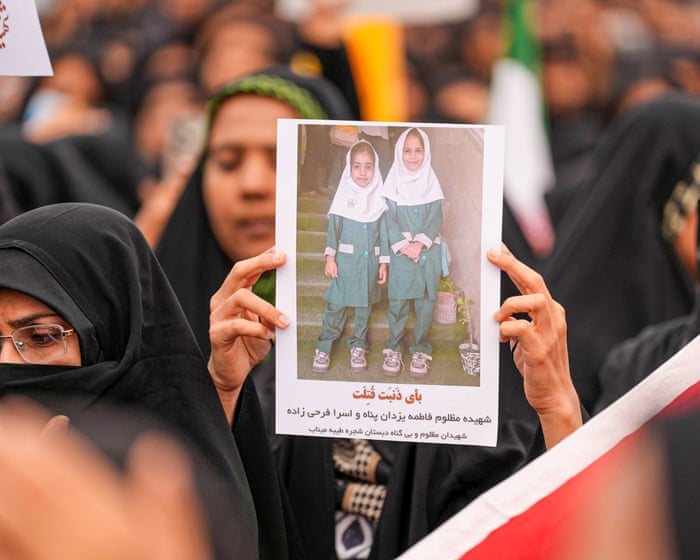
A strike on Shajareh Tayyebeh school during the US-Israeli bombing campaign killed up to 168 people. The Guardian has pieced together the incident and its aftermath using verified footage and images from the site

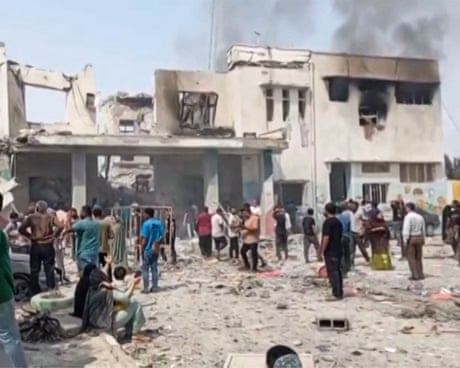
Above the pastel murals of trees, paintbrushes, crayons and microscopes, black smoke rises. The glass windows of the school have been blown out by the force of the blast, and its curtains hang shredded from the frames.

Against one burned-out wall, the remains of a playground lie scattered: a red plastic slide, a jumble of child-sized chairs. On an overturned bookshelf a pair of pink plastic sandals have been neatly placed, now covered in dust from the blast.

Continue reading...
© Photograph: Anadolu/Getty Images
© Photograph: Anadolu/Getty Images
© Photograph: Anadolu/Getty Images

  •  

Death toll from Iran school bombing reportedly rises to almost 150

Strike on girls’ elementary school in south of Iran has killed 148 people and injured 95 others, according to Iran state media

The death toll from a missile strike on a girls’ school in southern Iran has risen to almost 150, according to Iranian state media.

Mizan news agency, the official news outlet of Iran’s judiciary, reported that the number killed in Saturday’s strike on a girls’ elementary school in Minab in southern Iran had risen to 148 killed, with 95 others wounded. The news agency cited Ebrahim Taheri, a prosecutor in Minab.

Continue reading...

© Photograph: Iran Ministry of Culture and Islamic Guidance, via Reuters

© Photograph: Iran Ministry of Culture and Islamic Guidance, via Reuters

© Photograph: Iran Ministry of Culture and Islamic Guidance, via Reuters

  •  

‘The most bitter news’: Iran reels as more than 100 children reportedly killed in school bombing

The building appears to be among many devastated in Trump’s ‘major combat operations’ as long expected attacks arrive

Iran’s parents had just dropped their children off for class on Saturday morning when they found themselves racing back to school gates, as bombs began to fall across the country in a joint US-Israel attack.

At one elementary school, according to Iran’s state-controlled media, they arrived to find devastation. At least 100 children had been killed in the strike on Shajareh Tayyebeh girls’ school in Minab, southern Iran, the Mizan news agency reported, with dozens more unaccounted for.

Continue reading...

© Photograph: Alex Mita/IRIB TV/AFP/Getty Images

© Photograph: Alex Mita/IRIB TV/AFP/Getty Images

© Photograph: Alex Mita/IRIB TV/AFP/Getty Images

  •  

‘Deliberate targeting of vital body parts’: X-rays taken after Iran protests expose extent of catastrophic injuries

Exclusive: Expert analysis of images from one hospital suggests severe trauma to the face, chest and genitals was caused by metal birdshot and high-calibre bullets

Across the planes of Anahita’s* face, white dots shine like a constellation. Some gleam from inside the sockets of her eyes, others are scattered over the young woman’s chin, forehead, cheekbones. A few float over the dark expanse of her brain.

Each dot represents a metal sphere, about 2-5mm in size, fired from the barrel of a shotgun and revealed by the X-ray camera for a CT scan. Shot from a distance, the projectiles, known as “birdshot”, spray widely, losing some of their momentum. At close range, they can crack bone, blast through the soft tissue of the face, and easily pierce the eyeball’s delicate globe. Anahita, who is in her early 20s, has lost at least one eye, possibly both.

Continue reading...

© Photograph: supplied

© Photograph: supplied

© Photograph: supplied

  •  

‘I saw kids being shot, women, old people’: how a massacre unfolded in one Iranian city

The Guardian has constructed a timeline for the terrible events of one night of protests in Rasht, based on first-hand accounts, video and photographs

On Thursday 8 January, Iran went dark. In the midst of massive national protests, the government shut down the internet, phone calls, and almost all communication out of the country. That evening a violent crackdown began. In some cities, government forces opened fire on crowds, killing thousands – according to some estimates, possibly tens of thousands – in two days of bloodshed. The internet blackout has meant that a clearer picture of what happened – drawn from witness reports, videos, photographs and testimony from hospitals – has taken time to assemble.

When the violence began, there were demonstrations taking place in more than 200 cities, according to human rights groups. This is the story of what unfolded in one of them.

Continue reading...

© Photograph: Courtesy of Tavaana

© Photograph: Courtesy of Tavaana

© Photograph: Courtesy of Tavaana

  •  

Disappeared bodies, mass burials and ‘30,000 dead’: what is the truth of Iran’s death toll?

Testimony from medics, morgue and graveyard staff reveals huge state effort to conceal systematic killing of protesters

On Thursday 8 January, in a midsize Iranian town, Dr Ahmadi’s* phone began to buzz. His colleagues in local emergency wards were getting worried.

All week, people had taken to the streets and had been met by police with batons and pellet guns. With treatment, their injuries should not have been too serious. But emergency room staff believed many wounded young people were avoiding hospitals, terrified that registering as trauma patients would lead to their identification and arrest.

Continue reading...

© Photograph: AP

© Photograph: AP

© Photograph: AP

  •  

Age of the ‘scam state’: how an illicit, multibillion-dollar industry has taken root in south-east Asia

Like the narco-state, a ‘scam state’ refers to countries where an illicit industry has dug its tentacles deep into institutions and transformed the economy

For days before the explosions began, the business park had been emptying out. When the bombs went off, they took down empty office blocks and demolished echoing, multi-cuisine food halls. Dynamite toppled a four-storey hospital, silent karaoke complexes, deserted gyms and dorm rooms.

So came the end of KK Park, one of south-east Asia’s most infamous “scam centres”, press releases from Myanmar’s junta declared. The facility had held tens of thousands of people, forced to relentlessly defraud people around the world. Now, it was being levelled piece by piece.

Continue reading...

© Composite: Jittrapon Kaicome/The Guardian

© Composite: Jittrapon Kaicome/The Guardian

© Composite: Jittrapon Kaicome/The Guardian

  •  

Brain damage, blindness and death: the global trail of trauma left by methanol-laced alcohol

Methanol, a cheap relative of ethanol, is entering the supply chain, causing thousands of deaths around the world

For Bethany Clarke, poison tasted like nothing. There was no bitter aftertaste, no astringent sting at the back of the tongue. If anything, she thought in passing, the free shots she and her friends were drinking at a hostel bar in Laos had probably been watered down – she wasn’t detecting a strong vodka flavour through the veil of Sprite she had mixed it with.

All in all, Clarke remembers drinking about five of those shots, sitting with her best friend, Simone White, and a crowd of others at the hostel’s happy hour. CCTV footage shows the group laughing in the warm air of the open bar in the town of Vang Vieng, green and red lights dancing over their shoulders.

Continue reading...

© Photograph: Bethany Clarke

© Photograph: Bethany Clarke

© Photograph: Bethany Clarke

  •  
❌