A weeks-long outage at a major Australian liquefied natural gas export plant has dealt a further blow to a global market still reeling from the halt of operations in Qatar.
Three Australian plants that provide about 8% of the world’s liquefied natural gas have had their output curbed by a cyclone, in a further blow to mainly Asian buyers reeling from the halt of shipments from Qatar.
The Gorgon liquefied natural gas (LNG) and carbon capture and storage (CCS) facility, operated by Chevron Corp., on Barrow Island, Australia, on Monday, July 24, 2023. Chevron received approval to develop the site into a major liquefied natural gas export facility on the basis they could capture and store 80% of the CO2 mixed in with the fuel, instead of releasing it.
Severe Tropical Cyclone Narelle strengthened and is threatening to disrupt gas and iron ore operations on Australia’s west coast, after leaving mine closures and evacuations in its wake along the north shore over the past week.
Bulk carriers sitting offshore wait to enter the port in Port Hedland, Australia, on Monday, March 18, 2019. The two parts of the town — Port Hedland and South Hedland — are divided by the water and long red piles of iron ore between rail tracks that are waiting to be loaded onto ships that dock along the edges of the inlet.
As the war in the Middle East enters its third week, Australia — with little domestic refining capacity left — underscores how even major fossil fuel exporters aren’t immune to a widening energy crunch.
The Australian arm of London-based investment manager Foresight Group Holdings Ltd. will acquire New Zealand renewables developer NZ Clean Energy, with plans to invest A$500 million ($360 million) over the next twelve months.
Shares in Australian liquefied natural gas exporters surged after tankers stopped crossing the Strait of Hormuz, hampering about a fifth of global supply and threatening to raise prices of the fuel.
European natural gas prices could more than double if shipping through the Strait of Hormuz is halted for one month, according to Goldman Sachs Group Inc.
Santos Ltd. is targeting a 10% headcount reduction after Australia’s second-biggest natural gas producer reported a slump in profit on lower oil and gas prices.
The Santos Ltd. Logo atop Santos Place building, which houses the company's office, in Brisbane, Australia, on Monday, Dec. 11, 2023. Woodside Energy Group Ltd.’s hopes of a tie-up with Santos to create Asia’s dominant liquefied natural gas exporter face a potential hurdle over the valuation of a target whose shares recently fell to an eight-month low. Photographer: Ian Waldie/Bloomberg
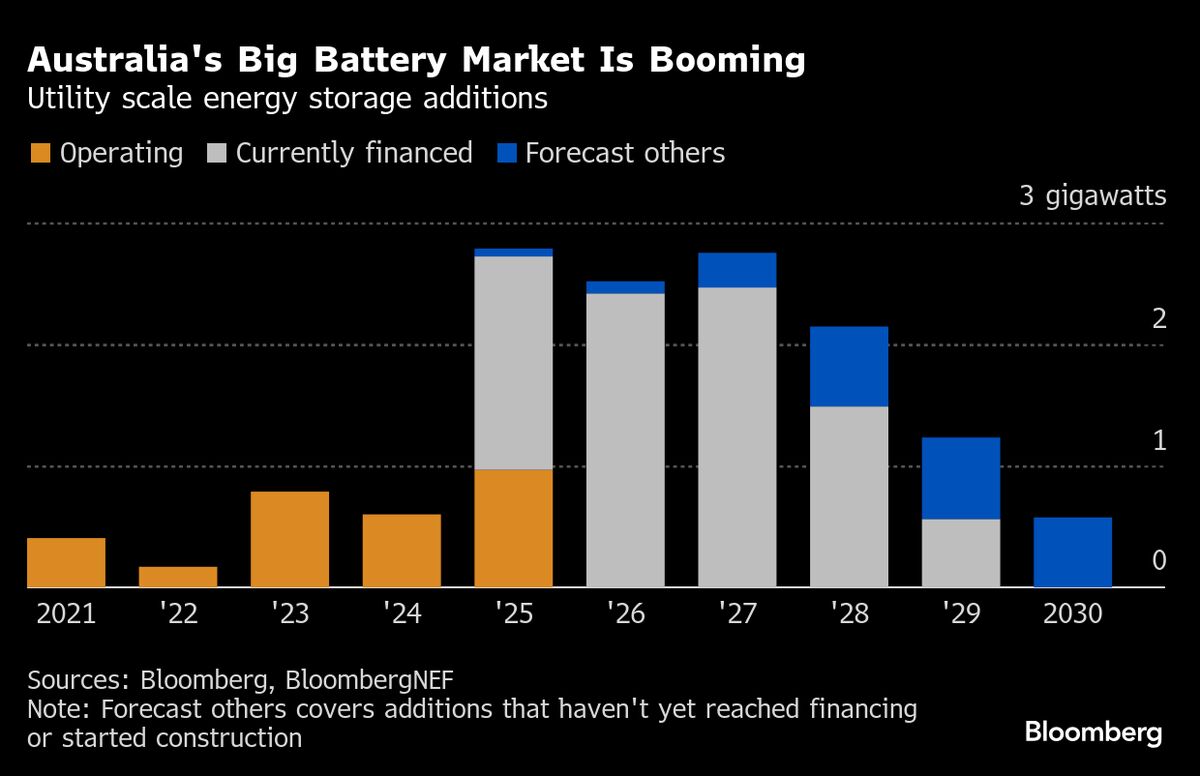
Australia commissioned a record-breaking amount of renewable projects and big batteries last quarter, signaling fresh momentum in the country’s clean-energy transition.
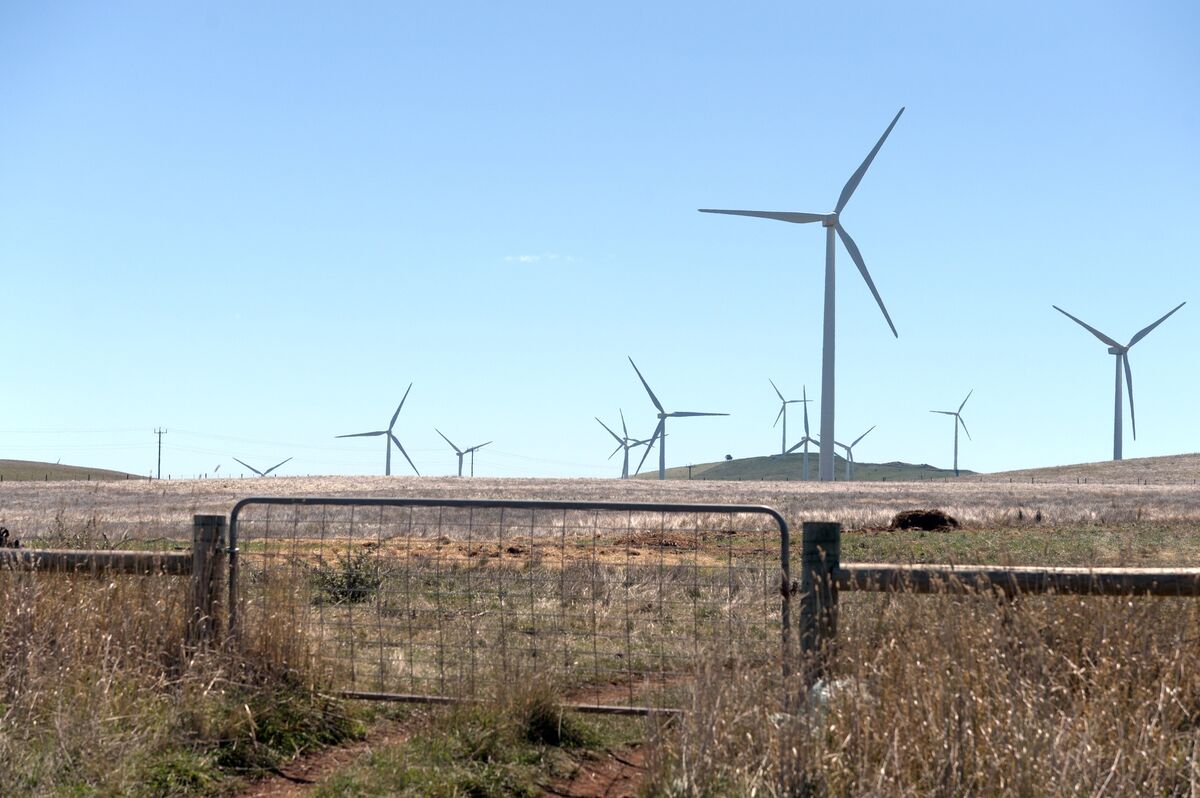
Wind turbines on a wind farm in Waubra, Victoria, Australia.
Australian Court Dismisses Case Against Oil and Gas Giant Santos
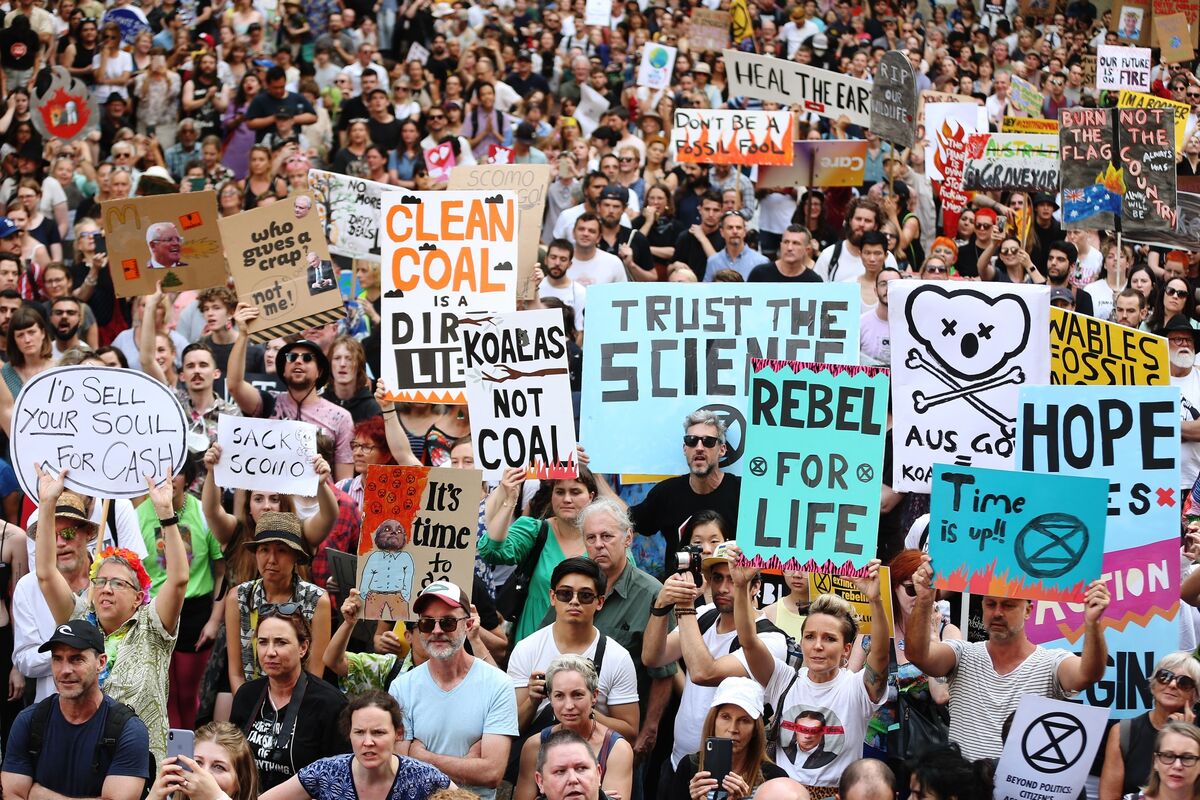
Demonstrators carry placards during the Fund The Firies And Demand Climate Justice Protest in Sydney, Australia, on Friday, Jan. 10, 2020. The fires in Australia have come as the country is polarized by the debate over global warming. The government has downplayed the link between the fires and climate change and Prime Minister Scott Morrison is not bowing to demands from environmentalists for more concerted action. Photographer: Brendon Thorne/Bloomberg
A judge dismissed a long-running legal challenge against Santos Ltd., which had accused the Australian oil and gas producer of misleading investors over its climate strategy.
A Santos Ltd. pilot well operates on a farm property in Narrabri, Australia, on Thursday, May 25, 2017. A decade after the shale revolution transformed the U.S. energy landscape, Australia — poised to overtake Qatar as the world’s biggest exporter of liquefied natural gas — is experiencing its own quandary over natural gas.
Australian households — already world leaders in the number of rooftop solar panels per capita — installed as many batteries in the second half of 2025 as they did during the previous five years combined.
A collection of BYD batteries inside a garage of a home in Byron Bay, Australia.
Origin Energy Ltd. will delay the retirement of Australia’s largest coal-fired power station by almost two years to ensure stable energy supply through the roll-out of renewable generation.
A stockpile of coal at Eraring Power Station in Eraring, New South Wales, Australia.
Australia’s Akaysha Energy Pty is considering options to raise more funds, including selling a significant minority stake, as demand for energy storage grows, according to people with knowledge of the matter.
Australia’s Akaysha Energy Pty is considering options to raise more funds, including selling a significant minority stake, as demand for energy storage grows, according to people with knowledge of the matter.
Chevron Corp. and private equity group Quantum Capital Group LLC will join forces to buy the international assets of sanctioned Russian oil company Lukoil PJSC, according to the Financial Times.
A Lukoil PJSC gas station in Bucharest, Romania. Photographer: Ioana Moldovan/Bloomberg
Millions of people living on the expanding outskirts of Australia’s major cities face an increasing risk of urban wildfires similar to the deadly blazes in Los Angeles last year.
Homes destroyed by the Palisades Fire in Los Angeles, on Jan. 15, 2025.
UK utility Octopus Energy Group Ltd. has agreed to sell a stake in software unit Kraken Technologies at a valuation of $8.65 billion as an initial step toward spinning the business off.
Engineers prepare to install an Octopus Energy Ltd. Cosy 6 heat pump at a residential property in Derby, UK, on Tuesday, July 15, 2025. In order for the share of households with heat pumps to go from 1% now to its goal of 50% by 2040, the Climate Change Committee says consumers will need to be enticed with subsidies.
 Anmelden