President Trump has not yet decided whether to resume military strikes on Iran, but Defense Secretary Pete Hegseth told lawmakers that the Pentagon had “a plan to escalate if necessary.”
A report from the Congressional Budget Office said that space-based interceptors, which do not currently exist, would probably consume 60 percent of the total cost.
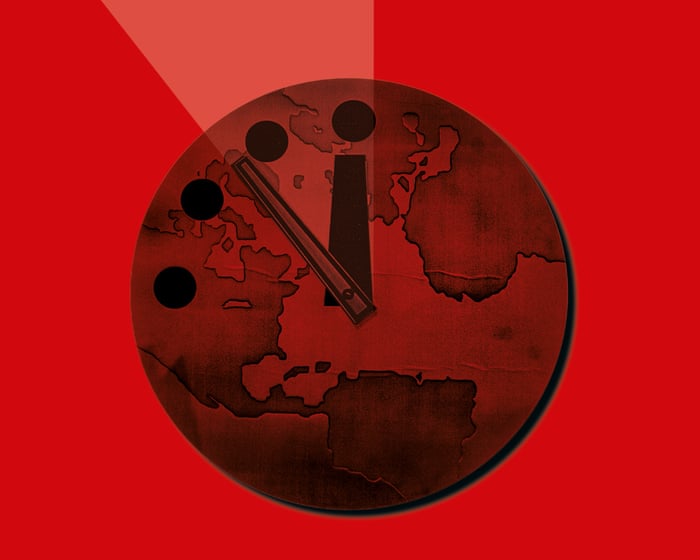
With the war on Iran, Ukraine, AI and climate breakdown increasing the likelihood of a nuclear war, the clock stands closer to midnight than ever before. So who decides how many seconds we have left – and can we buy ourselves more time?
The Earth is getting hotter. Conflicts are raging, in the Middle East and Ukraine, each increasing the chance of nuclear war. AI is infiltrating almost every aspect of our lives, despite its unpredictability and tendency to hallucinate. Scientists, tinkering in labs, risk introducing new, deadly pathogens, more destructive than Covid. Our pandemic response preparedness has weakened. The Doomsday Clock – a large, quarter clock with no numbers, keeps ticking, counting down the seconds until the apocalypse. Tick. Tick. Tick. In January, we reached 85 seconds to midnight. Experts believe humanity has never stood so close to the brink.
“What we have seen is a slow almost sleepwalk into increasing dangers over the last decade. And we see these problems growing. We see science advancing at a rate that defies our ability to understand it, much less control it,” says Alexandra Bell, CEO of the Bulletin of the Atomic Scientists, the organisation that sets the Doomsday Clock. She speaks of the “complete failure in leadership” in the US and other countries, which are doing little to address global, catastrophic threats, even as they feed into one another. Climate change increases global conflict, for instance, and the incorporation of AI into nuclear decision-making is, frankly, terrifying.
For more than a decade, Besnik Kelmendi has been under US sanctions for facilitating the alleged drug trafficking operations of his father, Naser, yet in that time he obtained a gun licence in Kosovo with the help of a senior anti-drugs officer.
Court orders detention for bank owner Aleksandar Djukanovic, brother of the country's former president, after police seized firearms, ammunition and ballistic vests at his family home.
Months after it was supposed to be ready, the government says it’s still reviewing a draft law tightening gun ownership rules, after calls for reform sparked by two mass shootings.
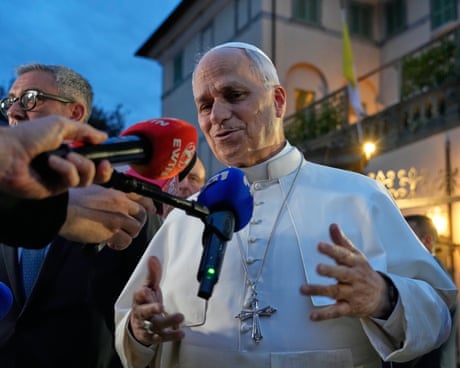
Pope Leo has said he has never supported nuclear weapons and that those who criticise him need to speak the truth, in response to Donald Trump’s latest tirade accusing him of “endangering a lot of Catholics” with his stance on the Iran war.
Speaking to journalists on Tuesday night after leaving the papal retreat in Castel Gandolfo, near Rome, the first US-born pontiff said: “The mission of the church is to preach the gospel, to preach peace.”
In December 1982, South African Rodney Wilkinson walked four bombs into Koeberg power station – the crown jewel of the apartheid state – pulled the pins and then left on his bicycle. How did he do it?
At 21, Rodney Wilkinson was the best fencer in South Africa: national champion in foil and sabre, second in epee. He had toured Europe and Argentina. He had not stood on the Olympic podium, because South Africa was banned. The apartheid state had taken that from him, along with everything else it took from everyone.
One evening in August 1971, Wilkinson stood in the gym at the University of the Witwatersrand in Johannesburg, foil in hand. He was facing his coach Vincent Bonfil, a 25-year-old Englishman who had represented Britain as a reserve at the 1968 Mexico Olympics, and who was now in Johannesburg finishing a master’s thesis in metallurgy. They were working on a technique in which both fencers lunge simultaneously, and the one who reads the other’s move a split second earlier wins the point. They came at each other. Wilkinson’s foil caught the edge of Bonfil’s sleeve. There was a pop.
If lawless aggression by ‘might is right’ nuclear-armed powers spreads unchecked, what other option do middle-ranking countries have?
With every bomb dropped, ship seized and blood-curdling threat of annihilation, Donald Trump increases Iran’s incentive to reject his “grand bargain” peace deal and sprint instead to acquire nuclear weapons for future self-defence. Justifying his declaration of war on 28 February, Trump claimed that Iran – and primarily its nuclear programme – posed an “imminent threat”. But Iran does not possess nukes. The US and Israel do.
US intelligence chiefs and UN inspectors agree there’s no firm evidence that the regime, while developing its technical capabilities and keeping political options open, has built, or ever tried to build, a nuclear weapon since at least 2003, when a covert scheme was exposed. But after Trump’s second unprovoked attack in a year, and his vow to bomb Iranian civilisation back to the “stone ages”, that is very likely to change.
Simon Tisdall is a Guardian foreign affairs commentator
President Trump withdrew from the Obama-era nuclear accord in 2018, saying it was the worst deal ever. But Iran responded with an enrichment spree that haunts the negotiations to this day.
In February in preparation for a possible war with the United States, Iran moved missile launchers into positions within striking distance of Israeli and American military forces.
Developments in Berlin and Tokyo show how far the strategic environment has shifted in response to authoritarian threat and American unpredictability
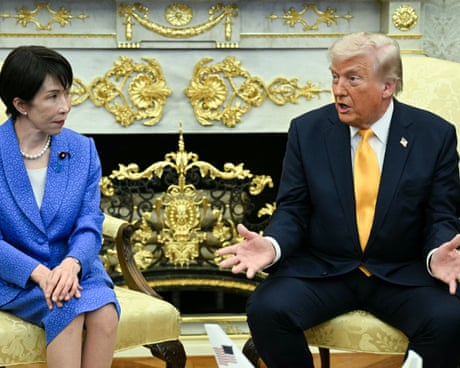
When Donald Trump hosted Sanae Takaichi, the Japanese prime minister, last month, he could not resist a gratuitous reference to Pearl Harbor. The US president is impelled to trash longstanding alliances. He has done more than anyone to demolish the postwar global order.
This week alone, the Polish prime minister, Donald Tusk, questioned whether the US would be “loyal” to Nato if Russia attacked. A Pentagon memo reportedly floated suspending Spain from Nato and reviewing support for the British claim to sovereignty over the Falkland Islands. And a report said US officials believe that it has depleted munitions so rapidly in Iran as to put in question contingency plans to defend Taiwan against a Chinese invasion in the near future.
Do you have an opinion on the issues raised in this article? If you would like to submit a response of up to 300 words by email to be considered for publication in our letters section, please click here.
The conflict has morphed into a volatile standoff in the Strait of Hormuz, as the economic costs mount and President Trump faces a political backlash at home.
A satellite image from February showing construction on buildings at the Isfahan nuclear site in Iran that were destroyed during U.S. airstrikes last June.
President Trump has ridiculed President Barack Obama and the agreement, which he withdrew from during his first term. His critics say he could have avoided a war had he left it in place.
Iranian leaders fear being burned again by President Trump, who tore up a nuclear agreement reached during the Obama administration after lengthy negotiations.

 Anmelden