❌

Lese-Ansicht

‘Best player England has developed’: Olise’s rise from Hayes to the World Cup

One of the Bayern and France playmaker’s early coaches tells the story of how a move to Reading kickstarted a career

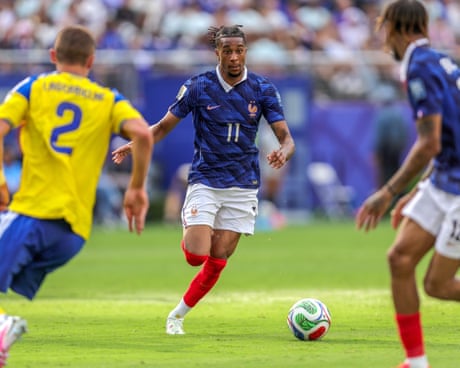
If Michael Olise wins the World Cup, there will be a corner of a Hayes housing estate that is for ever France. It is Olise’s corner, a scrap of parkland grass among the west London suburban homes where a seven-year-old practised his football with his brother, Richard. “Football in these conditions, it’s just freedom,” Olise told L’Équipe last month. “It’s not really learning in the strict sense. It was simply the pleasure of playing football. I just loved it.”

Sean Conlon, one of Olise’s early coaches with Old Isleworthians in west London, recalls: “I would go over to his house and he would be practising outside with Richard. That little estate probably really aided him; there weren’t a lot of cars but it had quite a lot of concrete open space and then a small green. He’d just be practising out here all the time, obsessed with football.”

Continue reading...

© Photograph: Scott Rausenberger/ZUMA Press Wire/Shutterstock
© Photograph: Scott Rausenberger/ZUMA Press Wire/Shutterstock

© Photograph: Scott Rausenberger/ZUMA Press Wire/Shutterstock

  •  

From cheap transport to football geekery: how Zohran Mamdani won the World Cup

The New York City mayor has made his mark on the tournament to cap an extraordinary run of sporting success over the last few months

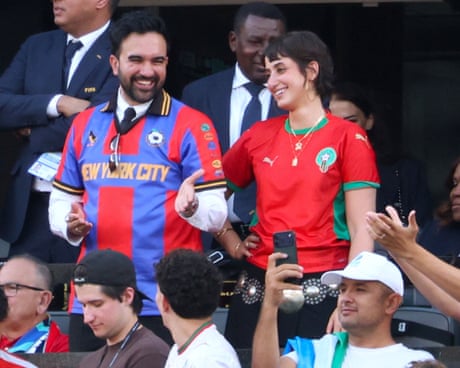
A stunning evening sun was setting behind Union City on Wednesday. It made it slightly harder to see the giant screen that had been set up for the Brazil v Scotland watch party in Hudson River Park, but not enough to ruin the vibe of a New York City World Cup evening. Partly it didn’t matter because the clutch of Brazilians watching the game, kitted out in canary yellow and “100% Jesus” headbands, were already in full samba mode, given how comfortable their 3-0 win was. But mainly it was because this was a beautiful World Cup moment.

This is my eighth World Cup. The outdoor screening, combined with the gentle breeze off the Hudson – I had already navigated the hubbub in Times Square, colonised by chanting Germans and flag-waving Ecuadorians – was as captivating as anything I’ve experienced in Marseille, Seoul, Cape Town or Rio de Janeiro. New York City is perhaps the only place in the world where a World Cup may go unnoticed but the tournament genuinely feels like an intrinsic part of life in large parts of the city, certainly since the Knicks’ victory parade finished. In fact, the feelgood endorphins seem to have segued seamlessly into World Cup fever for many in the city.

Continue reading...

© Photograph: Guerin Charles/ABACA/Shutterstock

© Photograph: Guerin Charles/ABACA/Shutterstock

© Photograph: Guerin Charles/ABACA/Shutterstock

  •  

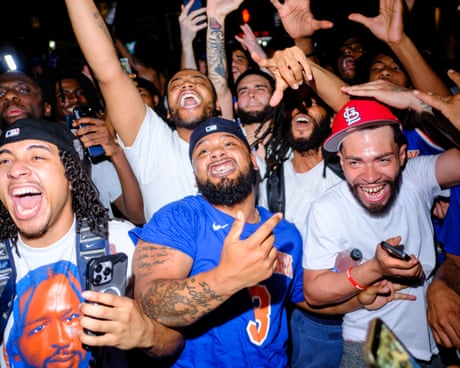
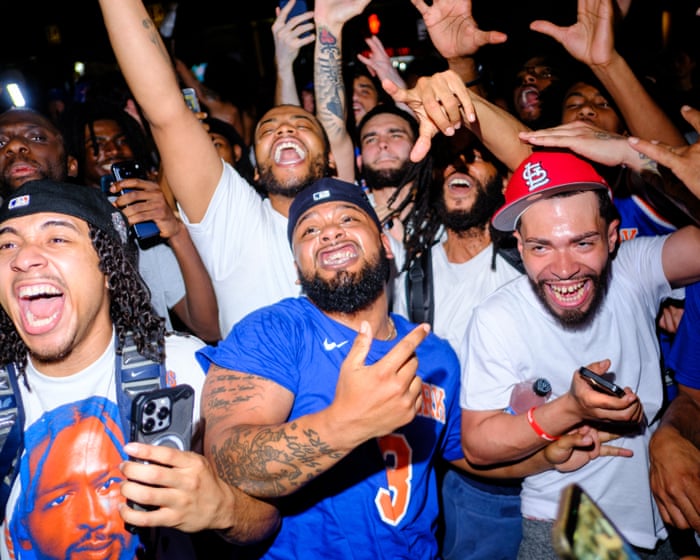
A New York night: the World Cup may be in town but the Knicks rule in Manhattan

The bar may have been busy for the football but it was nothing compared with the crowd that surged in as team ended 53-year wait for the NBA title

At John Doe’s bar on 28th and 5th in Manhattan, the crowd was already heaving energetically by early evening, as a multitude of TV screens beamed Vinícius Júnior’s equaliser for Brazil, responding to Ismael Saibari’s opener for Morocco. With competing nations’ flags as bunting and inflatable footballs – the correct, round kind – hanging from the roof, there was no lack of World Cup visibility. Football shirts abounded, with Brazilians here and the odd Moroccan shirt there, as well as a Manchester United and Casemiro fan somewhat aghast at the mobility of his hero.

Yet there could be no doubting the main event in town. Despite the fact that New York’s mayor Zohran Mamdani was at MetLife Stadium for the football – a subdued groan met his appearance on the TV screen, followed by loud, defiant Democrat cheers – this was a mere curtain-raiser for the real show. The New York Knicks were bidding to end a 53-year wait to win the NBA title and were playing the San Antonio Spurs in Texas.

Continue reading...

© Photograph: Julius Constantine Motal/The Guardian

© Photograph: Julius Constantine Motal/The Guardian

© Photograph: Julius Constantine Motal/The Guardian

  •  

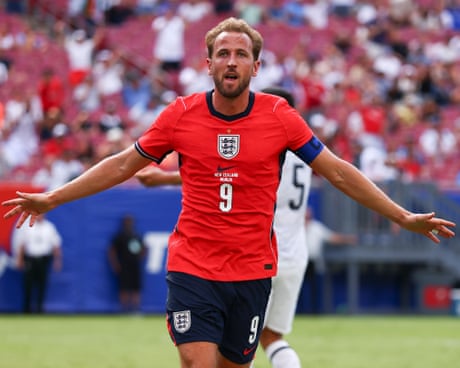
Bayern’s best ever? Kane in Ballon d’Or conversation but World Cup is pivotal

The England captain has finally assumed his place at the pinnacle of the game – it has been a long road to this point

The Bayern Munich president, Uli Hoeness, has a propensity for hyperbole, so when he labelled Harry Kane as the best transfer the club has ever made in the wake of the DFB-Pokal cup final, which Bayern won 3-0 thanks to a Kane hat-trick, you wondered whether he was simply dialling up the rhetoric. A month on, emotion subsided, it appears not. “He absolutely is the best we’ve had,” another Bayern insider confirms.

It’s impossible to overstate the unfussy way Kane has won over not just Bayern Munich but, perhaps, global football opinion. Kane’s travails through Euro 2024, when he still had yet to win a trophy, suggested a player on the downslide. Combined with the scepticism that met his Golden Boot at Russia 2018 among foreign observers – “top goalscorer despite not having scored from the quarter-finals on,” sniffed Le Journal du Dimanche – indicated that his six most productive years as a pro might have been regarded a tireless yet vain effort.

Continue reading...

© Photograph: Dustin Markland/Shutterstock

© Photograph: Dustin Markland/Shutterstock

© Photograph: Dustin Markland/Shutterstock

  •  

Arteta ready to take final step on Arsenal’s 20-year journey to redemption

Two decades of disappointment followed Parisian nightmare of Lehmann, Eto’o and all that, but now a first Champions League title is in sight

They left London in their thousands, full of hope and devotion, heading for Paris in the springtime, yet romantic anticipation lasted all of 18 minutes, which was when Arsenal’s goalkeeper, Jens Lehmann, was sent off in the 2006 Champions League final against Barcelona at the Stade de France.

Twenty years on, as Arsenal fans again travel in anticipation, this time to Budapest, for the club’s second Champions League final, you could argue that Arsenal hearts have been a little broken ever since.

Continue reading...

© Photograph: Tom Jenkins/The Guardian

© Photograph: Tom Jenkins/The Guardian

© Photograph: Tom Jenkins/The Guardian

  •  

How Arteta overcame setbacks, crises and boos to defy doubters at Arsenal

Manager’s early seasons were far from plain sailing but insiders credit club’s owners for staying the course

It didn’t start well for Mikel Arteta and Arsenal. On a crisp December night in 2019 at about 1am in a Manchester suburb, Vinai Venkatesham stepped out of Arteta’s home. The Arsenal managing director looked around, satisfied with his meeting. Arteta had just outlined a “hugely impressive” five-year plan to rebuild a club reeling from Arsène Wenger’s departure and Unai Emery’s failed succession. Venkatesham stepped into his car and was driven away with his colleague Huss Fahmy.

The club were about to take a huge gamble, but one with which they were increasingly comfortable. For many Arsenal executives, Arteta had won the interview round in 2018 when Wenger left. Yet it seemed too much to ask a 36-year-old rookie to manage a seismic transition and Emery had pedigree and experience; Arteta had charisma and a strong playing record.

Continue reading...

© Photograph: Peter Cziborra/Action Images/Reuters

© Photograph: Peter Cziborra/Action Images/Reuters

© Photograph: Peter Cziborra/Action Images/Reuters

  •  

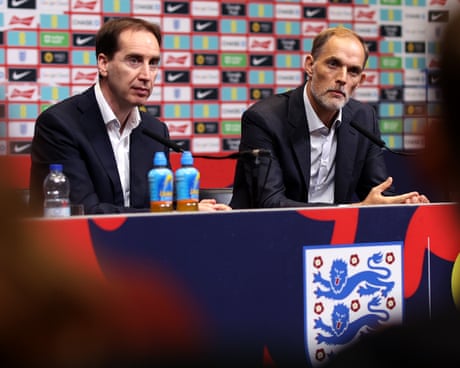
How Tuchel wowed the FA during secret meeting at Munich airport

In this exclusive book extract, Rob Draper and Jonathan Northcroft reveal the remarkable process which led to Thomas Tuchel’s appointment as England manager

In 2024, when the Football Association was tasked with finding Gareth Southgate’s successor, Mark Bullingham hired two external data companies who built a profile of what successful international managers looked like then tailored it to mesh with England’s player base.

The top 50 coaches in the world were matched against the criteria and a shortlist emerged. “I joked with the team afterwards, because it came up with a list you and I could have come up with in the pub in 10 minutes,” Bullingham, the FA’s chief executive, says.

Continue reading...

© Photograph: Ryan Pierse/Getty Images

© Photograph: Ryan Pierse/Getty Images

© Photograph: Ryan Pierse/Getty Images

  •  

Guardiola ready to benefit as fellow Cruyff disciple Arteta strays from path

Manchester City and Arsenal managers were both schooled in the expansive Barça tradition but the latter opting for caution could be his team’s undoing

When Pep Guardiola was preparing for the challenge of taking on Jürgen Klopp’s peak Liverpool team at Anfield in February 2021, training that week at Manchester City was a little different, according to Oleksandr Zinchenko. Guardiola’s instructions seemed counterintuitive. “Guys, let’s start from the goal-kick, I want you to make at least three or four touches on the ball,” the manager told them. “Most of the teams come to Anfield and shit themselves. They want to play one touch, two touch. ‘Oh, don’t give me the ball! Oh you take it!’ But you have to play with big balls at Anfield! Big balls! ‘Give me the ball!’ Demand it! If you need to dribble past two or three players, do it. But play football. I want you to play football.”

Zinchenko recalls that Guardiola made the same speech before they walked out at Anfield. “Teams coming here are scared. They play one or two touches, and that’s what Liverpool like, because they get the ball back so quickly. I want you to be brave. Play your football!” as Zinchenko puts it in his autobiography, Believe. Admittedly that game came in the midst of City’s record-breaking 21-game winning run that season but was also Guardiola’s first win at Anfield, so not dissimilar to the title showdown at the Etihad Stadium on Sunday with Arsenal.

Continue reading...

© Photograph: Javier García/Shutterstock

© Photograph: Javier García/Shutterstock

© Photograph: Javier García/Shutterstock

  •  

The day English football changed: 10 years on from Manchester City naming Pep Guardiola

That 1 February 2016 announcement led to Johan Cruyff’s gospel spreading to all corners of our game – and a bromance with Neil Warnock

It wasn’t quite without fanfare but when Manchester City announced, 10 years ago on Sunday, that Pep Guardiola was to be their manager from the next summer, it was a banal, bald press release that brought English football the news that would change it for ever. That was a simpler time, pre-Brexit and Donald Trump’s presidency, and before centre-halves in League Two would split wide for the keeper to pass out from the back to the holding midfielder, dropping in to receive the ball as a false 9 came deep to link with full-backs stepping into midfield.

“It’s not about coaches adapting to English football,” said Jordi Cruyff in 2016 as Guardiola began to make his mark on England. “It’s about English football adapting to the new things of the game.” And yet that typical Cruyffian confidence looked like hubris when Guardiola’s Manchester City got hammered 4-2 by Leicester, 4-0 by Everton and experienced Champions League humiliations at Barcelona and Monaco in that first season.

Continue reading...

© Photograph: Oli Scarff/AFP/Getty Images

© Photograph: Oli Scarff/AFP/Getty Images

© Photograph: Oli Scarff/AFP/Getty Images

  •  

‘A quick learner’: how Declan Rice went from Chelsea reject to Arsenal’s Rolls-Royce

Midfielder will be part of the conversation for a Ballon d’Or if he continues his ascent with trophies for club and country

Declan Rice likes to call it “clean feedback”, which sounds like a euphemism for a bollocking, though he would probably say that is a misconception. Rather, it is part of the reason why Rice is being discussed as one of the best players in the world.

“You can’t eff and blind, you can’t bully people,” says Terry Westley, the head of West Ham’s academy when Rice was there. “But we should be able to have a conversation and say: ‘Look, that ain’t quite good enough and we want to help you because this is what we need to do.’

Continue reading...

© Photograph: Dylan Martinez/Reuters

© Photograph: Dylan Martinez/Reuters

© Photograph: Dylan Martinez/Reuters

  •  
❌