Guardian reader Paul reached out via email and is apparently deep in the comments section of a 20-year-old Messi article we published here at the Guardian. I can only hope Guardian reader “snafuclarke” has fully recovered from such a scorchingly terrible take:
don’t kid yourselves. messi is currently hugely overrated. the amount of hype this lad gets has never matched his performances on the pitch the last game aside.
The Argentine’s career with Argentina was singular, and his exit is a reminder that all good things come to an end
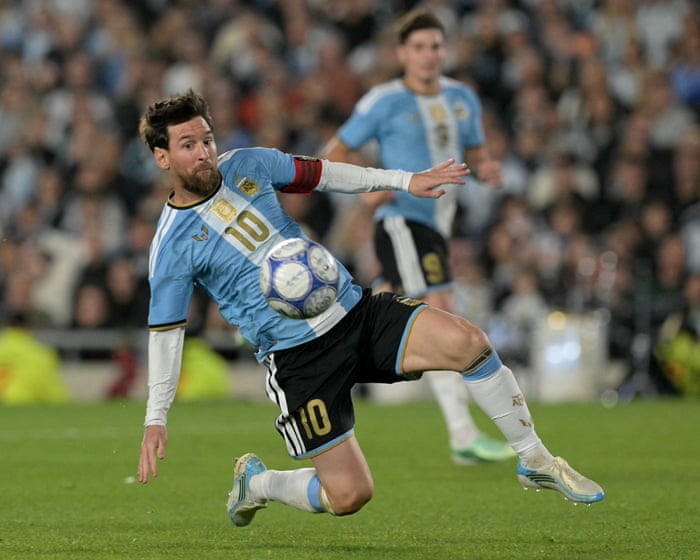
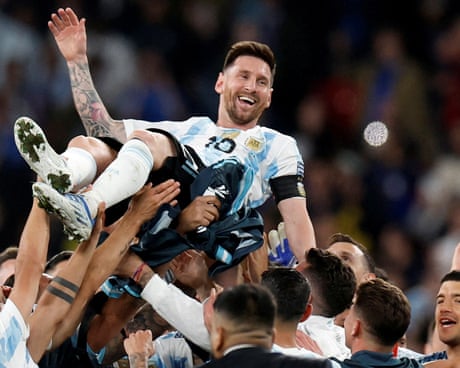
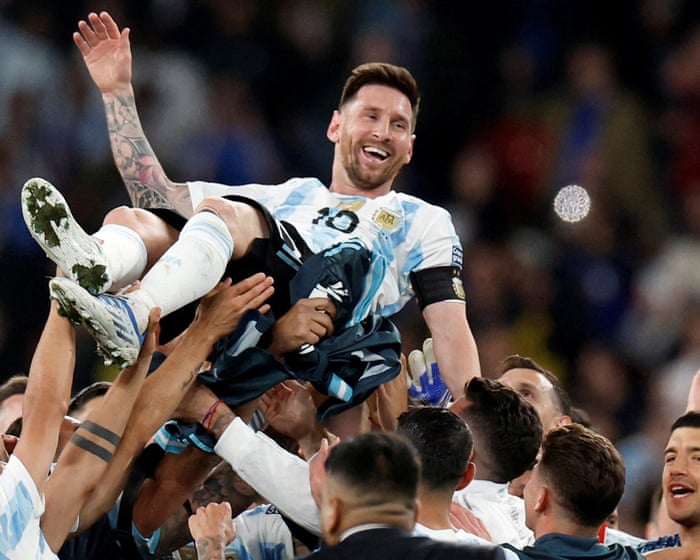
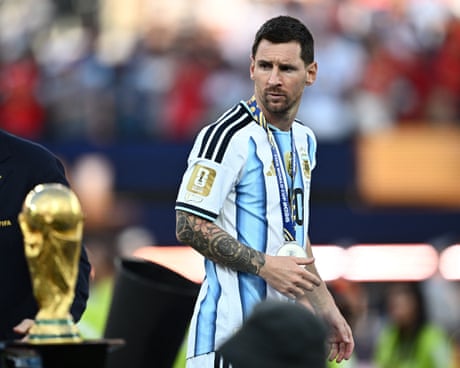
IIt was among the defining moments of the 2026 World Cup: Lionel Messi standing arms akimbo, looking up towards Argentina’s fervent supporters after losing the final. Tears streamed down his face after his team’s embarrassing loss to Spain in what we now know was Messi’s final match wearing that famous Argentina kit.
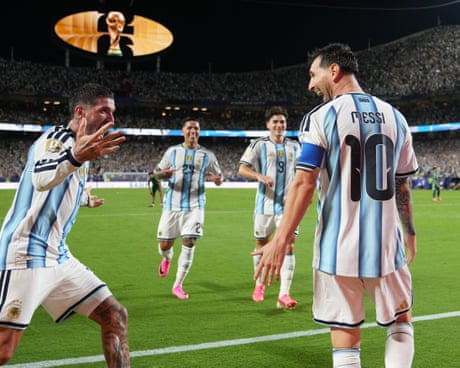
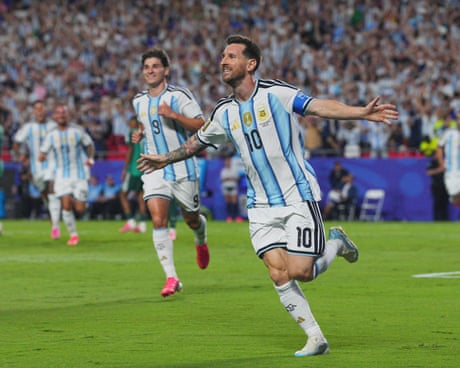
It was not the first time he’d cried at the tournament. There had been tears of joy in Argentina’s opening match, when Messi rolled back the clock to his glory days with a trio of spectacular goals against Algeria. There had been more when his brace against Austria pushed Argentina through to the knockout round as group winners, and even more when his equalizer against Egypt threw la Albiceleste a much-needed lifeline. Later, the world found out that Messi had been struggling all the while with the health struggles of his father, Jorge, a fact that clearly weighed heavily on him as Argentina made a dramatic return to the final in a bid to defend their 2022 title.
Game’s greatest player will not see his legacy sullied by defeat to Spain but his team’s display destroyed the game
Playing on the grandest stage in sport for the last time, Lionel Messi seemed almost certain to provide one last memorable moment in this World Cup final.
Yet as the sun ducked behind the west stand of New York New Jersey Stadium on Sunday, it became clearer and clearer that Argentina had lost the magic they had carried through this tournament. And as Spain gradually wrested control, one was left to confront reality: Messi, and Argentina, had finally run out of time, having long since given in to their worst instincts in a 1-0 defeat.
The tournament’s mascot came to herald the ubiquitous, commercial aims of a growing international spectacle
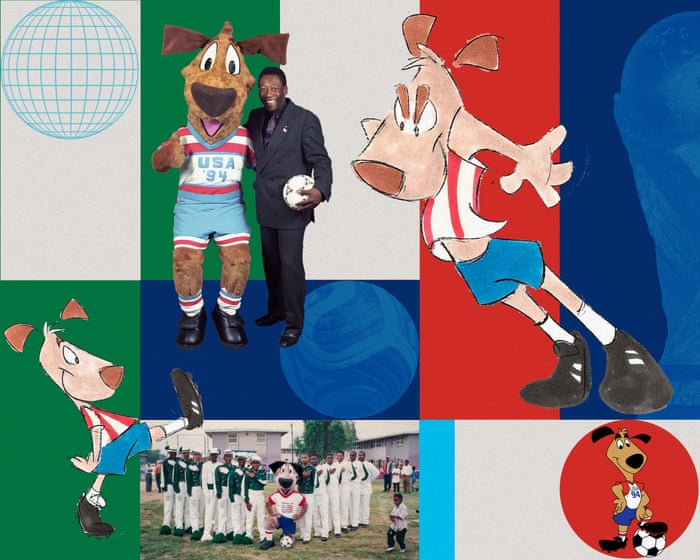
Deep within a dark warehouse in Hillsborough, North Carolina, there sits a severed head. Encased in plastic, perfectly preserved and seemingly begging to be reanimated, it belongs to an American soccer legend.
For a seismic summer 32 years ago, Striker the dog was more ubiquitous than any of World Cup 94’s players, plastered all over billboards, Coke cans, key chains, caps and hundreds of other items. Kids carried around Striker dolls. Grown men played Striker-themed pinball machines and Super Nintendo games and posed for photos with the pup in stadiums.
The image of the national icon has been ever present through this World Cup, in banners and songs and memory. It adds a fresh layer to Wednesday’s semi-final
Not two minutes after his side’s dramatic, extra-time quarter-final victory over Switzerland on Saturday, the Argentina head coach, Lionel Scaloni, was already getting asked about the semi-final. Looming on the horizon was a match against bitter rivals England.
“This won’t just be a special game from a footballing standpoint,” the reporter asked in Spanish, “but also in an emotional sense. How do you imagine you and the players will come out for this game and what message would you give to all of us Argentines that are …”
Close calls against Cape Verde and Egypt show Scaloni’s side are vulnerable, despite all the brilliance of Lionel Messi
It is among the defining moments of this World Cup: Lionel Messi wandering the pitch in Atlanta with tears rolling down his face. Minutes earlier, Argentina had been down two goals to Egypt and on the brink of elimination in the last 16. Messi had missed a penalty and was set to bear blame for the result. Instead, the Argentina legend created the same magic he always seems to, spearheading a miraculous, three-goal swing in just over 10 minutes and pushing the Albiceleste into the quarter-finals.
And now he was crying. And so were his teammates. And so was his head coach, Lionel Scaloni, who could not contain his emotion in a post-game interview. His own players, the coach says, have taken to calling him el llorón. The crybaby. “I can’t even look at you,” Scaloni told a touchline reporter, in tears. “I’m sorry. I’m obviously very emotional. What a group of players, brother. I’m sorry. That’s it, I have to go.”
The plane that French team used after match with Paraguay flew 44 deportation-related flights this year alone
The French men’s national soccer team, whose star Kylian Mbappé is one of the world’s most outspoken athletes against far-right politicians, has been using a charter airplane company that is at the heart of the Trump administration’s mass deportation campaign.
Images of the team posted on social media and flight tracking data show the French team have used Global Crossing Airlines (GlobalX) for at least three domestic flights between their World Cup games and base camp in Boston. That same airline charter company has operated more than half of ICE’s removal flights in 2024 and 2025.
The US had big problems in their last-16 defeat, but Mauricio Pochettino and his team said that the discourse around the red-card ban reversal wasn’t one of them
For a while, it seemed the only story in the lead-up to the US men’s national team last-16 matchup against Belgium was the presence of Folarin Balogun. In the end, Balogun’s presence didn’t really matter at all. Not on the field, at least.
The forward was serviceable in the USMNT’s 4-1 loss and even earned the foul that led to the Americans’ lone goal, a deflected free-kick off the foot of midfielder Malik Tillman. He was far from the dynamo he’d been in the US’s other World Cup matches. But Balogun alone would never have saved a US team who were comprehensively dismantled by a technical Belgian side.
In pushing Fifa to reverse Folarin Balogun’s suspension, the president did the most American thing possible: assert unasked-for power to get his way
The story of Garrincha’s red card in the 1962 World Cup is the stuff of legend. The Brazilian great was sent off in the semi-final for lashing out at an opponent, but back then Fifa had no automatic one-match suspension in place. So a disciplinary committee convened the next day to decide his fate for the final.
As the story goes, the assistant referee who had the best view of the offense was paid off and disappeared, and the president of Chile, the tournament’s host, put in a call to Fifa, urging them to decide against any additional suspension. He did so for the sake of keeping one of the tournament’s most entertaining players on the field. Garrincha emerged scot-free and Brazil won their second World Cup.
The Albiceleste’s last-32 match against Cape Verde will see the Inter Miami star’s paths for club and country meet at last
Take a walk around Miami’s Little Buenos Aires neighborhood, and nearly everyone there will tell you a story about meeting Lionel Messi.
There’s the bakery employee, working at the counter, who will tell you about Messi’s visitthere and how much the Inter Miami and Argentina captain enjoyed the medialunas. Down the street, someone at the coffee shop will talk of spotting Messi in traffic, behind the wheel of a luxury SUV. Messi, that person and others will tell you, will flash you a wide smile as he waits for the signal to change, and might even entertain the idea of an autograph.
Has World Cup fever really hit the US? Where did Country Roads come from?And just how bad are hydration breaks? US reporters Alexander Abnos, Pablo Maurer and Jeff Rueter answered your World Cup questions
AncientFootsteps asks: Many of the pitches used appear to be quite small (perhaps because they are designed for American football which uses a narrower field). Is this really the case? And, if true, are teams taking this into account in their selection and tactics?
Jeff: Field dimensions are uniform across every venue at every World Cup, so that’s 105 meters (115 yards) long by 68 meters (74 yards) wide. The difference, as you’ve spotted, is that their stationing in an NFL stadium shows just how narrow those fields are by really cutting into the space around the pitch. Throw-ins and corner kicks look claustrophobic. Fans are perhaps unusually close to the benches. There are no expansive running tracks to serve as a dryland moat, as there were at Italia 90. I think a lot of casual American sports fans are coming to appreciate the amount of space available in this sport – just wait until they learn you can comfortably fit a regulation basketball court inside one penalty box.
Jeff: Surprise: Cape Verde! I’ll be gutted if they can’t advance after famous draws against Spain and Uruguay – though I expect them to beat Saudi Arabia.
Disappointment: I had Ecuador into the business end because of how stout their defence is, but I completely overlooked the lack of chance creation and alternative scoring threats beyond Enner Valencia.
Long after the dust had settled on Argentina’s 3-0 group-stage victory over Algeria on Tuesday night, Algeria and Bayern Munich midfielder Ibrahim Maza wearily emerged from behind a curtain and stepped up to the microphone.
Maza had played well, even assisting on Algeria’s disallowed first goal. He’d also had a front row seat to a Lionel Messi masterclass, just a few yards away from Argentina’s captain when he scored his third goal of the evening and tied Miroslav Klose as the World Cup’s all-time leading goalscorer. In short order, he was asked to expand on what made Messi unplayable on Tuesday evening.
Those in attendance at Argentina’s opening match against Algeria could be forgiven, for a moment, for thinking they were at one of the great Argentinian cathedrals of football – La Bombonera, or maybe the national stadium, El Monumental. Kansas City Stadium, awash in the colors of the Albiceleste, roared with the sound of nearly 70,000 Argentine supporters serenading their team, and their hero, in rapturous song on Tuesday night.
The sportswear giant says it’s aware of the strange seam on some of the new shirts, and is looking into how to address it
When Nike rolled out its collection of World Cup kits in late March, fans and pundits alike largely approved. The US men’s national team got arguably their most distinctive pair of shirts in decades, while other federations – France, England, Canada and Uruguay among them – earned strong reviews.
Over the last international break, when players took the field in the kits for the first time, many fans couldn’t help but become fixated on one singular detail of the new shirts: a somewhat unsightly bulge along the shoulder seam.
Belgium score four in second half, Lukebakio nets double
USA face Portugal on Tuesday night in Atlanta
The US men’s national team entered its matchup with Belgium at Mercedes-Benz Stadium in Atlanta on Saturday riding a wave of momentum, needing a solid performance to continue to build excitement ahead of this Summer’s World Cup, played in part on home soil.
Instead, they struggled mightily against a talented Belgium side and left with more questions than answers. The 5-2 defeat, featuring five straight goals for the Belgians after a US opener, was an embarrassment and easily among the USMNT’s worst losses of head coach Mauricio Pochettino’s tenure. At times, it felt the margin of victory could’ve been significantly wider.
As a player, Mauricio Pochettino suffered under World Cup pressure. As a manager, he hopes to help the USMNT’s belief in the face of it
US men’s national team head coach Mauricio Pochettino probably understands the pressure of playing for your national team in a way few of his players can.
Pochettino was not involved in Argentina’s World Cup plans in 1994 and 1998. He finally made the squad as a veteran in 2002, part of a stacked team favored by many to win the entire tournament. The country itself was in the midst of an unprecedented economic crisis and an entire nation turned to La Albiceleste for a bit of hope.
Funds promised for security have not been received
Officials warn of potential cancellations to fan festivals
Local and national officials expressed concern on Tuesday that the ongoing partial government shutdown in the United States could adversely affect planning and preparation for the 2026 World Cup, which is just over 100 days away.
In a hearing before the House committee on homeland security, representatives from Miami, Kansas City and New Jersey – three locations that will host a combined total of 21 matches in the tournament, including the final – said they are still waiting on federal funds to be released to their respective local agencies. Last July, lawmakers pledged $625m in federal assistance toward World Cup security via the Trump administration’s “big beautiful” policy bill.
Miami star confronted officials in a doorway after 3-0 loss
League determined area was not off-limits to players
MLS has suspended players for entering officials’ room
Major League Soccer has cleared Lionel Messi of wrongdoing after the Argentinian appeared to pursue match officials after Inter Miami’s season-opening loss to LAFC on Saturday evening.
In a video posted to X by Síntesis Deportes reporter Giovanni Guerrero, Messi appears to confront match officials as they entered a doorway within the LA Coliseum after the match, a 3-0 win for LAFC. Miami forward Luis Suárez is seen restraining Messi, who slips out of his teammate’s grip and disappears behind a door. He emerged seconds later and retreated with Suárez to Miami’s locker room.

 Anmelden