These yachts are highly popular with the ‘super-bourgeoisie’ – and getting bigger. Can anything be done to stop them destroying our seas?
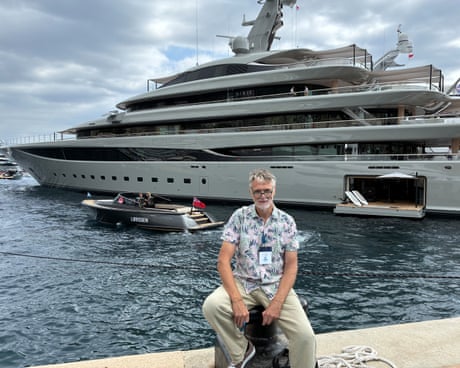
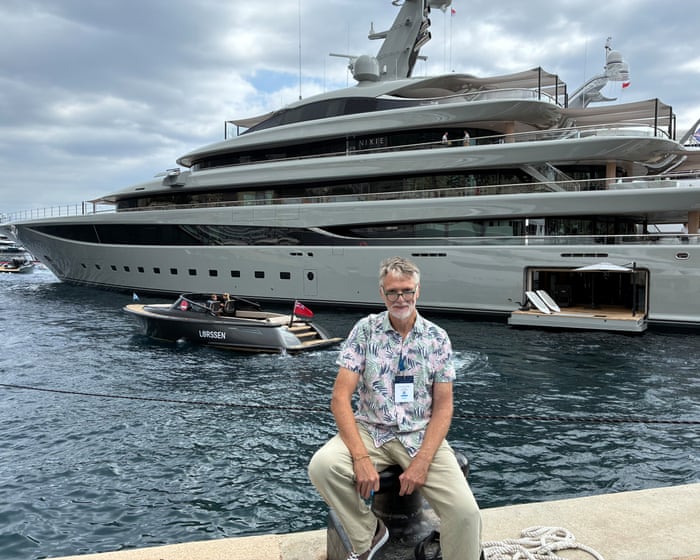
Who knew? Apparently everyone did, apart from me: you don’t wear shoes on a superyacht. Now, about to step on to my first teak deck at the Monaco Yacht Show, I’ve got to take my trainers off, and I’m having a sock panic. Have they got holes? Do they even match? Do they smell?
To be honest, I’ve come dressed all wrong for Europe’s big annual superyacht trade exhibition. The code for men seems to be crisp and tucked in, blazers and chinos, navy and white, sculpted hair and designer sunnies. (I went colourful, loose, casual). For women, it’s something like Riviera elegance. Everyone – whether they’re Italian, French, English, German, American, exhibitors, buyers, brokers, charterers – seems to know each other. The international superyacht community seems to be a close-knit one, and I’m not part of it. Yet.
Extremists are on the rise globally – but UK activists have seen them off in the past in everything from football, politics, music and more. How did they do it?
Tariq Mehmood encountered the far right early – at primary school. “When white children surround you in the playground and sing, ‘God made little black people, he made them in the night, he made them in a hurry, and forgot to paint them white’, and the school doesn’t clamp down on that, then you’re living within the far right. It’s not one organisation, it’s a mass movement.”
The standup has been the host of the panel show Mock the Week for more than two decades. As it returns to UK screens, he discusses its years as a macho bear pit, the dearth of jokes about Brexit – and why it’s important to punch up
Dara Ó Briain is still having photos taken when I arrive at the studio in west London. A comedian requires comedy pictures, so Pål, the photographer, has him sitting on the floor holding up a scroll of the rust-coloured paper that he’s using as a backdrop. It looks as if the roof is falling in on Ó Briain. He calls over to me. “We can tailor the interview to match the pictures,” he says. “Starting with: do you ever feel like you’re trapped in a box?”
Shoot over, he ditches his jacket and we walk up the road to find a quiet corner in a pub. There’s a new season of Mock the Week, the topical satirical panel show that ran for 17 years on BBC Two until 2022 and has now been reborn on the free-to-air channel TLC. A roster of comedians make up two teams and compete in a faux gameshow, ostensibly to answer questions about the previous week’s news, but really just to be funny.
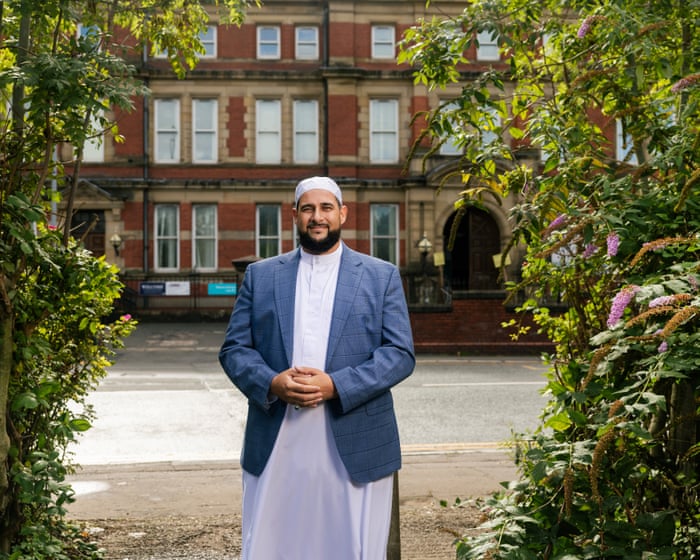
A prospective Restore Britain voter and a Green-supporting Chinese immigrant found some common ground over small-boat crossings, but where did they land on foxhunting?
• Want to meet someone from across the divide? Click here to find out how
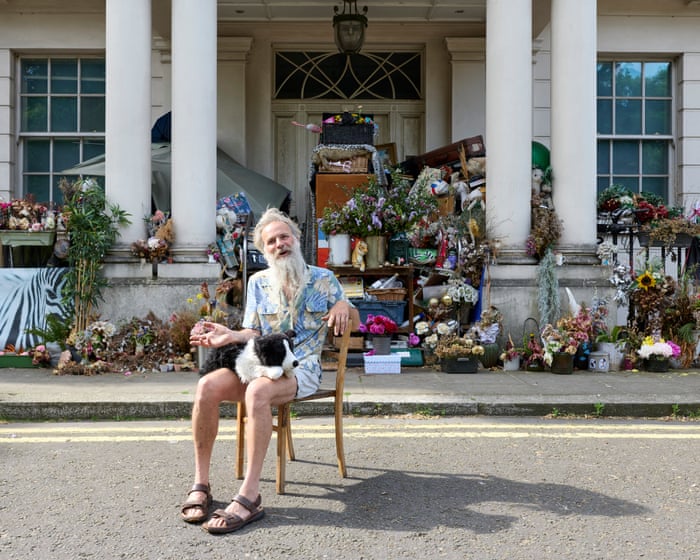
2-8A Rutland Gate had jewel-encrusted bathroom suites and gold wastepaper bins in its 45 rooms, but has lain empty for years. With many people desperate for secure housing, what does the abandonment of this palace tell us about the UK?
When it last changed hands, in 2020, 2-8A Rutland Gate was Britain’s most expensive house, selling for £210m. The word “house” hardly does it justice; palace is probably more accurate. It is in Knightsbridge, one of the most glamorous parts of London, and has 45 rooms, four lifts, an indoor pool and 116 windows, 68 of which overlook Hyde Park.
But no one is enjoying those views. This palace has been empty for years.
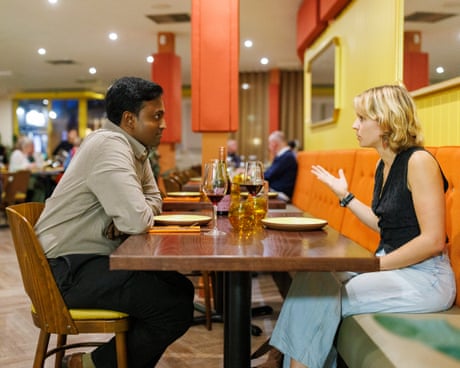
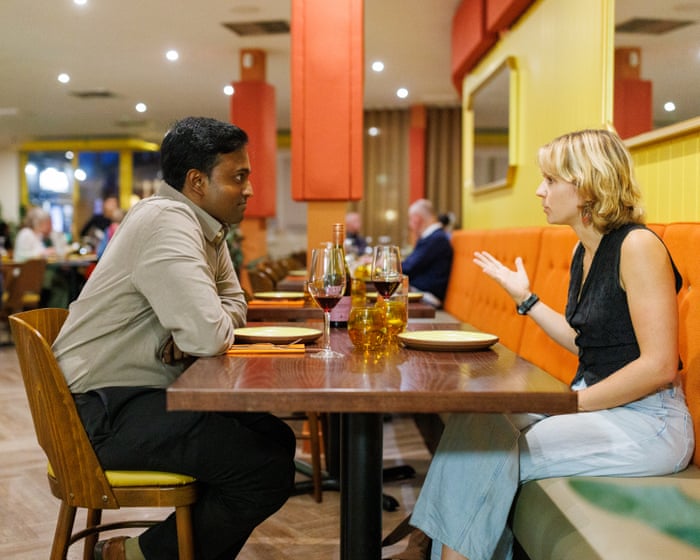
An ‘apolitical’ retired IT manager and a ‘far left’ biologist disagree over tackling global heating – but are they in harmony over truth and reconciliation?
• Want to meet someone from across the divide? Click here to find out how
At 60, Davies is less of a hell-raiser than he once was – but a great deal happier. He talks about the excesses of the 90s, the sexual abuse that made him such an ‘angry boy’, his recent bladder cancer, and fatherhood
It looks as if Alan Davies is in the wrong place. Not as in the wrong venue: he’s here at the Pleasance theatre in Islington, a north London fringe theatre and comedy venue, where we arranged to meet. But he’s in the wrong part of it. Although there’s a stage with a single microphone at standup height, Davies – who has performed here many times – joins me in the auditorium, sitting down at a table. Someone in the shadows is testing the lighting, and suddenly there’s a spotlight on the stage where the mic is. Is it tempting to jump up there and do his thing, even to an audience of one? “It is a bit, yeah,” he admits.
When I started the interview, I’d found that the notebook I’d brought with me contained some diary entries from my 14-year-old son. “Have you got the wrong notebook, or has he been writing in your notebook?” Davies asks. I think B. “Sounds like he wants it to be found.”
Lund Point in east London was once ‘a beautiful community’, according to Tee Fabikun, who has lived there since 1997. Now just four flats are occupied. Why are Fabikun and her friends hanging on? And what happened to the long-promised redevelopment?
Tee Fabikun is sitting in an armchair in her cosy, homely flat, surrounded by her things – papers and letters, family photos, a few Nigerian handicrafts, a forest of houseplants by the window. She is telling me about her neighbours here on the fifth floor of Lund Point, a tower block on the Carpenters estate in Stratford, east London. Next door there’s “a grumpy old man”; well, she thought he was a grumpy old man, but then she saw him in the lift with his granddaughter and he was sweet with her, so maybe he’s not so bad. “There’s always two sides.”
In the next flat along is a young couple who met in the building, maybe in that lift. She was living on a higher floor, but moved down and in with him when they got married, and rented out her place. Then there’s a Bangladeshi family who only speak a little English. Fabikun’s first contact with them was when their daughter knocked on the door holding out an exercise book and just said “homework”; after that Fabikun would often help with her studies. And so on. And it’s not just her immediate neighbours on the fifth floor that Tee knows; she knows pretty much everyone in the 21-storey block.
For 400 years, The Hare and Hounds in Bowland Bridge offered a warm welcome to locals and travellers. Then the rent doubled. With two pubs a day closing in England and Wales, can the community save this 17th-century gem?
The Hare and Hounds in Bowland Bridge, a few miles from Windermere, is exactly how you’d want a Lakeland pub to be. A pretty 17th-century stone building, whitewashed, with a couple of dormer windows poking up from the slate roof and a view of the fells, it was originally a coaching inn on the route from Manchester to Glasgow.
It is not, however, looking its best today. We arrive in a proper Cumbrian downpour. It should be warm and welcoming, with a place by the wood-burner to dry out and down a pint of Wainwright, perhaps. But the door is shut, the curtains drawn in one of the downstairs windows and no sign of life through the other. Attached to the front of the building is a sign; not a pub sign (the name of the pub is painted elegantly in grey over the door), this one has another message: FOR SALE.
It showcased the biggest stars of the day, including Stan Laurel, Harry Houdini, Morecambe and Wise and Shirley Bassey, before becoming a bingo hall, a church and a squat. It was almost turned into flats. What next for Manchester’s forgotten music hall?
It doesn’t look like much from the outside. An inelegant, industrial redbrick block; if you didn’t know, you might guess it’s a biscuit factory. Make that a former biscuit factory, because this is clearly somewhere that was rather than is: entrances are bricked up, drainpipes hang loose, shrubs sprout from crumbling masonry, pigeons come and go from holes in the roof. Pretty much everything within reach of a spray can has been reached; there are tags, Marvel characters, the perhaps surprising news that “God is dead and sheep killed him”.
You know those rocks, though, that look like any old rocks, but when you smash them open they have amazing, sparkling, coloured crystals inside? Amethyst and the like. Well, this building is a bit like them. If you took a wrecking ball to it (and it’s not inconceivable that this will happen), inside you’d find a splendid Edwardian galleried auditorium with gilded rococo plasterwork and plush red velvet seats … albeit covered in pigeon shit.
Half of the most important buildings in the UK are churches and, even when congregations fall away, they are vital community hubs. But many, including beloved St Tyfrydog’s in Wales, which closed in 2020, are decaying. Can they be saved?
There is a sign on the gate leading through the circular stone wall that surrounds St Tyfrydog’s church on Anglesey (Ynys Môn). Services, in Welsh and English, are held on the first and third Sunday of the month, at 2.15pm, it says. But this is no longer the case: the last service was held here on 22 November 2020.
There was a decent turnout that day, to say goodbye to this little medieval church, parts of which date from about 1400 (there has been a church on the site since 450). The problem was that, before then, apart from on big occasions such as Christmas and the harvest festival, the congregation was tiny; five or six people, sometimes just three.
For decades, Wildings was the poshest shop in town. But since it closed down in 2019, the storied building has fallen into disrepair and been commandeered as a drug den and a skate park. What happened?
I’m standing outside a lift in a department store in Newport, Wales, looking at the sign, wondering where to go. Stay on the ground floor for shoes, giftware and presents, ladies’ accessories and Estée Lauder? Or up to the first floor for furniture and ladies’ fashions – Annabelle, Tigi-Wear, Autonomy? It’s the second floor for cookshop and homeware. Lingerie is on three, plus Alfred’s coffee shop and tea room. Maybe I’ll go straight there for a cappuccino and a ponder …
But nothing happens when I press the button. The panel is hanging from the wall by its wires and doesn’t look safe. I’d be nervous about stepping into this lift. Plus, it’s dark. I’m using the torch on my phone to read the sign. There’s no giftware on this floor, no presents, no cosmetics counter. Once, this floor would have smelled of perfume; now, it’s musty, cold and empty. Because, on 19 January 2019, after 144 years of trading, this department store, Wildings, closed its doors for ever.
An offhand comment from my mother meant we suddenly owned a donkey. I loved him – but was embarrassed when I had to ride him to school
I was four when Cocolo accidentally became part of our family, so my memories are a bit patchy and predominantly sensory (I still remember the pleasant feel of his furry ears). But my mum has filled me in on the details.
We’d gone to live in Jerusalem for a year as my dad was doing some work over there. For a Sunday treat we sometimes went to the American Colony hotel for a buffet lunch, and on one such occasion Mum was chatting with the doorman. A man was passing in the street leading a donkey, and Mum casually told the doorman that she’d always wanted a donkey.
It starts with singing, banter or enthusiastic goal celebrations – and leads to so much more. Six groups of fan friends share how they met
Like so many football fans, I have my own routines and rituals with which I tie together the home games of a league season. Last year, one such routine involved the older gentleman in the seat to my right. I’d nod hello and, above the strains of pre-match music, ask him what he thought of Norwich’s chances – 23 times I asked, and 23 times he replied along the lines of: “We’ll probably get thumped” or “I don’t see where our goals are coming from.” A shred of contempt would be spared for the referee. Always, the referee was known to him and, always, I’d be forewarned that this or that referee was an “arsehole”, a “wanker”, or – once – “an arsehole and a wanker”.
This neighbour of mine was a retired engineer, a Norfolk boy, and a follower of both first team and academy, home and away. He was just one of thousands with a season ticket at the back of Carrow Road’s lower Barclay stand: a Saturday afternoon companion, a stranger at the start of the last season who became a little less strange as the matches went by. I was able to glean, for example, that after decades of loyal (if pessimistic) fandom, he would soon be moving to Yorkshire with his partner, unable to ignore his dreams of the Dales. He had already decided that he wouldn’t be renewing his season ticket. My first year in this part of the ground was his last.

 Anmelden