❌

Lese-Ansicht

How to make the perfect bara brith – recipe | Felicity Cloake's How to make the perfect …

This Welsh fruit loaf is tricky to get right, and even trickier to perfect, but it’s squidgy heaven if you do

Bara brith, the traditional Welsh fruit loaf whose name means speckled bread, is, as Ben Mervis notes, not dissimilar to Yorkshire brack, Irish barmbrack and Scottish “kerrie loaf” – the last is a new one on me, though, of course, I’m more than familiar with how well they all pair with strong tea and cold salty butter. According to food writers Laura Mason and Catherine Brown, they were originally known as teisen dorth in south Wales, and they date the recipe to no earlier than the beginning of the 20th century. However, the digitising of records since their book Food of Britain was published in 1999 allowed me to find a reference to it being eaten before school examinations in Bala, Gwynedd, in Seren Cymru from 1857. (Pen Vogler notes that “anything made with flour, however, is likely to be relatively modern, as wheat was too unreliable to be a staple in wet, upland Wales.”) There’s no reason to doubt the pair’s claim that bara brith was originally made from excess bread dough, but I think it’s good enough to need no such excuse.

Continue reading...

© Photograph: Robert Billington/The Guardian. Food styling: Loïc Parisot.

© Photograph: Robert Billington/The Guardian. Food styling: Loïc Parisot.

© Photograph: Robert Billington/The Guardian. Food styling: Loïc Parisot.

  •  

Breakfast at Pavyllon, London W1: ‘Does fine dining strictly have to wait until lunchtime?’ - restaurant review | Grace Dent on restaurants

Now that gen Z is eschewing booze and all-night raves, are we moving into a hospitality era when the big posh breakfast might well be the main event?

For 5am Club people such as myself, who love to be up, caffeinated and scribbling on Post-it notes pre-dawn, the Four Seasons’ recent launch of London’s first Michelin-starred breakfast is perfect. Now we can do all that over a £70, five-course tasting menu served at a counter in a genteel, pastel-shaded dining room. If, that is, you can get a booking, in which case well done; otherwise, you could simply sit a little farther from the counter and order almost the same food off the normal breakfast menu, only without all the explanations.

Regardless, chef Yannick Alléno is clearly doing the world a favour by luring all of us early risers to one room and distracting us with lobster flatbread and a bespoke “amuse juice”, because we are clearly some of the most annoying people on Earth. Have you ever heard one of my bumptious 5.46am WhatsApp admin voice notes? Or woken, blearily, to the sound of me rearranging furniture or stomping at a walking desk? People like me are a menace. We need to be contained so the polite world can sleep. Not only that, but, from a business point of view, the idea of offering snooze-averse diners pricey, Michelin-starred chia puddings is rather genius. We can now all meet and entertain equally up-and-at-’em colleagues over salted maple pancakes and fancy french toast. After all, does fine dining strictly have to wait until lunchtime? Perhaps now that gen Z is eschewing booze and all-night raves, we’re moving into a hospitality era when the big, posh breakfast may well be the main event.

Continue reading...

© Photograph: Amy Heycock/The Guardian

© Photograph: Amy Heycock/The Guardian

© Photograph: Amy Heycock/The Guardian

  •  

Spain’s very own sakura: cherry blossom season in the Jerte valley

You don’t have to travel to Japan to see a stunning floral display. Every spring, this corner of Extremadura is transformed as two million trees come into bloom

It’s late March and the villagers of the Jerte valley in Extremadura, Spain’s wild west, are twitchy – as if they’re hosting a party and wondering if all the guests will show up. The event they’re waiting for is the flowering of the valley’s cherry trees, which number about two million. So far, only a handful – a variety called Royal Tioga – have dared to don their frilly spring frocks. The rest are still clutching their drab grey winter garb.

Predicting the arrival of blossom is always tricky, but thanks to an unseasonably wet March the trees are three weeks late when I visit. With snow still cloaking the surrounding sierras, the tourist office in Cabezuela del Valle, halfway up the valley, is hastily finding alternative activities for the coachloads of blossom-seekers from Madrid. As with any nature-reliant activity, such as whale watching or aurora hunting, timing is challenging. But unlike hit-and-miss spectacles involving wild animals, at least I know the blossoming will happen eventually. (Sadly wildfires later affected parts of the Jerte valley last summer, but thankfully few cherry trees were affected.)

Continue reading...

© Photograph: CHECK CAPTION

© Photograph: CHECK CAPTION

© Photograph: CHECK CAPTION

  •  

Cocktail of the week: Nora’s baklava old fashioned - recipe | The good mixer

Honey and cinnamon bring a warming, Istanbul-inspired spin to a classic

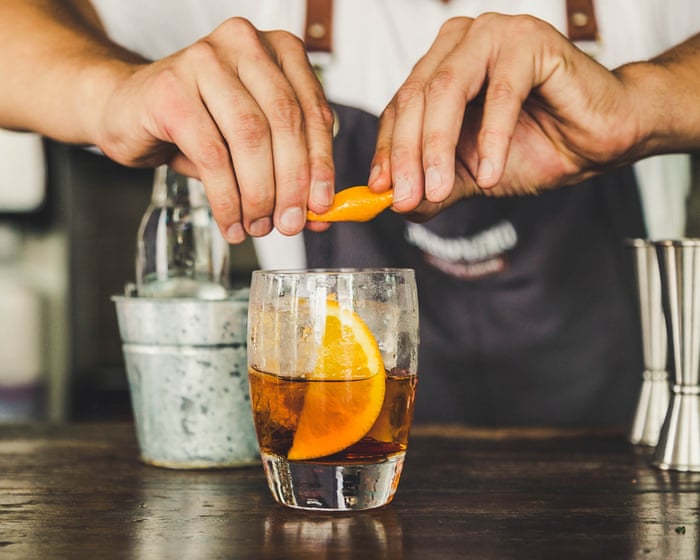
The scent of honey and warm pastry that spills out of the late-night baklava shops on Taksim Square in Istanbul is the inspiration for this twist on the classic old fashioned. The honey, cinnamon and walnut slip in perfectly without overpowering proceedings.

Andrea Ena, bar manager, Nora, London E22

Continue reading...

© Photograph: Rob Lawson/The Guardian. Drink styling: Seb Davis.

© Photograph: Rob Lawson/The Guardian. Drink styling: Seb Davis.

© Photograph: Rob Lawson/The Guardian. Drink styling: Seb Davis.

  •  

The bubbling beauty of baked pasta

From a Sichuan-inspired lasagne and a simple macaroni cheese to pasta al forno with meatballs, here are a few easy, inspired recipes to enjoy hot from the oven

• Sign up here for our weekly food newsletter, Feast

The other day, I climbed the communal stairs and opened the front door to the smell of cheese on toast. A welcome aroma made even more welcome when I realised that it was actually the tips of pasta tubes turning golden among grated cheese and creamy bechamel sauce. To add to the pleasant scene, my partner, Vincenzo, was washing up. Because that is the thing about pasta al forno – baked pasta – the time between finishing the construction and the eating is around about 25 minutes. That is, exactly the right amount of time to wash up and wipe up, or delegate those tasks to someone else while you make a salad and open a bottle of wine. There are few things as beautiful, inviting and complete as baked pasta and a clean kitchen.

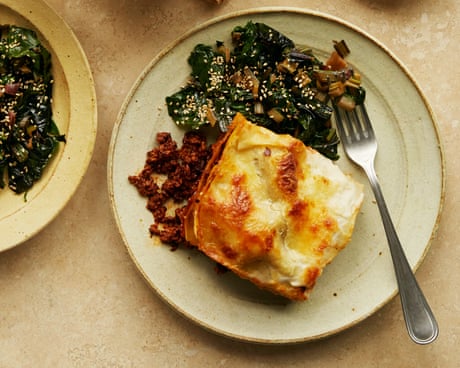
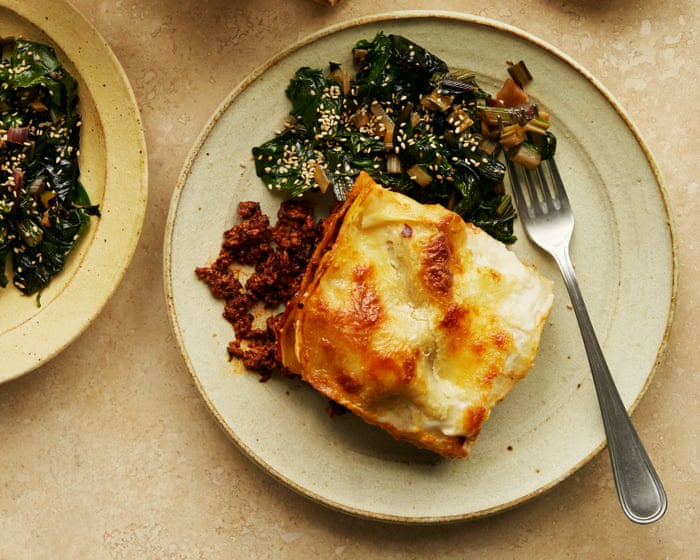
The baked-pasta galaxy is a big one, with many stars. Ann and Franco Taruschio provide a brilliant recipe for a classic lasagne bolognese, made with fresh pasta, a rich (but not tomato-rich) ragu and parmesan-enriched bechamel. While their recipe is undoubtedly written for fresh pasta – either homemade or bought – it can and should be adapted for dried pasta, too. Just remember to plunge the dried sheets in boiling water for 30 seconds before using them, even if the packet instructions say not to soak them. Also, make the bechamel slightly more liquid by increasing the milk by 100ml. Meanwhile, for a lasagne recipe specifically written for dried pasta and with a juicy, tomato-rich meat sauce, look to Katie Stewart via Hugh Fearnley-Whittingstall. Alternatively, Tamal Ray has a fantastic-sounding Sichuan-inspired lasagne made with pork mince, fermented bean ragu, bechamel and chard (pictured top).

Continue reading...

© Photograph: Matthew Hague/The Guardian. Food stylist: El Kemp. Prop stylist: Anna Wilkins. Food styling assistant: Immy Mucklow.

© Photograph: Matthew Hague/The Guardian. Food stylist: El Kemp. Prop stylist: Anna Wilkins. Food styling assistant: Immy Mucklow.

© Photograph: Matthew Hague/The Guardian. Food stylist: El Kemp. Prop stylist: Anna Wilkins. Food styling assistant: Immy Mucklow.

  •  

Bitter-sweet symphony: vermouth is more than just another cocktail ingredient

There’s depth, complexity and nuance to this fortified wine that’s worth its own moment in the spotlight

I like to think of vermouth as the Nile Rodgers of drinks, a backbone of good times known more for big hit collaborations than for its solo work. It is a foundation of any self-respecting cocktail cabinet (though it should be kept in the fridge), and also a family of drinks with many individual talents, which are now at long last being more widely recognised – Waitrose’s most recent Food & Drink report even touted vermouth as a 2026 trend, with searches for the stuff up by 26%.

A fortified wine that originated in 19th-century northern Italy, vermouth is most associated with western Europe, but these days it’s produced in or close to many wine-producing regions across the world. It is made by aromatising a base wine with botanicals – traditionally wormwood, from which it takes its name (wermut in German), but also gentian, citrus peel, herbs, spices and others – before that’s bolstered by grape spirit or brandy, generally taking the ABV to between 15% and 18%. This is a gladiator of a wine: it has brawn, but also plenty of complexity.

Continue reading...

© Photograph: Rocio Chiappino/Getty Images/iStockphoto

© Photograph: Rocio Chiappino/Getty Images/iStockphoto

© Photograph: Rocio Chiappino/Getty Images/iStockphoto

  •  

Zoning in on Ménilmontant, Paris: ‘bohemian, arty and off the tourist trail’

This former industrial quartier is now getting noticed for its community-focused art spaces, lively local bars and inexpensive north African food

On a hill that rises up between Belleville’s Chinatown and Père-Lachaise cemetery, Ménilmontant was once a rural hamlet with vines and farms, before becoming more industrial in the 19th century. The quartier boasts a united, colourful community whose working-class Parisian roots have long been integrated with a strong north African diaspora. Bohemian, arty and socially committed, it remains off the tourist trail with no notable museums or monuments; it’s just a genuinely Parisian neighbourhood. The locals were bemused to learn that Time Out made Ménilmontant one of its World’s Coolest Neighbourhoods for 2025, though tourists who do venture here to discover a glimpse of a fast-disappearing Paris are sure of a warm welcome.

Continue reading...

© Photograph: Alan Wilson/Alamy

© Photograph: Alan Wilson/Alamy

© Photograph: Alan Wilson/Alamy

  •  

Rachel Roddy’s recipe for beans with greens and sausages | A kitchen in Rome

A comforting and rustic plate inspired by trip to a traditional Roman trattoria

The benefit of soaking and cooking (or, better still, pressure cooking) your own beans are many: less packaging; money saved (a 500g bag of dried beans costing £2.50 will yield 1.5kg cooked beans, while some 400g tins can cost more or less the same); the suspiciously coloured but flavourful and starchy bean cooking water; and some personal satisfaction that you actually remembered to soak the beans in the first place. The benefits – and joy – of tinned beans, however, are almost instantaneous. That is, just a ring-pull away – unless, of course, said ring-pull comes off prematurely, turning the tin into a door without a knob and leaving you two options: searching for the tin opener that is somewhere in the miscellaneous drawer (or among the picnic equipment, which is on top of the wardrobe), or puncturing the tin at exactly the right spot on the seam with a pointy parmesan knife, which is somewhere in the same drawer.

Fortunately, the ring pull didn’t come away prematurely on any of the three tins – two borlotti beans and one plum tomatoes – required for this week’s recipe, which came about thanks to a meal at Dal Cordaro, a hard-working and decent trattoria just behind Porta Portese, a 17th-century city gate (arch) in the Aurelian wall on the right bank of the river Tiber. Everything we ordered – whole braised artichokes, slow-cooked oxtail stew, flash-fried rags of beef (straccetti), pasta and chickpeas – was pleasing and could have made its way into this column. However, my plate of beans in a rich, orange-tinted tomato sauce with poached sausages and greens (escarole) stirred in at some point was the satisfying idea that came home with me.

Continue reading...

© Photograph: Rachel Roddy/The Guardian

© Photograph: Rachel Roddy/The Guardian

© Photograph: Rachel Roddy/The Guardian

  •  

How to use on-the-turn milk to make an Italian classic – recipe

Maiale al latte pairs tender pork with a creamy, caramelised sauce – and saves old milk from a down-the-sink fate

According to the Sustainable Food Trust, “the milk from 40,000 cows (300,000 tonnes) is tipped down the kitchen sink each year – a real slap in the face for the farmer”. Even though some supermarkets have now swapped use-by for best-before dates on their milk, those dates can still be confusing, so always do the sniff test before binning it: even if it’s a little sour, you can still cook with it.

Continue reading...

© Photograph: Tom Hunt/The Guardian

© Photograph: Tom Hunt/The Guardian

© Photograph: Tom Hunt/The Guardian

  •  

The ‘vegan but bacon’ principle is here. Could it help us achieve our goals? | Polly Hudson

Social media’s latest trend is a reminder that perfectionism isn’t always the best way forward. If we want to make change, maybe we need to give ourselves a bit of a break

You might at first be tempted to mark the date and write down the exact time, certain that this was the moment we really had heard it all. A new hypothesis is doing the rounds on social media, and it’s called Vegan but Bacon. Yeah, I thought flexitarian was annoying enough too, but apparently not.

Vegan but Bacon. Whatever next, eh? Virgin But Sex? Hang on though, because there might actually be something to this. A plant-based content creator called Liz kicked it off, replying to somebody who said they’d join her culinary crusade if it wasn’t for their relish for rashers. “So do it,” she told them, “Go vegan but bacon.” Three million views later, many had shared how they didn’t eat any animal products 95% of the time, or only at home, or allowed themselves a hall pass item. “Harm reduction is harm reduction,” said Liz (which is vegan for “it’s better than nowt”), before pointing out that most people make progress a step at a time rather than all at once.

Continue reading...

© Photograph: LauriPatterson/Getty Images

© Photograph: LauriPatterson/Getty Images

© Photograph: LauriPatterson/Getty Images

  •  

Rogan josh and keema pau: Aktar Islam’s recipes for cooking with mutton

A traditional Kashmiri curry and spicy street food bring the best out of this flavourful meat

Mutton rarely gets the attention it deserves. It’s a mature meat, so is naturally sustainable, and it has a depth and richness that younger cuts simply cannot offer. That robustness is exactly what makes it so rewarding to cook with. Mutton’s bold character stands up beautifully to spices, aromatics and slow cooking, so it’s ideal for curries, stews and braises; on the grill, meanwhile, it takes on smoke in a way that enhances its complexity, rather than overwhelming it. You’re unlikely to find mutton in the supermarket, so you’ll need to make a trip to the butcher’s (many halal ones sell it) or order online.
Continue reading...

© Photograph: Rita Platts/The Guardian. Food styling: Hanna Miller. Prop styling: Louie Waller. Food styling assistant: Isobel Clarke.

© Photograph: Rita Platts/The Guardian. Food styling: Hanna Miller. Prop styling: Louie Waller. Food styling assistant: Isobel Clarke.

© Photograph: Rita Platts/The Guardian. Food styling: Hanna Miller. Prop styling: Louie Waller. Food styling assistant: Isobel Clarke.

  •  

Should you sanitise your strawberries? Experts on the right way to wash fruit and vegetables

Online influencers are soaking and spraying their fresh produce, but experts say the ‘number one rule’ of food hygiene has nothing to do with special sanitisers

You know the cost-of-living crisis is biting when videos of influencers unpacking their grocery “hauls” are viral on TikTok. Chewing through millions of views, fruit and vegetables are aesthetically plopped into a sink filled with water, piece by piece. “Sanitising” products are then added, ranging from the fizz of baking soda and vinegar to specialised vegetable soaps (“Amazon link in my bio!”). There are even expensive electronic purifiers, which shake, shimmy and bubble away in the basin, supposedly removing any nasties.

But is ASMR deep-cleaning your fresh produce really necessary? And is it all too late for those of us who can barely remember to rinse our pears?

Continue reading...

© Photograph: Carol Yepes/Getty Images

© Photograph: Carol Yepes/Getty Images

© Photograph: Carol Yepes/Getty Images

  •  

José Pizarro’s recipe for roast carrot, saffron and chickpea stew with spinach

A fuss-free, comforting supper to see you through the last days of winter

This is everyday cooking, the kind that comes naturally in winter. Carrots are always around and often forgotten, but they give a lot when you treat them properly. The saffron brings warmth and colour, and always makes me think of home. February can feel quiet and grey, and this stew suits that mood. It is comforting without being heavy, made for evenings when you want something ready on the stove and bread on the table, eaten calmly and enjoyed without any fuss.

Continue reading...

© Photograph: Rita Platts/The Guardian. Food styling: Hanna Miller. Prop styling: Louie Waller. Food styling assistant: Isobel Clarke.

© Photograph: Rita Platts/The Guardian. Food styling: Hanna Miller. Prop styling: Louie Waller. Food styling assistant: Isobel Clarke.

© Photograph: Rita Platts/The Guardian. Food styling: Hanna Miller. Prop styling: Louie Waller. Food styling assistant: Isobel Clarke.

  •  

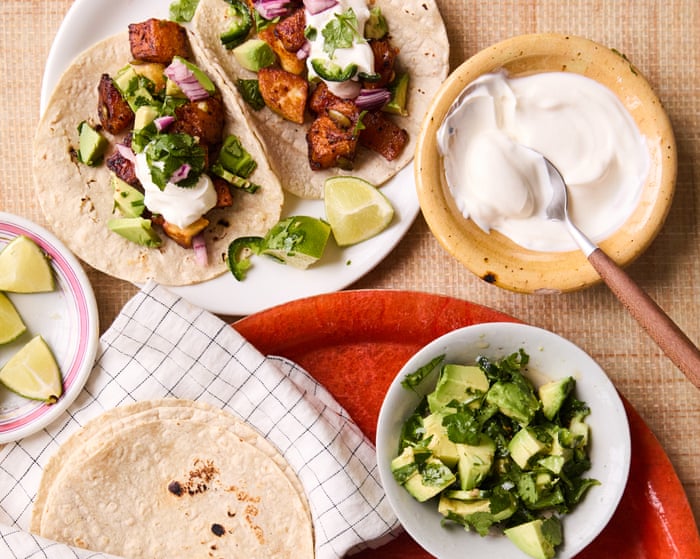
Georgina Hayden’s quick and easy recipe for roast butternut squash, halloumi and avocado tacos | Quick and easy

Switch it up, swap it around and dig in: this rainbow veg weeknight supper is ready in about half an hour

Taco night has become a weekly occasion in our house – something all ages and palates can get on board with. We like to switch up the protein depending on the season and our cravings, but this is our current vegetarian favourite. It’s not traditional by any means, but a wonderful way to get a rainbow of veg into our diets. The cubes of halloumi are joyful when roasted, as are the pops of toasted spiced pumpkin seeds. You could even drizzle them with a little honey for the last couple of minutes of cooking, leaning into a salty-spicy-sweet finish.

Continue reading...

© Photograph: Ola O Smit/The Guardian. Food and prop styling: Kitty Coles

© Photograph: Ola O Smit/The Guardian. Food and prop styling: Kitty Coles

© Photograph: Ola O Smit/The Guardian. Food and prop styling: Kitty Coles

  •  

Nadiya Hussain’s recipes for chicken half-moons and rice paper tteokbokki

Aromatic snacks stuffed full of flavourful chicken mince, and a comforting Korean stew

I use a lot of rice paper and always have plenty at home, because it can be used in a wide variety of ways. It’s delicious fried, as are most things! These half-moons are filled with an aromatic chicken mince, while tteokbokki is a Korean dish of chewy rice tubes that are often cooked in a stew. They are not always easy to find, but I love them, so I make my own.

Continue reading...

© Photograph: Kim Lightbody/The Guardian. Food and prop styling: Florence Blair. Food styling assistant: Phoebe Altman.

© Photograph: Kim Lightbody/The Guardian. Food and prop styling: Florence Blair. Food styling assistant: Phoebe Altman.

© Photograph: Kim Lightbody/The Guardian. Food and prop styling: Florence Blair. Food styling assistant: Phoebe Altman.

  •  

Thailand moves to cut sugar in popular drinks amid health drive

Major chains agree to halve default sweetness, but street vendors and cafes remain outside sugar tax rules

A crowd of customers, holding phones aloft, watch intently as Auntie Nid mixes up her bestseller: an iced Thai tea.

Condensed milk is poured into a glass, followed by three heaped tablespoons of sugar, and then freshly strained tea. The end product – a deep orange, creamy treat – is poured into a plastic bag filled with ice.

Continue reading...

© Photograph: Rebecca Ratcliffe/The Guardian

© Photograph: Rebecca Ratcliffe/The Guardian

© Photograph: Rebecca Ratcliffe/The Guardian

  •  

The story of Georgian wine has been 8,000 years in the making | Wine

Dubbed ‘the holiest of holies’, produce from this former Soviet republic today boasts a variety and deftness that’s sending sales surging

France, Italy and Spain purport to be the best-loved classical wine regions, but if you’re in the market for the real old-world deal, look no further than Georgia, which has more than 8,000 years of winemaking prowess. There’s something about this place on the lush intersection of the silk roads between Europe and Asia that gets under the skin. Perhaps it’s the combination of unpolished authenticity paired with profound generosity (guests are considered a gift from God and fed accordingly), all while being gently rocked in a cradle of civilisation, that make Georgian wine so beguiling. (My first visit in August 2023 – a khachapuri-fuelled reconnaissance for my book, Drinking the World: A Wine Odyssey – lingered in my mind long after my flight touched back down on British tarmac.

What I find most refreshing is that the country, and its wine, is completely itself, despite being hemmed in by empires with a proclivity for invasion (Persians, Turks, Mongols et al), as well as the decades spent under USSR rule, which between 1922 and 1991 switched the grape-growing focus to yield over quality. Today, you really feel the Georgian delight at flipping that old Soviet diktat on its head.

Victoria Brzezinski is co-author of Drinking the World: A Wine Odyssey, published by Pavilion Books/HarperCollins at £22. To order a copy for £19.80 go to guardianbookshop.com

Continue reading...

© Photograph: Alexander Lutsenko/Alamy

© Photograph: Alexander Lutsenko/Alamy

© Photograph: Alexander Lutsenko/Alamy

  •  

Rachel Roddy’s recipe for chocolate and rosemary panna cotta | A kitchen in Rome

A decadent, velvety and chocolatey set cream dessert infused with aromatic rosemary

The pungent and lingering aromas of familiar kitchen herbs – oregano, rosemary, sage, thyme, bay, lavender, mint – seem purposely made to donate their landmark volatiles to our everyday lives and food. In fact, their design is not for domestic calm and onion basket or fridge drawer neglect, but for uncultivated wilds. In particular the limestone terrain of the Mediterranean, where their defining smells are hardcore chemical defences, with every small, tough leaf or needle loaded with enough volatiles to deter both predators and competitors.

Rosemary is particularly kick-arse in this respect, with those volatiles (mostly organic compounds called terpenoids) synthesised and stored in minuscule glands that project from the surface of each dark green needle, which breaks when brushed against or bitten, releasing an intense, hot, bitter shot. It’s the evergreen equivalent of carrying personal defence spray. The needles also mark territory. By leaking their volatiles into the nearby soil, they inhibit the seeds of other plants (maybe even their own) from taking root and, in turn, taking space, water and precious minerals in a challenging environment.

Continue reading...

© Photograph: Rachel Roddy/The Guardian

© Photograph: Rachel Roddy/The Guardian

© Photograph: Rachel Roddy/The Guardian

  •  

Thuy Diem Pham’s recipe for joy pancake

This bold, traditional taste of Vietnam is a joy both by name and to eat

There’s something endearing and confident about a dish named after the feeling it gives you. Bánh khoái means “delight” or “joy” cake. This crisp, savoury pancake originates from Hue, the historic capital of Vietnam’s central region. Traditionally served with a rich hoisin dipping sauce, my take swaps that out for a lighter nước chấm with sesame seeds. It stays true to the spirit of the original, though, preserving its joyful texture and bold, satisfying flavours, while using more accessible ingredients.

This recipe is an edited extract from One Pan Vietnam, by Thuy Diem Pham, published by Quadrille at £22.

Continue reading...

© Photograph: Ola O Smit/The Guardian. Food and prop styling: Kitty Coles

© Photograph: Ola O Smit/The Guardian. Food and prop styling: Kitty Coles

© Photograph: Ola O Smit/The Guardian. Food and prop styling: Kitty Coles

  •  

My rookie era: I attempted only the easiest Australian Women’s Weekly birthday cakes. Then came the duck cake

When I shared my attempt online, my duck cake was described as ‘Big Bird on crack’

I assume no parent aspires to give their offspring an unmemorable and vanilla childhood. I wanted to be a fun mum, creating love-soaked memories and quirky family traditions for my children right from the get-go. I wanted to be Bluey’s parents before Bluey even existed.

The Australian Women’s Weekly birthday cakes were destined to be a pillar of my perfectly imperfect parenting rituals. One child quickly became three, and that iconic recipe book was in constant rotation. In the early years, I would simply choose a cake that matched my very basic baking skills. I also only owned a round tin, so my kids’ early cakes were circle-shaped, or circle-adjacent: the swimming pool (a round cake filled with jelly), the cat (a round cake with ears) and the race track (two round cakes with the centres removed).

Continue reading...

© Photograph: Blake Sharp-Wiggins/The Guardian

© Photograph: Blake Sharp-Wiggins/The Guardian

© Photograph: Blake Sharp-Wiggins/The Guardian

  •  
❌